
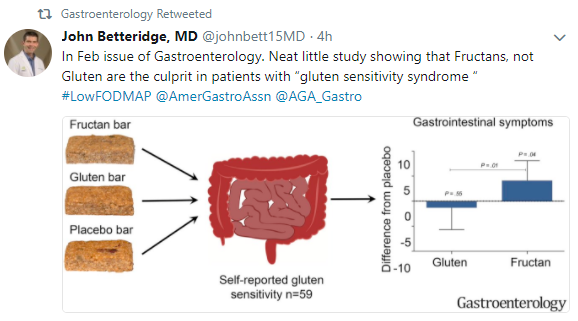
As with yesterday’s post, today’s study (GI Skodje et al. Gastroenterol 2018; 154: 529-39) implicates fructans, not gluten, as a culprit in increasing symptoms in those with self-reported non-celiac gluten sensitivity (NCGS).
These researchers performed a double-blind crossover challenge in 59 individuals who had instituted a gluten-free diet (GFD). The symptoms were assessed with a Gastrointestinal Symptom Rating Scale Irritable Bowel Syndrome (GSRS-IBS) through 3 challenges –gluten, fructan, and placebo.
Key findings:
- GSRS-IBS mean values for gluten 33.1, for fructan 38.6, and placebo 34.3. The overall GSRS-IBS value for fructans was significantly higher than for gluten P=.04
- GSRS-IBS mean values for bloating with gluten 9.3, for fructan 11.6, and placebo 10.1
In a related editorial (K Verbeke, pages471-3), the commentary notes that alpha-amylase-trypsin inhibitors (ATIs) may be another factor which contributes to symptoms in those with reported NCGS. ATIs protect plants from pests/parasites by inhibiting their digestive enzymes. They also resist proteolytic degradation in the human intestine and are known to be potent activators of innate immune cells.
My take: This is yet another study showing that among individuals with NCGS that a GFD is often unnecessary and ineffective. Fructans are more likely to induce gastrointestinal symptoms; however, their are likely to be several food components which contribute to GI symptoms & sometimes extra-intestinal symptoms.
Related blog posts:
- FODMAP diet -Real World Experience
- FODMAPs Advice From Harvard
- An Unexpected Twist for “Gluten Sensitivity” | gutsandgrowth
- Low-FODMAPs with or without Gluten-Free Diet in IBS …
- Mechanism for FODMAPs diet | gutsandgrowth
- Another Study: Low FODMAPs for IBS
 gutsandgrowth
Pingback: My Favorite Posts from the Past Year | gutsandgrowth
Pingback: Nonceliac Gluten and Wheat Sensitivity: Review | gutsandgrowth
Pingback: Is Non-Celiac Wheat Sensitivity an Autoimmune Disorder? | gutsandgrowth