
AY Lam et al. Clin Gastroenterol Hepatol 2023; 21: 3041-3050. Open Access (Partial)! Epidemiologic Burden and Projections for Eosinophilic Esophagitis–Associated Emergency Department Visits in the United States: 2009-2030
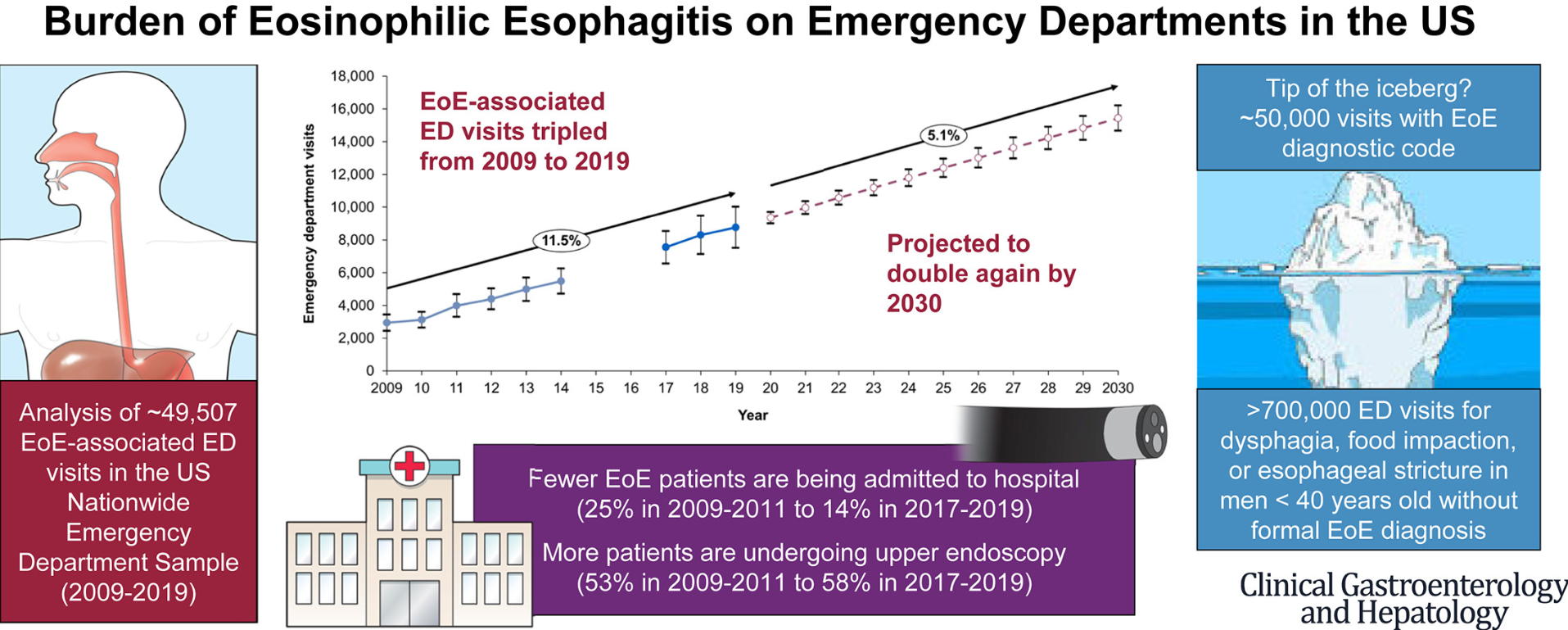
Methods: Data from the US Nationwide Emergency Department Sample (NEDS) were used to estimate weighted annual EoE-associated ED visits from 2009 to 2019. Autoregressive integrated moving average (ARIMA) models were used to project EoE-associated ED visits to 2030. NEDS is a large, publicly available, all-payer ED database in the United States, approximating a 20% stratified sample of US hospital-based EDs.
Key points:
- There has been a near tripling of the frequency of EoE-associated ED visits over the course of the past decade which is correlated with an increasing prevalence of EoE. The annual volume of EoE-associated ED visits increased from 2934 in 2009 to 8765 in 2019, and is projected to reach 15,445 by 2030.
- Without new interventions, this article projects further increases with doubling again by 2030 (using conservative estimates).
- Increasingly EoE is being managed without admission, though average charges associated with ED visits for EoE have tripled since 2009. Total mean inflation-adjusted charges for an EoE-associated ED visit were $9025 US dollars in 2019.
- Half of EoE patients presenting to the ED required an endoscopy and 40% required a foreign body/food impaction removal.
Related blog posts:
- “Tug” Sign For Eosinophilic Esophagitis and EoE Bowel Sounds Tips
- Highest Reported Prevalence Rates for Eosinophilic Esophagits
- Frequency of Strictures in Pediatric Eosinophilic Esophagitis
- What Happens When Topical Steroids are Stopped in EoE?
- Neglibible Effect of Eosinophilic Esophagitis Treatment on Longitudinal Growth
- What is EoE?
- EoE Update 2018 (Dr. Seth Marcus)
- Updated Consensus Guidelines for Eosinophilic Esophagitis
 gutsandgrowth