
T Rokkas, DY Graham. Gastroenterol 2026; 171: 271-284. The Unfinished Agenda in Helicobacter pylori Treatment: Resistance, Microbiome Effects, and Future Directions
This was a narrative review aimed at synthesizing contemporary evidence.
Background: Globally, approximately half of the population is infected. Prevalence surpasses 70% in many low- and middle-income countries (LMICs) where crowded living conditions, poor sanitation, and limited access to clean water enhance transmission.
Key points:
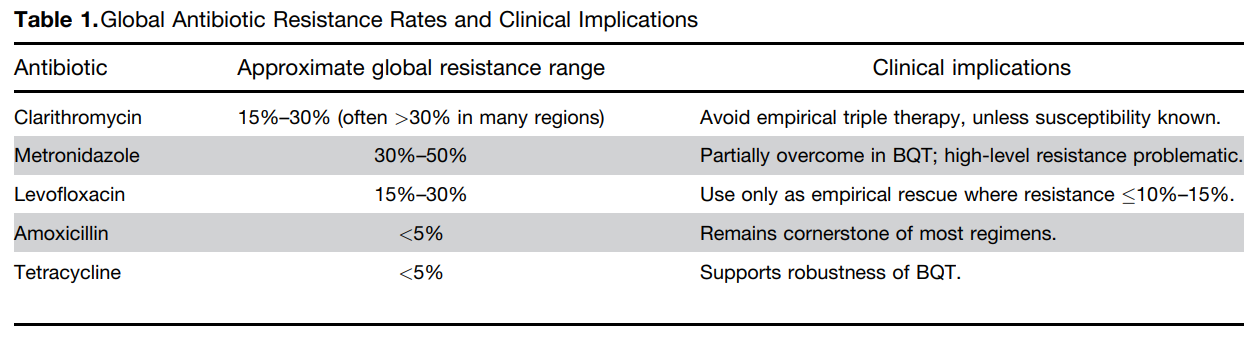
- Global resistance to clarithromycin, metronidazole, and fluoroquinolones significantly undermines the performance of traditionally effective antimicrobial therapies. The corner stone of successful antimicrobial therapy is susceptibility-guided therapy but remains of limited use with H pylori because of lack of infrastructure.
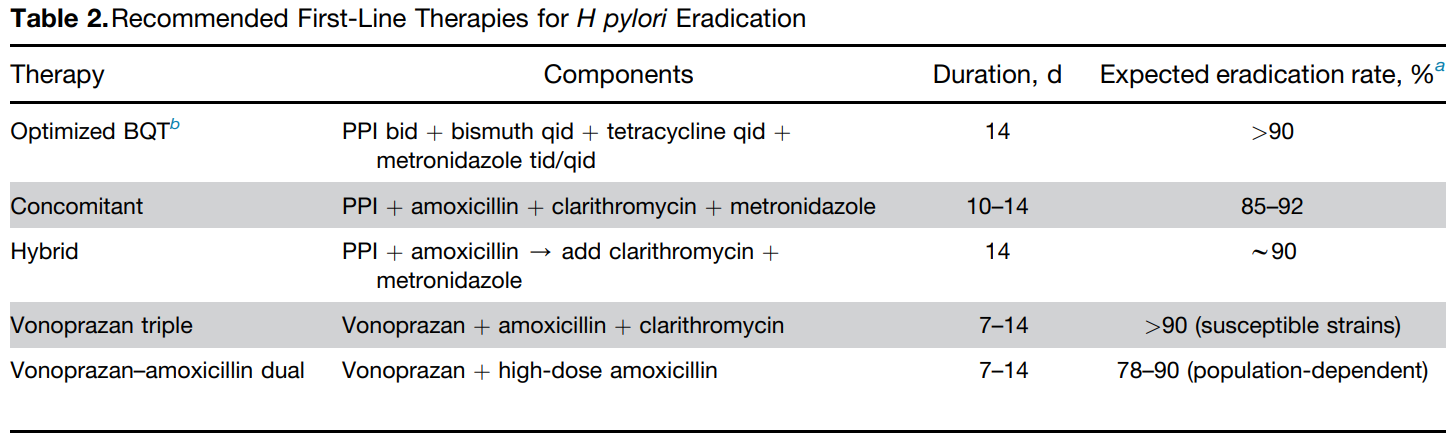
- Clarithromycin should no longer be prescribed as an empiric therapy (ie, it should be restricted to susceptibly based therapy)…Despite the poor cure rates with clarithromycin achieved with vonoprazan in the United States, the American College of Gastroenterology H pylori guideline still recommended vonoprazan triple therapy.17 (With clarithromycin-susceptible infections, vonoprazan is not more effective than PPIs.) The discordance between guideline recommendations and clinical effectiveness contributes to treatment failures.
- Bismuth quadruple therapy (BQT), which combines metronidazole with tetracycline and bismuth, can partially overcome moderate metronidazole resistance through antimicrobial synergy and higher effective dosing.
- Next-generation sequencing (NGS) is now available at a fraction of the cost of an endoscopy in the United States using stools, fresh, frozen, or paraffin-embedded gastric biopsies37 (American Molecular). Economic analyses indicate that susceptibility-guided therapy is cost-effective.
- When BQT fails or is unavailable, several alternative regimens can be considered.4–6 Rifabutin-based triple therapy can achieve eradication rates of 70% to 90% even in heavily pretreated patients.40
- When designing rescue therapy, antibiotics previously associated with failure should not be reused unless susceptibility has been clearly established.
- Optimizing H pylori treatment requires evidence-based regimen selection, precision-guided strategies, antimicrobial stewardship, and equitable access to essential medications
My take: This is a helpful review of H pylori issues and management.
Related blog posts:
- “Evidence-Practice Gap” and How It Applies to H pylori Treatment
- 5 Rights and H pylori Treatment
- Vonoprazan-Tetracycline: Effective Dual Rescue Regimen for H Pylori
- QI Project: Increasing H Pylori Eradication
- Helicobacter Pylori Stool Susceptibility in Children –How Good Is It?
- How To Achieve Helicobacter Pylori Cure Rates of >95%
- Give the Right Dose (for H pylori) -It Works Better!
- Dr. Benjamin Gold: 2024 Pediatric H pylori Guidelines (Part One)
- Dr. Benjamin Gold: 2024 Pediatric H pylori Guidelines (Part 2)
- Excellent Review of H Pylori in Children Plus One on Healthy Aging
- Brief Updates: H pylori Resistance Rates, VEDOKIDS, Increasing Bariatric Surgery in Kids


Pingback: Helicobacter pylori Treatment 2026 | gutsandgrowth – Reviewer4you