
This past month I helped diagnose a 2nd young child with eosinophilic colitis. This was an 8 month old who developed rectal bleeding over a 6 week period with subsequent anemia (Hgb 7.1). His colonoscopy showed patchy deep erythema in the right colon and transverse colon; his biopsies identified >100 eosinophils/hpf.
This prompted me to review a case of a child presenting with eosinophilic colitis at 13 months of age.
Case study: He was born at 36 week gestation with a prenatal diagnosis of proximal bowel obstruction due to type IIIb jejunal atresia, s/p ex-lap and tapering enteroplasty for long dilated jejunal segment and with subsequent short gut syndrome (~50 cm of small bowel). He required supplemental HAL dependency for his initial 9 months of life. At 13 months of age, he developed bloody diarrhea (up to 12/day) with associated anemia and peripheral eosinophilia (max elevation of AEC during his course was 23,000).
Initial endoscopy took place in January 2022. Images are noted below and histology confirmed eosinophilic colitis (>100 eos/hpf).
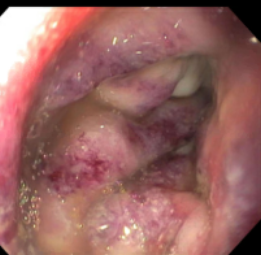
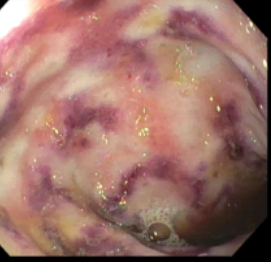
He underwent extensive testing and no monogenetic/immune dysregulation disorders were identified. After not improving with an elemental diet, his treatment consisted of prednisolone along with enteral antibiotics (vancomycin/gentamicin). His symptoms recurred with steroid taper and he was changed from antibiotic therapy to mesalamine. This was also ineffective. Subsequently, he started with vedolizumab therapy.
Due to ongoing symptoms, tacrolimus (along with PCP prophylaxis) was added two months later (this was 4 months after initial colonoscopy). The target level was between 8-10. He had a rapid and sustained response allowing him to stop corticosteroids which had been used intermittently for more than 6 months. His vedolizumab was stopped shortly thereafter.
After a followup panendoscopy demonstrated resolution of his colitis (see image below), his diet was gradually advanced (no restrictions) while continuing tacrolimus.
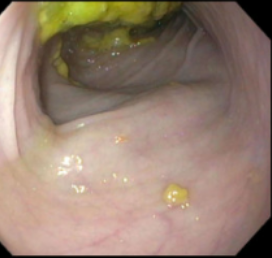
His tacrolimus was discontinued after 2.5 years and he has continued to do well off therapy for two years at this point. He still requires periodic vitamin-micronutrient monitoring for his short bowel syndrome.
My take: Eosinophilic colitis is a rare disorder in pediatrics with sparse data to guide management. In this young pediatric patient, tacrolimus was effective. It is possible that vedolizumab would have been effective if given for a longer duration prior to administration of tacrolimus. At the time of presentation, dupilumab had not been approved for eosinophilic esophagitis. There have been case reports of its use off-label for eosinophilic colitis (T Sia et al. Clin Transl Gastroenterol. 2025 Aug 26;16(10):e00908. Dupilumab for Adult and Adolescent Patients With Primary Eosinophilic Colitis).
Related blog posts:
- Eosinophilic Colitis Is Not a Typical EGID or IBD
- Short Bowel Syndrome and Risk of Eosinophilic Disease
- How Many Eosinophils Indicate Eosinophilic Gastroenteritis or Colitis?
- Beneficial Off-Target Effect: Upadacitinib Improved Eosinophilic Esophagitis (Case Report)
- Vedolizumab -Could it Work for Eosinophilic Gastroenteritis?
- 2026 Review: Eosinophilic Gastrointestinal Diseases (EGIDs)
- Anti-TNF Therapy for Eosinophilic Gastroenteritis
- How Closely Related Are Eosinophilic Gastrointestinal Disorders To Isolated Eosinophilic Esophagitis
- Etrasimod for Ulcerative Colitis (2026)
- Etrasimod for Eosinophilic Esophagitis?
Disclaimer: This blog, gutsandgrowth, assumes no responsibility for any use or operation of any method, product, instruction, concept or idea contained in the material herein or for any injury or damage to persons or property (whether products liability, negligence or otherwise) resulting from such use or operation. These blog posts are for educational purposes only. Specific dosing of medications (along with potential adverse effects) should be confirmed by prescribing physician. Because of rapid advances in the medical sciences, the gutsandgrowth blog cautions that independent verification should be made of diagnosis and drug dosages. The reader is solely responsible for the conduct of any suggested test or procedure. This content is not a substitute for medical advice, diagnosis or treatment provided by a qualified healthcare provider. Always seek the advice of your physician or other qualified health provider with any questions you may have regarding a condition.

