
C Dang et al. Gastroenterology, 2026; 171, 489-503. Pre-Crohn’s Disease Stool From Discordant Siblings Promotes the Development of Colitis in Germ-Free Mice
Methods: This study was conducted as part of The GEM Project, a prospective cohort study of healthy first-degree relatives of CD patients. Germ-free mice were colonized with fecal samples from 12 pairs of discordant siblings, where one sibling later developed CD (pre-CD), and the other remained a healthy matched control (HMC). The microbiome collected wa ~2.6 years before CD diagnosis.
Key findings:
- Mice receiving pre-CD stool exhibited increased weight loss, fecal lipocalin-2, and intestinal histologic damage compared with mice receiving HMC stool. Thus, mice colonized with stool from individuals who later developed Crohn’s disease showed significantly faster and more severe intestinal inflammation compared with mice colonized with stool from the siblings who remained healthy.
- Fecal metabolomic analysis revealed differences in 40 metabolites between pre-CD and HMC colonized mice.
My take:
- Silly take: It’s a good idea not to eat someone else poop — it might make you sick!
- Serious take (borrowed in part from the authors): “The stool microbiome of individuals susceptible to CD is altered years before diagnosis, exhibiting greater inflammatory potential when transferred to susceptible mice.” These studies about the microbiome are remniscent of studies 15-20 years ago indicating that manipulation of the microbiome may play a role in the developement of obesity and Kwashiokor. (Related posts: Could antibiotics make you fat? gutsandgrowth, Microbiome and the risk of Kwashiokor | gutsandgrowth, Microbial transfer for metabolic syndrome? | gutsandgrowth)
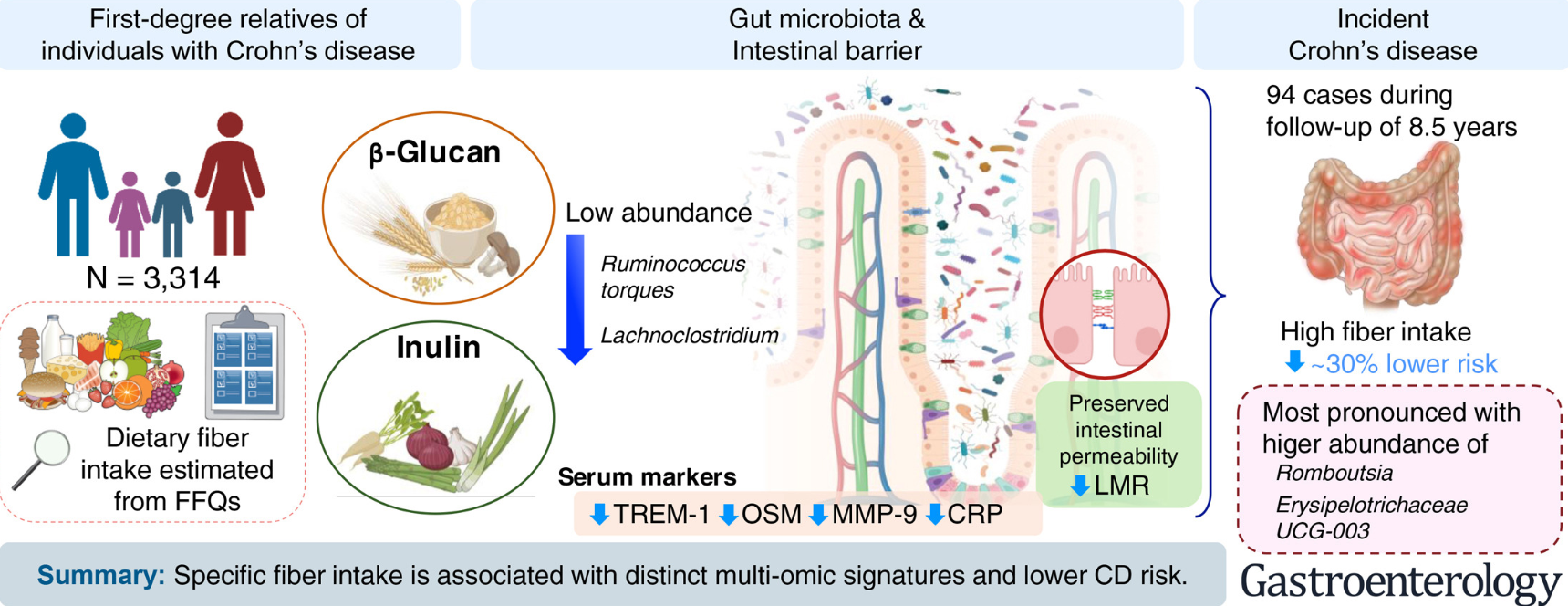
Related article: M Xue, C McShane, J Kim et al. Gastroenterol 2026; 171: 641-655. Open access! β-Glucan and Inulin Estimated Intake Are Associated With Reduced Risk of Crohn’s Disease, Improved Gut Barrier and Systemic Inflammation Markers, and Multi-Omic Signatures in a High-Risk Cohort
Methods: The Genetic, Environmental, Microbial (GEM) Project prospectively followed asymptomatic first-degree relatives of individuals with CD. Habitual intake of total fiber and select fiber subtypes was estimated from baseline food frequency questionnaires and biologic samples were collected.
Key findings:
- During a median follow-up of 8.5 years of 3314 first-degree relatives, 94 developed CD. Higher β-glucan (HR, 0.70) and inulin (HR, 0.68 intake were associated with lower CD risk.
- Higher β-glucan and inulin intake were associated with lower lactulose–mannitol ratio, lower abundance of pathobionts (Ruminococcus torques and Lachnoclostridium), and lower concentrations of inflammation- and barrier-related proteins.
- Increased β-glucan found in oats, barley and grains. Increased inulin found in garlic, onions, leeks and asparagus
Related blog posts:
- Elegant Study: Childhood Exposure to a Sibling with Crohn’s Disease and Disease Susceptibility
- Lower Fiber Intake May Increase Risk of Crohn’s Flare (2016)
- Mediterranean Diet’s Impact on Crohn’s Disease Outcomes
- How Does Remission in Crohn’s Disease Affect the Abnormal Microbiome/Gut Signature?
- More Evidence That A Proinflammatory Diet May Increase the Risk of Crohn’s Disease
- “Tasty & Healthy” Whole Food Diet For Crohn’s Disease

