Background: Nearly two decades ago, the Eight Americas study offered a novel lens for examining health inequities in the USA by partitioning the US population into eight groups based on geography, race, urbanicity, income per capita, and homicide rate. That study found gaps of 12·8 years for females and 15·4 years for males in life expectancy in 2001 across these eight groups. In this study, we aimed to update and expand the original Eight Americas study, examining trends in life expectancy from 2000 to 2021 for ten Americas (analogues to the original eight, plus two additional groups comprising the US Latino population), by year, sex, and age group.
Methods: The authors tabulated deaths from the National Vital Statistics System and population estimates from the US Census Bureau and the National Center for Health Statistics from Jan 1, 2000, to Dec 31, 2021.
Key findings: .
At the beginning of the 21st century, there was already a 12.6-year gap in life expectancy among Americas, but this gap grew even larger during the 2000s and 2010s and accelerated to 20.4 years after the first 2 years of the COVID-19 pandemic.
One’s life expectancy varies dramatically depending on where one lives, the economic conditions in that location, and one’s racial and ethnic identity.
There are limitations with the data that were used. For example, there is known to be substantial misreporting of race and ethnicity on death certificates
My take (borrowed from the authors): “The extent and magnitude of health disparities in the USA are truly alarming. In a country with the wealth and resources of the USA, it is intolerable that so many are living in conditions and with health outcomes akin to those of an entirely different country.”
‘Fistula Foundation which arranges obstetric fistula repair. This restores a woman’s life after this life-altering complication –a corrective surgery that costs just $619 per person
Muso Health helps reduce childhood mortality. In Mali, this organization reduced childhood mortality by 95%. The cost of bringing one more person into the Muso health care network is only $22 per year.
Reach Out and Read. This U.S-based charity allows doctors to “prescribe” reading to the child. This promotes reading as well as childhood well-child visits.
Crisis Text Line is for those who want to volunteer, rather than donate. This organization trains (15-20 hrs) volunteers to help individuals needing mental health support. “More than 90 percent of the volunteers report that their own mental health improves as a result of their participation.”
Personal pet peeve: I receive so many unwanted promotional materials from pediatric hospitals and pediatric gastroenterology divisions from across the country. This is such a waste of paper and effort. Presumably, this is an endeavor to raise the profile of these institutions and programs.
If anyone reading this blog has any role in this, please stop sending this crap and only send this material to alumni or those that request (opt-in) it.
“Alex Benigno, 45, has spent the past 10 months riding his ElliptiGO stand up bike around town, picking up nails, screws and other little annoying things that cost drivers tons of money.” Now he has picked up more than 280 pounds of metal off the street.
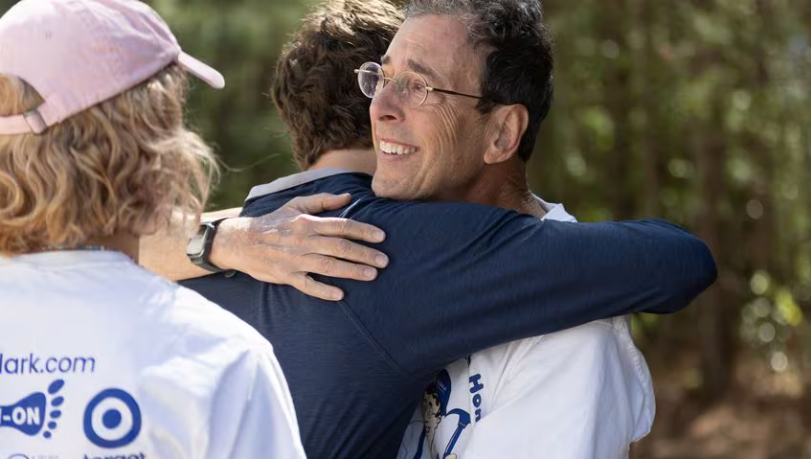
“Clark Howard gets a hug from his son Grant Howard before the start of the Atlanta Habitat for Humanity dedication of the 98, 99, and 100th Howard’s sponsored homes in Atlanta on Saturday, April 13, 2024.”
My take: Recently, one of my patients who had been neglected was being taken care of by elderly couple. In addition to this infant, this couple had helped about 80 children over several decades. Everyday I see people who are making this world a better place -not all of them are in the news. It really is an inspiration.
My IT advisor (my youngest son) recommends using the Stolen Device Protection setting on the iPhone. The link below explains the rationale for this change, what’s affected, and how to adjust your settings.
After 43 years, Stan Cohen is retiring. He deserves enormous credit for the successes of our group and I wanted to highlight some of his many accomplishments and innovations.
Clinical care:
I am certain Stan has seen more kids with GI problems than any physician in the State of Georgia (possibly the entire country). He is well-known for his dedication and caring. Areas of special expertise include children with inflammatory bowel disease and children with special needs
Publications/Research:
In addition to his numerous scientific articles and book chapters, Dr. Cohen edited two textbooks for physicians and wrote two books for parents: 1. Healthy Babies, Happy Kids: a Common Sense Guide to Nutrition for Growing Years. 2. What to Feed Your Baby
Stan has participated in a lot of clinical research projects. Some notable publications include pioneering the use of the patency capsule for capsule endoscopy, developing a scoring system for capsule endoscopy, and the first prospective study of a specific diet for IBD
Service:
He was the founding chairman of the Committee on Nutrition for the Georgia Chapter of the American Academy of Pediatrics and chairman of the Physicians Advisory Board of The Georgia WIC Program. In this role, he developed a cost-sensitive, evidence-based algorithm to assist health care providers select the appropriate infant formula for infants with various problems. It is estimated that this saved the state of Georgia 56 million dollars
Nutrition4Kids.com and the Nutrition4Kids Foundation were established by Dr. Cohen (with the help of his son David and Mark Lorimer) to provide medically curated educational content for parents and providers
Stan has lectured extensively at local, national and international medical conferences
He provided critical input in El Salvador during its civil war to lower infant mortality
Recognition:
Premier Physician of the Crohns and Colitis Foundation of Georgia (1995)
Turner Broadcasting featured Dr Cohen in 2001 as one of Atlanta’s “Super 17” for his contributions to the community and specifically for his role in starting Camp Colitiscope (now Camp Oasis)
Honored by the Atlanta Alliance on Developmental Disabilities for his work on feeding and nutrition for children with neurodevelopmental delays
Lay Education Award from the American Academy of Pediatrics for his work promoting a school curriculum to teach and promote non-abusive behaviors which was used in Fulton County and later adopted by other school systems in the country, the state of Hawaii and maternal child health programs
He is also a recipient of The Natasha Trethewey Poetry Prize. His poems have been included in various poetry journals. Additionally, several of his poems have been published in the Annals of Internal Medicine, while others are archived and available audibly on TheArtSection website.
Stan has many interests outside medicine. He has always had an interest in artwork, good eating, corny jokes, and his family. I am so grateful to Stan for helping to develop our GI group, for his service to children/families, his advice, his friendship and even most of his jokes.