How Generative AI Is Worsening the Meta-Analysis Glut

JM Rosen, SK Gupta SK, R Kellermayer. Pediatr Gastroenterol Nutr. 2026; 1-4. doi:10.1002/jpn3.70634. Four decades in the making: generative artificial intelligence and the secondary-literature glut in biomedical publishing.

Key points:

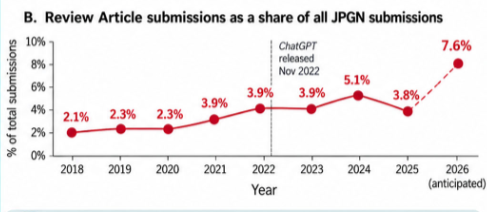
  • “Narrative reviews, systematic reviews, and meta-analyses (articles that synthesize existing evidence rather than generate new observations) have been accumulating at a pace that outstrips the growth of primary research for more than three decades. Generative artificial intelligence (AI) … has removed the last practical constraint on it and made the process much faster.”
  • Systematic reviews by 2019 had seen “a greater than 20-fold rise across two decades, compared with only a 2.6-fold rise in PubMed-indexed publications generally….Ioannidis argued that the production of systematic reviews and meta-analyses had “reached epidemic proportions,” estimating that a large share were redundant, misleading, or conflicted, with some clinical questions accumulating more than a dozen overlapping meta-analyses of the identical evidence base, and with production increasingly concentrated among a small number of prolific sources (geographic, topical, and/or contracted) rather than spread evenly across the field.1“
  • “The tasks that constitute a systematic review, framing a question, searching, screening, extracting data, synthesizing findings, and drafting prose, are precisely the tasks at which large language models now perform with superficial competence…the technology is now fluent enough to produce a document with the surface features of a competent review, but not trustworthy enough to be left unsupervised”
  • “Fabricated references in PubMed Central had increased more than 12-fold since 2023, to 4046 instances; these were concentrated in exactly the kind of citation-dense writing on which reviews and meta-analyses depend for their evidentiary claims.9“
  • “Nearly all current policy operates at the level of disclosure: authors must state whether and how they used AI.”

Proposed Changes:

  • “First, a mandatory novelty statement… that distinguishes their submission from the existing literature and from what a generative AI system, prompted on the same topic, could already produce unassisted.”
  • “Second, a stated human contribution, an explicit account of the clinical judgment, methodological innovation, or original synthesis that the authors, not a language model, provided.”
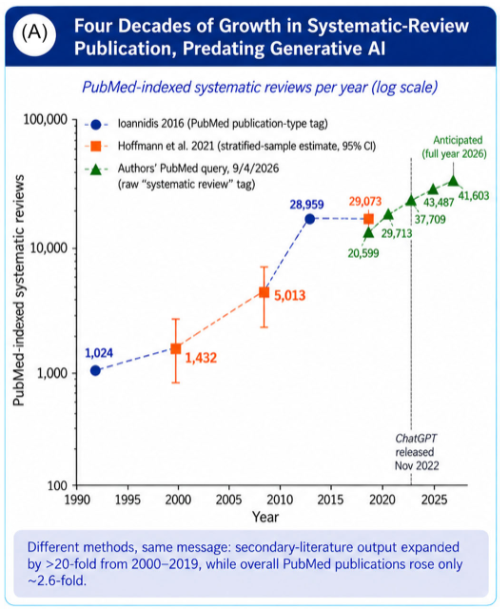
Four decades of growth in PubMed‐indexed systematic‐review publication, predating generative AI by roughly three decades.Blue circles show raw PubMed publication‐type tag counts for “systematic review” reported by Ioannidis. Orange squares show independent,model‐based stratified‐sample estimates reported by Hoffmann et al. Green triangles show the authors’ own PubMed query for the raw“systematic review” publication‐type count; the open triangle for 2026 (41,603) is an anticipated full‐year total.

My take: AI has exponentially worsened the problem of flooding journals with unnecessary and untrustworthy systematic reviews.

Related blog posts:

Badmouthing other doctors from NYTimes

A fascinating piece from the NY Times (nyti.ms/1b1IqCM ) indicates that many physicians are quick to disparage other physicians, even when the care that was provided was appropriate. Below is an excerpt:

Over the last decade, few issues have garnered as much interest among health care experts as disrespectful behavior among doctors. While sociologists have devoted careers to researching the topic, it wasn’t until the 1990s that the medical profession itself began to take serious note.

Spurred on by the increasing complexity of medicine, concerns about safety and patient satisfaction and an ever-growing urgency to contain costs, the Institute of Medicine convened a national panel of health care experts to discuss “the chasm” between what could be and what was actually being done for patients. In 2002, they published an ambitious report that called for a “sweeping redesign of the entire health system.” Realizing that vision, said the panel, would require, among other changes, better collaboration and cooperation among physicians and the creation of a “culture of respect.”

Medical schools, regulatory agencies, professional organizations and entire health care systems responded to this cri de coeur. Official definitions of professionalism were rewritten to incorporate the concepts of teamwork and shared responsibility. Schools added mandatory coursework on thewhys and hows of working in a team. And licensing and accreditation boards began asking for evidence that doctors could not only lead, but that they also knew how to work as part of a team.

But this new study reveals that old habits and responses die hard.

Researchers trained three actors to portray “standardized patients” with advanced lung cancer who had recently moved to town after being treated by another doctor and who remained unsure about their diagnosis or prognosis. The actors, carrying medical records written to reflect only universally accepted guidelines of care, made a total of nearly three dozen office visits to various family physicians and cancer specialists working in the community.

The actors were not told to elicit the doctors’ opinions about their previous care; but after analyzing transcripts from each office visit, the researchers found that in 40 percent of the consultations, doctors went ahead and spontaneously offered their opinion anyway. A tiny percentage of these comments were neutral; a third were supportive. The vast majority, however, were unabashedly critical, with the doctors’ comments ranging from “Hell, you don’t want to trust doctors,” to “This guy’s an idiot!”

“Doctors will throw each other under the bus,” said Susan H. McDaniel, lead author of the study and a professor of psychiatry and family medicine at the University of Rochester Medical Center. “I don’t think they even realize the extent to which they do that or how it can affect patients.”

Probably, added Dr. McDaniel, most of the comments were unintentional. Faced with a constant pressure to cut costs, increase productivity and keep patients happy, plus the additional difficulty in this case of discussing prognosis with a terminal cancer patient, many of the doctors no doubt experienced significant levels of stress. In the moment, criticizing another physician to a patient might have felt like an effective way to fortify their own credentials and build up the patient’s trust.

“There is probably something reassuring in saying, ‘Boy, your doctor didn’t do a good job and now I’m going to take care of you,’” Dr. McDaniel noted. “But those kinds of comments are bad for the patient.”