Regulating Medication Promotion on the Internet

N Kruger et al. NEJM 2026; 395: 319-321. When Celebrities Prescribe — Regulating Drug Promotion on the Internet

An excerpt:

Since the 1980s, direct-to-consumer advertising of prescription drugs has been prevalent in the United States — one of only two high-income countries to permit such ads…Endorsements of prescription drugs on social media can be rapidly disseminated across platforms, complicating regulatory oversight…

Under federal law, a prescription drug is considered to be misbranded if labeling or advertising for the product is false or misleading, which can include omission of material information. According to implementing regulations from the Food and Drug Administration (FDA), fair balance is required in the communication of benefits and risks…when social-media influencers and online pharmacies are the source of drug-related communication, their financial or other relationships to manufacturers or compounding pharmacies can be unclear…

Patient-facing content that now circulates pervasively on social-media platforms can blur the distinction between health-related information about prescription drugs and misleading advertising…

Stronger guardrails are needed to protect the public and to keep pace with the ways in which patients now encounter drug promotion…

The FDA could modernize fair-balance requirements for digital platforms by mandating that information about risks be presented directly alongside claims about benefits (e.g., provided in the same social-media communication, using spoken or visually prominent content), rather than being relegated to fine print or a separate website…

The Protecting Patients from Deceptive Drug Ads Act (S. 652) attempts to modernize oversight by requiring influencers to disclose compensation they receive for prescription-drug promotion to the Open Payments database. It would also authorize civil penalties for entities engaging in paid social-media communication that they know is misleading or that is recklessly false and extend FDA advertising requirements, including fair-balance obligations, to telehealth companies. Under such a regime, regulators could prioritize enforcement actions against high-reach celebrity-endorsement campaigns, since a small number of people have outsized influence and enforcement activities could deter similar behavior.

My take: Paid influencers should be held to the same standards of disclosure about their pharmaceutical endorsements as manufacturers.

Kvernufoss, Iceland.
The size of the waterfall can be gaged in part by looking at the people behind the falls.

“Bowel Sounds” Pediatric GI Podcast: Dr. Martin and Dr. Vartabedian

It’s been nearly two years since the start of the NASPGHAN Bowel Sounds Podcast.

They are really good. While I am more of a visual learner, I like listening to the hosts banter at the beginning and then their capable interviews. The Podcasts have chosen terrific guests. You can read about and listen to all of the episodes at the NASPGAN website (link below), or listen on the go on Apple Podcasts, Spotify, Google Podcasts, or wherever else you listen to podcasts.

Here’s the NASPGHAN link: Bowel Sounds: The Pediatric GI Podcast

The two most recent podcasts (Dr. Martin and Dr. Vartabedian) exemplify the wide range of information available.

Dr. Martin Martin reviews the topic of congenital diarrheas and enteropathies (CODEs). Some key points:

  • History: Timing and Severity. Onset in the first week of life is suggestive of a congenital diarrhea (CODE). In those with later onset (eg. >4 weeks), need to consider infections, post-infectious diarrhea, and allergic disorders
  • Workup if suspicious of CODE -detailed in UpToDate (Dr. Martin is one of the authors). Many kids need serum studies, stool studies, imaging (AXR, UGI/SBFT) and EGD/Flex sig. In UpToDate, search either “congenital diarrhea” or “approach to chronic diarrhea in neonates and young infants (<6 months)” (36 pages)
  • Treatment: Most kids need a short (~24 hr) trial of NPO when there is adequate IV access to determine if diarrhea is malabsorption (goes away with fasting) and if diarrhea persists which is suggestive of an electrolyte transport-related diarrhea (aka. secretory diarrhea)
  • Dr. Martin advises use of bolus feeds when feeding trials are introduced in this population to get to an answer quicker. Usually with significant diarrhea, it is reasonable to start with a carbohydrate-free formula (eg. RCF formula). If there is not diarrhea with RCF, this suggests a carbohydrate malabsorption whereas ongoing diarrhea is suggestive of a more generalized malabsorption
  • Genetic testing should be performed earlier in the evaluation of those with a high suspicion of a CODE (eg. 1st week of life onset, severity, polyhydramnios, consanguinity) if the infectious workup is negative

Links:

  1. Advances in Evaluation of Chronic Diarrhea in Infants (nih.gov)
  2. PediCODE
  3. www.uptodate.com – Title: Approach to chronic diarrhea in neonates and young infants (<6 months)
  4. https://www.preventiongenetics.com/

Related blog posts:

Dr. Vartabedian, in his episode, discusses the importance of “owning your online identity as a physician, something “Dr. V” has written and spoken about extensively, including on his blog at 33charts.com” (from NASPGHAN website). He explains that everyone has a presence online and physicians can influence the content. At the very least, most physicians should make sure that their institutional profile looks good and that they take advantage of placing a profile on LinkedIn.

Other key points:

  • Dr. V’s book is available on 33charts (see link below)
  • Physicians can do a “vanity” search on Google and see what is posted about them
  • Dr. V recommends a book called “Keep Going” by Austin Kleon. “Whether you’re burned out, starting out, starting over, or wildly successful, Keep Going will help you stay on the path to more creative work.” (from Austin Kleon website)
  • Dr. V discusses a range issues which include negative physician reviews, online Trolls, and patient privacy

Links:

  1. The Public Physician | A Guide to Life in a Connected World
  2. 33charts.com (also be sure to sign up for the 33mail newsletter while you are there)

Related blog posts:

“Ethical Considerations in Pediatricians’ Use of Social Media”

From AAP: R Macauley et al. Pediatrics: 2021; 147 (3) e2020049685. Full text. Ethical Considerations in Pediatricians’ Use of Social Media Thanks to Ben Gold for this reference.

Summary -Recommendations

  1. Pediatricians who choose to use social media should have separate personal and professional social media pages, with patients and their parents directed to the professional page.
  2. A pediatrician’s personal page should have adequate privacy settings to prevent unauthorized access. Professional pages should be set to prevent tagging.
  3. It is wise to pause before posting, given that information posted online can exist in perpetuity and can be captured and redisseminated by viewers before it can be deleted.
  4. Pediatricians should follow state and federal privacy and confidentiality laws as well as the social media policies of their health care organization and any professional society to which they belong.
  5. Independent practitioners should develop social media policies for their practices to protect patients and clarify expectations. These policies should be in writing and widely distributed to all staff and clinicians. If restrictions on communicating with patients are in place in such policies, this should be shared with patients. Given advances in technology, these policies should be reviewed regularly and updated as needed.
  6. Conflicts of interest, including in tweets, blog postings, and media appearances by pediatricians, should be disclosed.
  7. Pediatricians should use a HIPAA-compliant secure site with encryption when communicating about health care or rendering advice directly to patients or families. Individually identifiable protected health information should not be shared through social media without documented authorization from the patient or guardian.
  8. Before posting on social media, protected health information should be deidentified (and clearly noted to be so) and presented respectfully.
  9. Professional boundaries should be maintained in the use of social media. Accepting (and certainly initiating) friend requests from current patients is discouraged. It is up to the pediatrician’s discretion whether to accept such requests from former patients. It may be appropriate to accept a friend request from a patient’s parent if the physician’s relationship to that person extends beyond the clinical environment.
  10. Searching for patient information through the Internet or social media should have a specific purpose with clear clinical relevance. Any information obtained through this route should be shared directly with the patient to maximize transparency and before recording any such information in the patient’s chart.
  11. Pediatricians should monitor their online profile to protect against inaccurate postings. Negative online reviews warrant a thoughtful response that honors confidentiality requirements, including the fact that the reviewer is or was the physician’s patient.
  12. Pediatricians should recognize that providing specific medical advice to an individual through social media may create a physician-patient relationship that may have documentation, follow-up, state licensing, and liability implications.

Related blog posts:

Gibbs Gardens, 4/3/21

Digital Media Exposure and Well-Being

Two studies show that increased digital media exposure (DME) is inversely related to a child’s well-being.

In the first study (S Ruest et al. J Pediatr 2018; 197: 268-74), the authors analyzed more than 64,000 U.S. children (2011-2012). ages 6-17 years.  Only 31% reported <2 hours per day of DME.  2-4 hrs/day of DME was noted in 36%, 4-6 hrs/day in 17%, and >6 hrs in 17%.  There was an inverse relationship between DME and 5 markers of well-being: completing homework, caring about academics, finishing tasks, staying calm when challenged, and showing interest in learning.

In the second study (P-Y Pin et al. J Pediatr 2018; 197: 262-7), the authors conducted a 1 year prospective trial with 1861 adolescents.  They found that 23% had internet addiction at baseline, with internet addiction based on the Chen Internet Addiction Scale. 59 students (3.9%) developed new self-harm/suicidal behaviors.  Internet addiction risk conferred a 2.41 relative risk of emerging self-harm/suicidal behaviors.

My take: These studies document a strong association between digital media exposure/internet addiction and worrisome behaviors/worsened well-being.

Pine Mountain Trail

Modern Malady: Text Neck

In every age, our bodies need to adapt to new challenges.  Apparently, in this age, we need to solve another problem induced by texting, “Text Neck.”

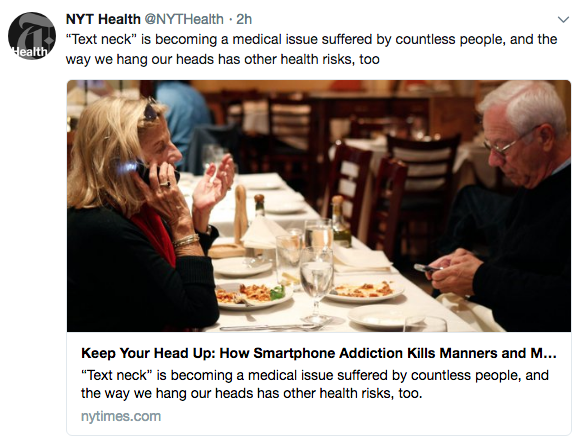
NY Times: Keep Your Head Up: How Smartphone Addiction Kills Manners and Moods

Here’s an excerpt:

The average human head weighs between 10 and 12 pounds, and when we bend our neck to text or check Facebook, the gravitational pull on our head and the stress on our neck increases to as much as 60 pounds of pressure. That common position, pervasive among everyone from paupers to presidents, leads to incremental loss of the curve of the cervical spine. “Text neck” is becoming a medical issue that countless people suffer from, and the way we hang our heads has other health risks, too, according to a report published last year in The Spine Journal.

Posture has been proven to affect mood, behavior and memory, and frequent slouching can make us depressed…

And the remedy can be ridiculously simple: Just sit up.

My take: Smartphone use increases the risk of many health problems besides “Text Neck” including car accidents.  Their use also contributes to missing social cues, including placing those in front of you behind those who interrupt conversations with texts and phone calls.

One of 340,000 Followers of NEJM

A recent editorial (EW Campion et al. NEJM 2016; 375: 993-4) made a few worthwhile points and shows how NEJM has been successful and innovative over 20 years of using the web and social media.

  • This has allowed more widespread access to its content, even by resource-poor countries.
  • The use of the web has facilitated quick distribution of multiple resources for outbreaks like  Ebola and Zika.
  • Currently, every article back to 1812 is available online (over 173,000 with more than 570,000 pages)
  • NEJM has 340,000 twitter followers and 1.3 million followers on facebook
  • Despite the importance of NEJM, as well as other healthcare media, important caution is needed.

“We do need to be wary of challenges and dangers that the new media have created.  On the Internet, speed and simplicity often displace depth and quality, especially on complex subjects.  Our privacy is increasingly vulnerable. Misinformation, misrepresentation, and piracy are common.  There are health scams and even sham medical conferences and fake medical journals.”

My take: Careful use of internet resources has been incredibly helpful.  But, beware of the inherent hazards that have accompanied these advances.

Related blog posts:

Balancing Rock, Bar Harbor

Balancing Rock, Bar Harbor


“The future of gastrointestinal disease and symptom monitoring: biosensor, E-portal, and social media”

At this year’s NASPGHAN meeting, the keynote lecture was given by Brennan Spiegel.  (Brennan Spiegel, MD (@BrennanSpiegel) | Twitter) This was a great talk!

This blog entry has abbreviated/summarized the presentation. Though not intentional, some important material is likely to have been omitted; in addition, transcription errors are possible as well.

Challenges in healthcare:

  • Time with patient is limited/poorly-timed in comparison to health care needs.
  • Care is reactive rather than proactive.
  • Care is expensive.

We spend all our time within walls of our clinic/hospital, but patients spend 99% time outside


How do we tailor care to the individual and make it more cost-effective? How do we get there?  Potential/Emerging Tools:

    • Patient provider portals (including mobile)
    • Social media
    • Wireless biosensors


Key question for patients: What is the most important goal for you/your family today?

How to improve communication with family? Electronic medical records often designed for billing rather than educating

MyGiHealth website/soon-to-be-app.  Here’s a link to YouTube video introduction.

  • HISTORY: Trained computer to interview patient re: abdominal pain –where, timing, risk factors for H pylori, etc.
  • Symptoms and severity: constipation, abdominal pain, gas/bloating, heartburn, diarrhea, dysphagia, incontinence, nausea/vomiting (Promise scales –percentiles).
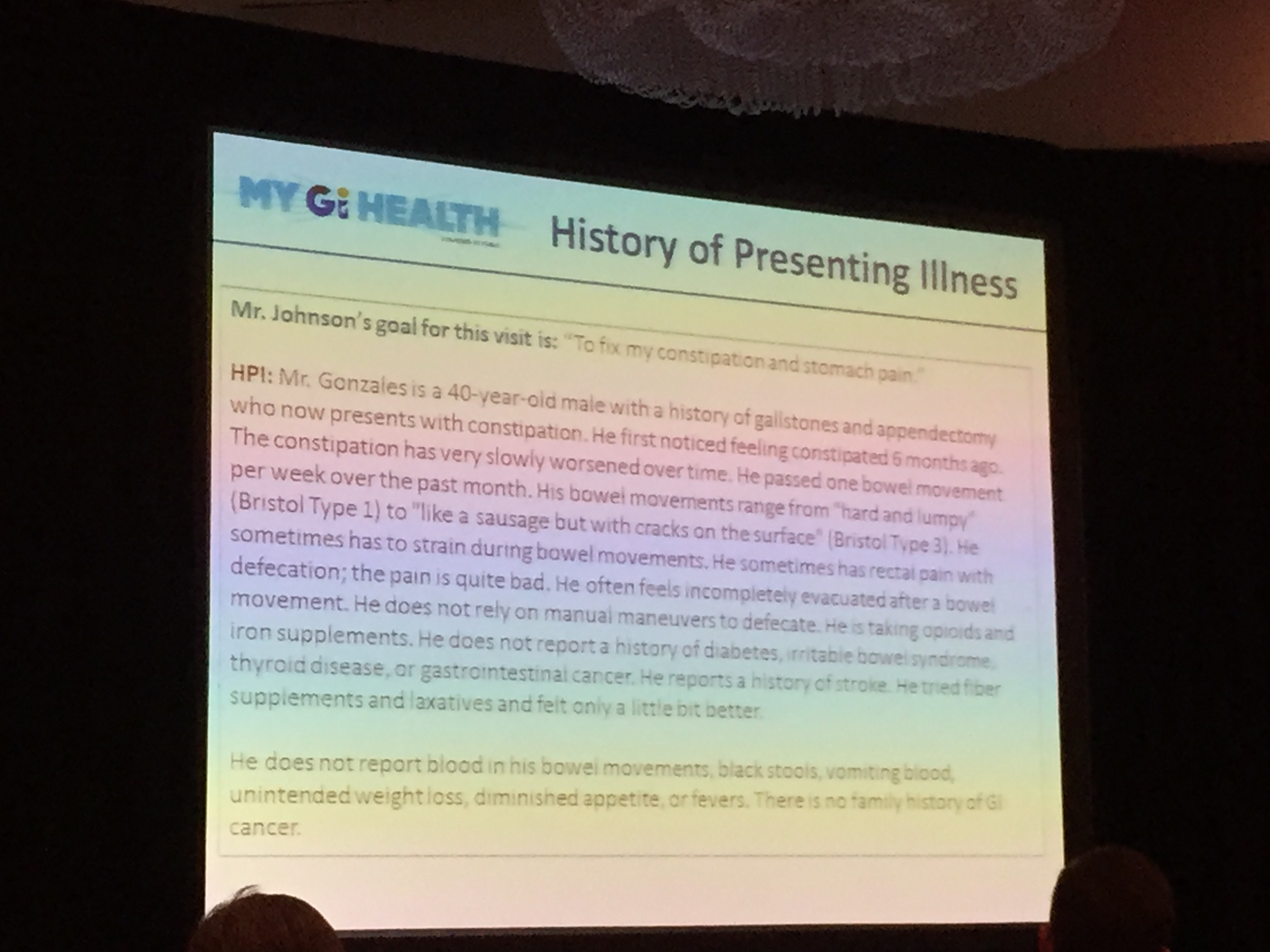
  • Computer history looked better than history by physician (example below with fictional patient). If history obtained prior to physician coming into room, this would allow physician more time to communicate with patient rather than documenting (Related post: Aptly titled “The Cost of Technology” | gutsandgrowth)
  • Man vs Machine (Spiegel in press Am J Gastro 2014). History performed well with regard to billing complexity and completeness.
  • THIS IS COOL!
  • Physician still needed to analyze information and make diagnosis/treatment plan.
  • Also website/app with EDUCATION applicable to patient.

History by computer outperformed physicians

History by computer outperformed physicians

Obtaining information outside the confines of the office can help overcome Hawthorne effect. (Related blog post: Checklists -Helpful? Overhyped? Hawthorne Effect …). Passive vs Active monitoring.

Twitter: “What you say on twitter may be seen by everyone all over the word instantly”

  • Tool for epidemiologic data.
  • Marketing/advertising
  • Recruiting for clinical studies
  • Measure consumer sentiment
  • Educate patients/providers
  • Forge patient affinity groups
  • Monitor patients for clinical practice
  • Help to manage and direct care

Mayo clinic is studying the impact of social media.

Example of patients initiating research. “Spontaneous Coronary Artery Dissection: A Disease-Specific Social Networking Community-Initiated Study” Lead author: Marysia Tweet

Biosensors:

  • “91% of people keep their phone within 3 feet of themselves 24 hours a day.”
  • Can be used to track intake of food, air quality, movements etc
  • Current sensors: Fit bit, amigo (?sp), shine (?sp), Zeo (for sleep) others.
  • Fitbit: Calories, distance, active time, sleep time
  • More advanced sensors for athletes. Stride dynamics can predict marathon winner at mile 16!
  • Wireless sleep (eg. Zeo) monitor equivalent to formal sleep study
  • Q Sensor –can measure stress: physical ,cognitive, emotional (watching horror movie)
  • Hapi fork –can tell if you are eating too fast (correlated with BMI)
  • Proteus –monitors intake
  • Propeller –monitors MDI use for asthma (FDA approved)
  • AbStats Digestion Sensor –adheres to abdomen and can provide neurogastroenterology data. Green light –will tolerate feeds, Yellow light –will tolerate clears

75,000 health apps available at this time.

Recommended Reading by Dr. Spiegel: The Creative Destruction of Medicine by Eric Topol.  The Creative Destruction of Medicine: How the Digital …