Endoscopic Pancreatic Function Testing -NASPGHAN Position Paper

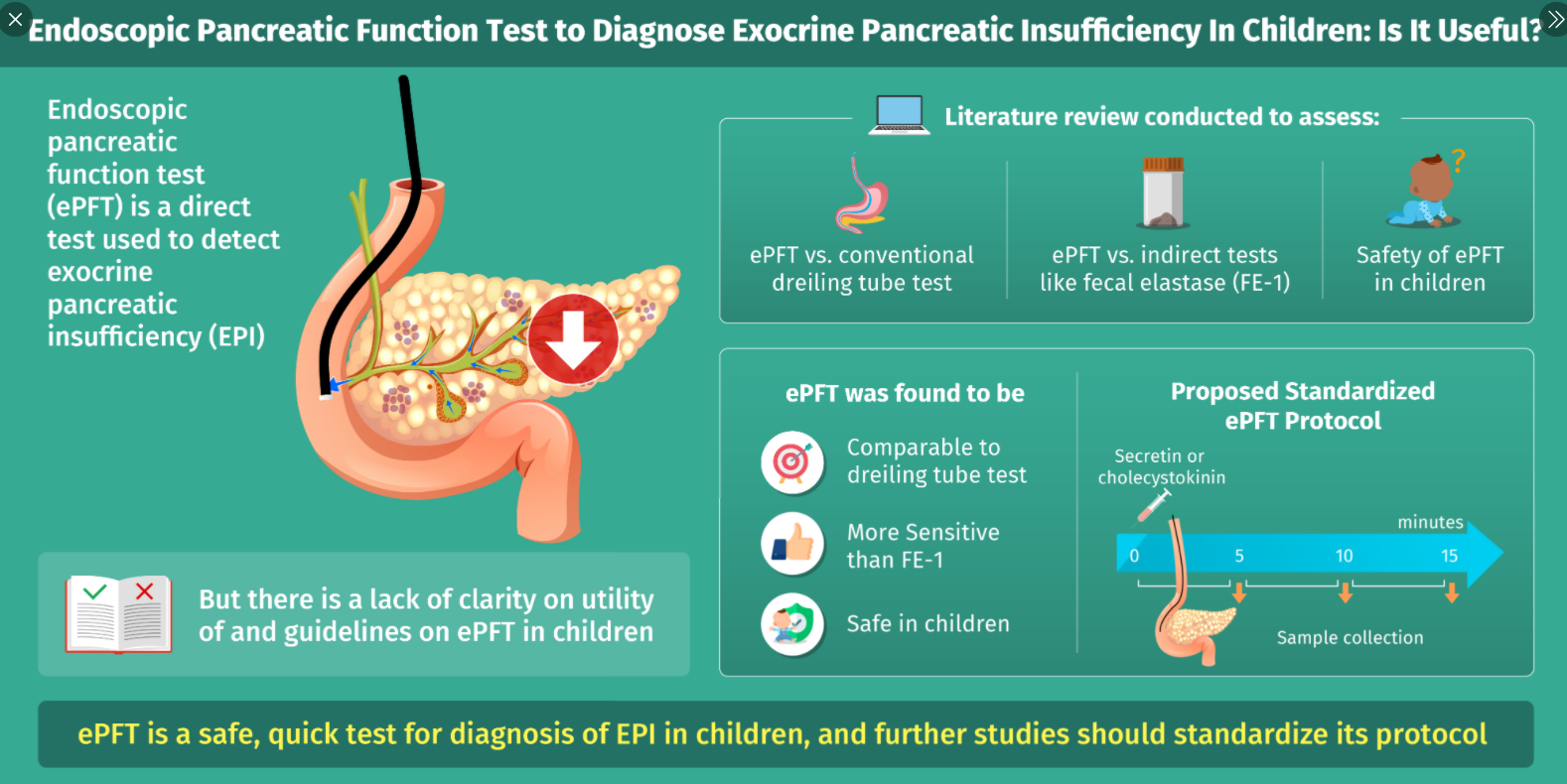
N Patel et al. JPGN 2021; 72: 144-150. full text Endoscopic Pancreatic Function Testing (ePFT) in Children: A Position Paper From the NASPGHAN Pancreas Committee

This articles serves as a good review of exocrine pancreatic insufficiency (EPI).

Etiologies:

  • “Cystic fibrosis is the most common cause of EPI in children .” Other congenital causes include  aberrant embryonic development of the pancreas, “Shwachman-Diamond syndrome, Johanson-Blizzard syndrome, Pearson marrow pancreas syndrome, and Jeune syndrome”
  • “Acquired causes of EPI can be transient, such as in the aftermath of acute pancreatitis (which can persist weeks to months)”
  • Also, infants, compared to adults, have “physiological” EPI. Lipase output is 5–10% of adult values during the 1st 6 months of life.

Advantages/Disadvantages of Endoscopic Testing for EPI:

  • Advantages:
    • Safe, technically easy, and quick procedure to perform in conjunction to routine investigative EGD
    • • Allows assessment of acinar and ductal function
    • • High sensitivity and specificity in detection of isolated and generalized enzyme deficiencies
    • • Can diagnose minor and more severe degrees of EPI and aid in early diagnosis of CP in patients with unremarkable radiological changes
  • Disadvantages:
    • Can be done only in conjunction with EGD and the patient will likely require sedation• Prolongs routine EGD
    • • Assesses peak enzyme activity and bicarbonate concentrations rather than total secretory capacity
    • • No standardized pancreatic fluid collection frequency or duration in pediatrics
    • Lack of age-specific standardized reference ranges in pediatrics

Endoscopic Testing Caveats:

  • Any sample with a pH less than 7 may be unreliable as it is below the pH optimum of the enzymes and may reflect contamination with gastric fluid; however, ” the inability to increase pH, or bicarbonate, upon secretin stimulation may be reflective of loss of cystic fibrosis transmembrane conductance regulator (CFTR) function”
  • Samples need to be frozen or placed on dry ice
  • “Commonly used laboratory (Kaleida Health Children’s Hospital Laboratory, Buffalo, NY) are: trypsin >55.4 nmol · mL−1 · minute−1, amylase >32 μmol · mL−1 · minute−1, lipase >146 μmol · mL−1 · minute−1, and chymotrypsin >2.5 μmol · mL−1 · minute−1

My take: With careful clinical judgement, endoscopic EPI testing is rarely needed. First of all, fecal elastase measurements can detect most patients with EPI. In addition, a lot of patients with poor growth and suspected malabsorption are too young for reliable endoscopic EPI testing.

Related blog posts

Imaging Recommendations for Pediatric Pancreatitis

AT Trout et al. JPGN 2021; 72: doi: 10.1097/MPG.0000000000002964 Free full text: North American Society for Pediatric Gastroenterology, Hepatology and Nutrition and the Society for Pediatric Radiology Joint Position Paper on Noninvasive Imaging of Pediatric Pancreatitis: Literature Summary and Recommendations. Also, I want to give a shout out to Jay Freeman who is one of the authors and a very appreciated colleague.

Some of the recommendations:

  • Acute Pancreatitis:
    • Transabdominal ultrasound is recommended as a first-line noninvasive imaging modality for suspected AP
    • If ultrasound is negative for AP and an imaging diagnosis of AP is needed, either CT or MRI is recommended
      • “MRI, particularly MRCP, has also been shown to be more sensitive than CT for biliary etiologies of pancreatitis”
      • “In clinical practice, MRI is often used for assessment and monitoring of late complications of AP, such as fluid collections, to time and guide therapeutic interventions.”
  • Acute Recurrent Pancreatitis:
    • MRI is recommended to identify structural or obstructive causes for ARP
  • Chronic Pancreatitis:
    • MRI is the recommended modality for imaging of suspected CP
    • When imaging is needed to assess a suspected or known episode of AP in a child with CP, transabdominal ultrasound is the preferred first-line imaging modality

My take: This report provides a great deal of detail regarding the imaging modalities, terminology and diagnostic considerations for pediatric pancreatitis.

Related blog posts: