New Age for Hepatitis B Therapies

M-F Yuen et al. NEJM 2022; 387; 1957-1968. Efficacy and Safety of Bepirovirsen in Chronic Hepatitis B Infection

This study is nicely summarized in a “quick take” video and also reviewed in an accompanying editorial by J Hoofnagle (pages: 1996-1998).

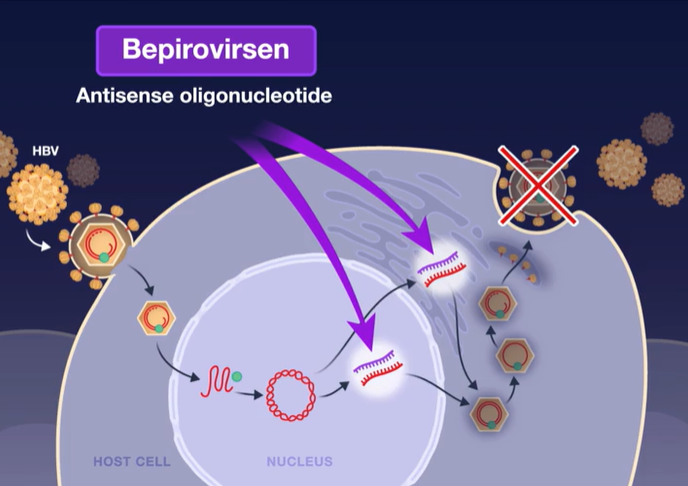
In this phase 2b, randomized, investigator-unblinded trial involving 457 participants with chronic HBV infection (1/2 receiving nucleotide analogue (NA) therapy), the authors evaluated bepirovirsen is an antisense oligonucleotide that targets all hepatitis B virus (HBV) messenger RNAs and acts to decrease levels of viral proteins.

Background: HBV infection affects 4% of worldwide population and has a prevalence of 0.3% in the U.S. Worldwide, HBV causes more than 1/2 million deaths each year.

Key finding:

Mechanism of Action: Bepirovirsen is an antisense oligonucleotide that targets all hepatitis B virus (HBV) messenger RNAs and acts to decrease levels of viral proteins.

Current therapies (like entecavir and tenofovir) are able to suppress viral replication but have low rates of clearance of HBsAg and most often HBV relapses when medications are stopped. This is due to covalently closed circular DNA which can persist in hepatocytes despite these medications.

In Dr. Hoofnagle’s editorial, he notes that bepirovirsen is one of several RNA-based HBV therapies that are being pursued. There are also “the more malleable small interfering RNA molecules (“-sirans”) are currently in early-phase clinical trials.”

My take: While these studies point to new therapies for those afflicted with HBV infection, the best strategy for reducing HBV mortality and morbidity still relies of wide-scale use of the highly effective HBV vaccine.

Mongerson -Phase II Data Available in NEJM

Previously, this blog noted that a phase II study showed that Mongerson, an oral SMAD7 antisense oligonucleotide, had promising data for moderate-to-severe Crohn’s: An Oral Oligonucleotide in the Crohn’s Treatment Pipeline …

The study has now been been published: NEJM 2015; 372: 1104-13.  Among patients who received 40 mg and 160 mg of mongerson, remission (CDAI <150) at 15 days was achieved in 55% and 65% respectively compared to 12% for 10 mg dose and 10% for placebo group.

The associated editorial (pg 1166-67) notes that only 18% of the patients with elevated C-reactive protein and randomized to the 40 mg and 160 mg doses normalized these levels at the end of the treatment period.  Thus, further trials will need to look more closely at objective biomarkers.

Unrelated but interesting -from John Pohl & Bryan Vartabedian’s twitter feeds:  “Food Babe” Exposed as a Fraud

Microtargeting HCV

“Where there is no vision, the people perish.” –King Solomon, Proverbs

A recent study (NEJM 2013; 368: 1685-94) sheds light on a new vision of potential therapies, using microRNAs designed to interfere with the pathogenesis intracellularly.  While this study used this technology to target the Hepatitis C virus (HCV), the same technology has already received FDA approval for a medication (mipomersen) used to treat familial hypercholesterolemia.

With familial hypercholesterolemia, antisense oligonucleotides were developed which inhibit the expression of apolipoprotein B-100 in the liver.  For HCV, miravirsen is a 15-nucleotide antisense oligonucleotide microRNA (miR-122) which binds two highly conserved sites in HCV RNA.  The liver-expressed miR-122 protects HCV from degradation. Thus, the antisense oligonucleotide miravirsen causes degradation of HCV.  All strains of HCV depend on miR-122. (This aspect is reiterated in an associated editorial: NEJM 2013; 368: 1741-43.)

This study enrolled 36 patients from 2010 to 2011 in a randomized, double-blind, placebo-controlled, sequential series, ascending multiple dose-ranging study (7 study sites).  All HCV patients had not received previous therapy and were genotype 1.  Patients received five weekly subcutaneous injections of miravirsen at 3 mg/kg, 5 mg/kg, 7 mg/kg or placebo injections.

Results: In the miravirsen groups, the mean maximum log reduction in HCV RNA level was related to dose: 1.2 in 3 mg/kg cohort, 2.9 in 5 mg/kg cohort, and 3.0 in 7 mg/kg cohort compared with a 0.4 reduction in the placebo cohort.  During 14 weeks of follow-up after completing treatment, HCV RNA was not detected in one patient in the 5 mg/kg group and in four patients in the 7 mg/kg group.

There were no dose-limiting toxic effects or treatment discontinuations because of adverse events.  However, cholesterol levels did decrease by ~25%. No viral resistance was identified.  In addition, during treatment with miravirsen, a sustained decrease in serum alanine aminotransferase was evident.

The authors note that the pharmacologic data from this study indicate that once-monthly regimen would be feasible.  Because miravirsen is not a substrate for P-450, it is not expected to have significant drug-drug interactions.  Further studies are underway.

Potential drawbacks of treatment: miR-122 is a tumor-suppressor gene for hepatocellular carcinoma (HCC).  Thus, treatment with miravirsen could increase the risk of HCC.  Also, in mice that lack miR-122, there is a high risk of fatty liver and fibrosis.

Related blog posts: