
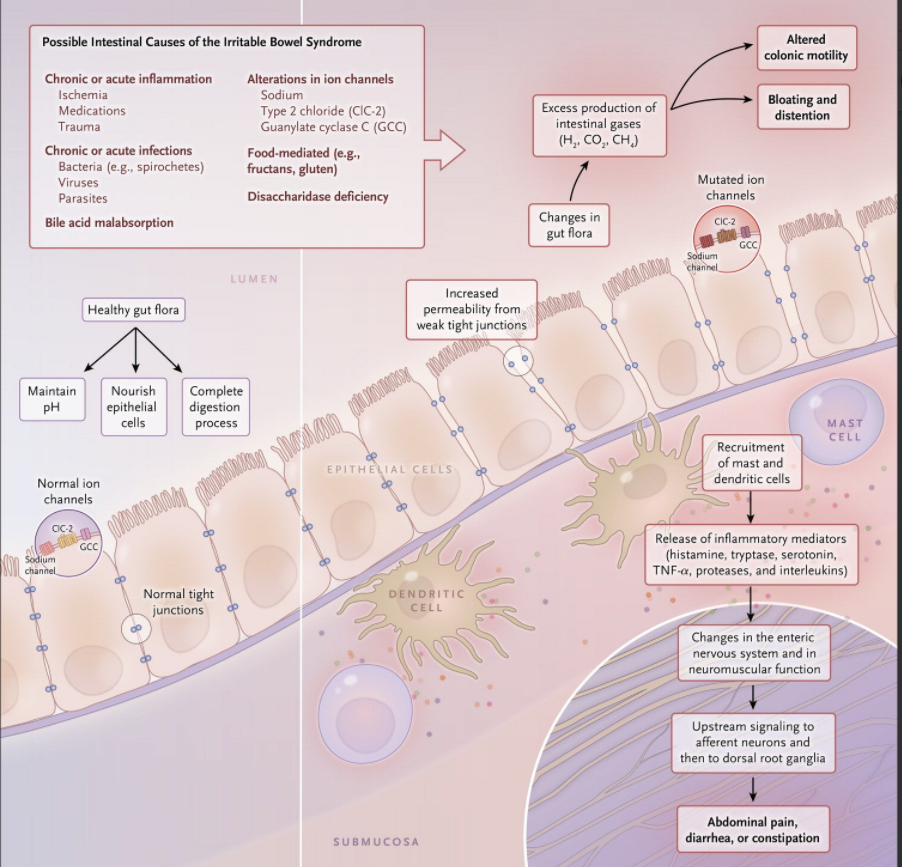
A terrific 12 page review of irritable bowel syndrome (IBS): AC Ford, BE Lacy, NJ Talley. NEJM 2017; 376: 2566-78. While yesterday’s post reviewed some of the updated diagnostic and pathophysiology information, today’s will focus on treatment.
The article’s Table 2 outlines the most frequent treatments, their efficacy, side effects, costs, and quality of evidence. I’ve tried to highlight the key points from table and discussion:
- Soluble fiber (eg. psyllium). Efficacy: effective -start at low doses. Quality of evidence: Moderate, Cost: $15-30 per month.
- Low-FODMAP diet. Efficacy: “May be effective, nutritionist guidance helpful.” While there have been studies showing this diet can be effective, two studies have shown that this diet is not significantly superior to conventional IBS diets (eg. “eating small, regular meals and avoiding insoluble fiber, fatty foods, and caffeine”).Quality of evidence: Very low.
- Gluten-free diet. Efficacy: May be effective. “No additive effect over that of a low-FODMAP diet in another small RCT.” Quality of evidence: Very low.
- Antispasmodic drugs (eg. dicyclomine).Efficacy: May be effective. Quality of evidence: Low, “No high-quality trials.” Cost: $50 per month.
- Peppermint oil. Efficacy: Effective, though few RCTs and no FDA-approved end points. Quality of evidence: Moderate. “No high-quality trials.” Cost: $9-19 per month
- Lubiprostone. Efficacy: Effective, though “only a modest benefit over placebo, particularly for abdominal pain.” Quality of evidence: Moderate. Cost: ~$350 per month.
- Linaclotide. Efficacy: Effective.. ” Quality of evidence: High. “No high-quality trials.” Cost: ~$350 per month.
- Alosetron/5-HT3 receptor antagonists. Efficacy: Effective. ” Quality of evidence: High. “No high-quality trials.” Cost: ~$350-1100 per month. Alosetron may trigger ischemic colitis.
- Eluxadoline. Efficacy: Effective, though “only a modest benefit over placebo for global symptoms and no benefit over placebo for abdominal pain.” Quality of evidence: High. “No high-quality trials.” Cost: ~$1100 per month. May trigger pancreatitis.
- Rifaximin. Efficacy: Effective. Quality of evidence: Moderate. “Modest benefit over placebo.” “Relapse among patients who have a response is usual.” Cost: ~$1500 per month.
- Probiotics. Efficacy: May be effective. Quality of evidence: Low. “Few high-quality trials and no FDA-approved end points.” Cost: ~$20 per month.
- Tricyclic antidepressants. Efficacy: Effective. Quality of evidence: Moderate. “Few high-quality trials and no FDA-approved end points.” “A meta-analysis showed that tricyclic antidepressants were more effective than placebo in 11 randomized trials involving a total of 744 patients.” Cost: ~$5-10 per month.
- Psychological treatments. Efficacy: Effective. Quality of evidence: Low. “Few high-quality trials and no FDA-approved end points.” “Their efficacy may be overestimated because of the lack of blinding.” There is also difficulty for many patients in finding an appropriate provider. Cost: ??
- Placebo. In treatment trials, a placebo response is noted in 30-40%.
- Complementary/Alternative Therapies. “Herbal therapies remain unclear. STW5 (Iberogast) has been tested and “showed superiority over placebo.” Melatonin “has been reported to reduce abdominal pain in patients with IBS.”
The authors recommend judicious testing “Any reassurance derived from colonoscopy to rule out organic disease in patients with IBS is short-lived.”
The authors outline their typical approach. “Reassurance, explanation, and a positive diagnosis are essential steps in management. We recommend starting with dietary modification (slowly increasing soluble fiber if the patient has IBS with constipation or instituting a low-FODMAP diet temporarily if the patient has IBS with diarrhea or the mixed subtype of IBS). We also recommend increased exercise and stress reduction. A probiotic may be added, especially if bloating is prominent. Pain may be ameliorated with an antispasmodic agent or a tricyclic antidepressant, diarrhea with loperamide or a bile acid sequestrant (eg. colestipol) and constipation with polyethylene glycol.” The other therapies may be used in those with persistent IBS symptoms.
My take: When a disease has this many treatments, usually this means that none of the treatments are all that great.
Related blog posts:
- Mechanisms of irritable bowel syndrome | gutsandgrowth
- Psychological Treatments for IBS
- Balanced summary of probiotics & Microbiome effects on brain
- Don’t Skip this Article -Rome IV Summary | gutsandgrowth
- How Effective are the Treatments for Functional … – gutsandgrowth
- Cognitive Behavioral Therapy for RAP in childhood GutsandGrowth
- amplified pain syndromes | gutsandgrowth
- Anxiety and Functional Abdominal Pain | gutsandgrowth
- Brave New World: Psychotropic Manipulation & Pediatric ..
- Change the Name: “Functional” is Lousy | gutsandgrowt
- What NOT to say with functional pain | gutsandgrowth
- Acupuncture for irritable bowel syndrome
- Ondansetron for Irritable Bowel with Diarrhea?
- Why Eliminating Gluten May Help Irritable Bowel Syndrome

Chattahoochee River
Disclaimer: These blog posts are for educational purposes only. Specific dosing of medications (along with potential adverse effects) should be confirmed by prescribing physician. This content is not a substitute for medical advice, diagnosis or treatment provided by a qualified healthcare provider. Always seek the advice of your physician or other qualified health provider with any questions you may have regarding a condition.
 gutsandgrowth