Unpacking Health Care Corporatization in the U.S.

ECF Brown. NEJM 2025; 393; 1-3. Defining Health Care “Corporatization”

This blog has had many posts detailing the many flaws in the U.S. health care system. While the U.S. expends more per capita than any other country, our life expectancy is 4 years less than similar countries in Europe and Canada.

This article in the NEJM is the first of a series examining the ‘corporatization’ of health care and potential ways to improve health care delivery.

Excerpts:

The percentage of hospitals owned by companies controlling three or more hospitals increased from 11.6% in the 1980s to 56.1% today…and now nine megahospital chains own more than 50 hospitals each.

In the early 1980s, three quarters of U.S. physicians owned their practice, whereas in 2023 a similar proportion of physicians was employed by hospitals or corporate entities, including private equity funds.

Insurance conglomerates, such as UnitedHealthcare and CVS–Aetna, now control physicians, home care, pharmacies, and pharmacy benefit managers (PBMs). Horizontal hospital consolidation has been pursued for the promise of economies of scale and market power…

The term “corporatization” now refers to the general trend throughout the health care industry toward higher levels of integrated control by consolidated profit-seeking enterprises… First is the elevation of profit generation as the primary goal of the health care enterprise…the primary duty of the corporation is to maximize shareholder profits. Shareholder primacy subordinates the interests of other stakeholders, such as patients, the health care workforce, or the community…

Even nonprofit hospitals can become corporatized as they grow in size and organizational scale…powerful nonprofit health systems may come to prioritize revenue over patient and community welfare, evidenced by inflated prices, insurance network exclusions, medical debt–collection actions against patients, facility closures in low-income areas, and cuts to staffing levels and pay.

The second key element of corporatization is consolidation… Conglomerates’ market dominance, diversification across platforms, and change in locus of control insulate them from reputational or market discipline…

Corporatization has produced a system that is incredibly profitable for investors but increasingly unaffordable, inaccessible, and uncaring for everyone else — in other words, it has created a Gilded Age of medicine.5 …Corporate control over medical practices and the drive for profit have undermined many clinicians’ professionalism, autonomy, trust, and morale…

Traditional health policy interventions such as antitrust enforcement, tax subsidies and exemptions, prohibitions on the corporate practice of medicine, and payment reforms have not stopped the rise of the corporation in health care, owing to lax enforcement, political capture, and sophisticated regulatory workarounds…

Confronting corporatization may require a fundamental reorientation of the industrial organization of the health system… Future health policy efforts must confront the fundamental question of whom our health care system is meant to serve: corporate giants or the members of our society as a whole.

Related blog posts:

Exploring Walgreens’ Collapse: The Role of PBMs

This newsletter explains why Walgreens is collapsing. My concern is that even a company as big as Walgreens had hardly any control over the declining reimbursements for their pharmaceutical sales. They had to accept the reimbursement due to a lack of leverage related to the consolidation of insurance companies and pharmacy benefit managers (PBMs). Without intervention to reverse the ongoing consolidation of these companies (as well as hospitals), patients will face fewer choices and higher costs. Physician groups will face existential business threats.

Here’s an excerpt from the newsletter:

Walgreens is America’s second-largest drug store chain, and has been a public company for more than 100 years… it has closed a thousand stores since 2018, and plans to shut 1,200 more this year…

The real reason Walgreens, and the pharmacy business in general, is dying, is because of a failure to enforce antitrust laws against unfair business methods and illegal mergers…Moreover, even today, the other financial numbers from Walgreens aren’t bad. Sales aren’t going gangbusters, but the number is basically increasing, and so are the number of 30-day prescriptions, even though they’ve cut the number of stores every year since 2017…

But in its main line of business – pharmaceuticals – Walgreens doesn’t set prices. Insurance companies do. And there’s the rub…Walgreens gets a set reimbursement from that consumer’s insurance company for that medication. How much does it get? Well, those insurance company’s contract with what’s called pharmacy benefit managers (PBMs) to manage negotiations with pharmacies…

Theoretically, both sides have some leverage in this negotiation. If a pharmacy chooses not to accept the prices and terms offered by those PBMs, then consumers who have an insurance company that uses that PBM just won’t go there…Pricing wasn’t a big problem for Walgreens when there were lots of PBMs, because it had the ability to say no if the deal was unreasonable, and still maintain a flow of customers…Today, there are really only three PBMs – Express Scripts, Caremark and OptumRx – serving 80% of customers…

In 2015, the big three, with their market power, began lowering reimbursement rates on pharmacies and charging a host of new fees…

PBMs, however, are engaged in a sort of industry-specific arson. And we can see this dynamic by looking at independent pharmacies writ large, nearly one in three of whom have closed in the last ten years. Today, 46% of U.S. counties now have pharmacy deserts, meaning no pharmacies at all…

326 pharmacies have closed since December of 2024. Why is that month significant? Well, that’s the month Elon Musk tanked legislation to address some of the monopolistic squeezing that PBMs are putting on pharmacies and consumers.

Related explanation of PBMs (Dr.Glaucomflecken): The Middlemen of Healthcare (includes useful organizational flowchart)

Related blog posts:

Islands/Karsts in the Andaman Sea
Bangkok Canal

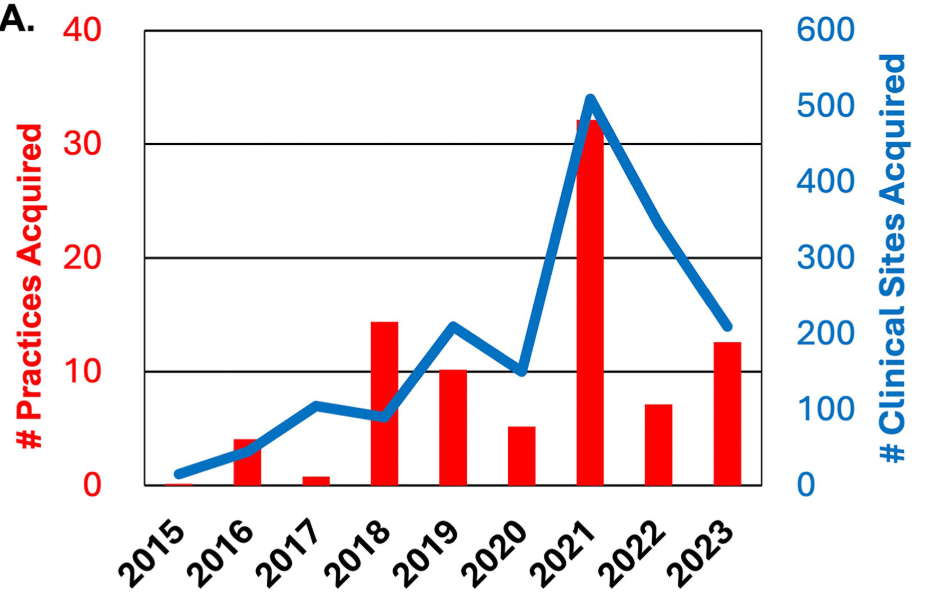
I Call BS -Consolidation in GI is Not a Good Trend

D Marino et al. Clin Gastroenterol Hepatol 2024: 22: 1770-1773. Trends in Consolidation of Gastroenterology Practices

This article describes trends and rationale for consolidation of gastroenterology practices.

Trends:

  • “From 2012 to 2022, the share of physicians who work in private practices dropped 13 percentage points, from 60.1% to 46.7%.” (In the 1980s, 76% of physicians owned their practice)
  • “Ownership among physicians younger than 45 dropped more than 12 percentage points from 2012 to 2022, from 44.3% to 31.7%.”

My Views (in bold) on the Authors’ Rationales for Consolidation:

  • “The potential advantages of consolidation include achieving economies of scale, increasing choices for patients beyond large hospital-based systems of care, enhancing the infrastructure to support high-quality value-based independent practices…whereas drawbacks …diminished authority.” The driving force for consolidation is money not improvement in “high-quality value-based” care. PE investors are tapping into health care to extract profits from the healthcare sector.
  • “The long-term implications for individual practices, physicians and patient care remain uncertain.” Some of the implications are already evident –increased costs for patients and without improvement in quality. PE consolidation does allow improved negotiation with insurers and hospitals.
  • “Large PE-backed groups provide resources to help independent practices stay independent.” This is quite a paradox. PE acquisition is a not a way to maintain independence.

My take: While consolidation, driven by financial incentives, is affecting all areas of healthcare, it is NOT resulting in improvement in patient care or physician satisfaction. This is true whether consolidation is acquisition by private equity or by hospitals. This article’s attempt to provide a different narrative is BS.

As an aside, in some ways, acquisition by hospitals is harder to justify than acquisition by PE; hospitals state that their main goal is patient care. Yet, when hospitals consolidate physician practices, this often runs counter to that goal by increasing costs for patients without improvement in quality.

Related blog posts:

Medical Billing Trap: Hospital Pricing for Urgent Care Visits and Outpatient Departments

Danielle Ofri. NY Times (June 17, 2024): Even Doctors Like Me Are Falling Into This Medical Bill Trap

An excerpt:

I reflected on how urgent-care centers filled a perfect niche between the overkill of an emergency room and the near impossibility of snagging an immediate orthopedic appointment….Two weeks later a bill arrived: The radiology charge from NorthShore University HealthSystem for the ankle and wrist X-rays was $1,168, a price that seemed way out of range for something that usually costs around $100 for each X-ray. When I examined the bill more closely, I saw that the radiology portion came not from the urgent care center but from a hospital, so we were billed for hospital-based X-rays. When I inquired about the bill, I was told that the center was hospital-affiliated and as such, is allowed to charge hospital prices…

It turns out that I’d stumbled into a lucrative corner of the health care market called hospital outpatient departments, or HOPDs. They do some of the same outpatient care — colonoscopies, X-rays, medication injections — just as doctors’ offices and clinics do. But because they are considered part of a hospital, they get to charge hospital-level prices for these outpatient procedures, even though the patients aren’t as sick as inpatients. Since these facilities don’t necessarily look like hospitals, patients can be easily deceived and end up with hefty financial surprises…

As of 2022, federal law protects patients from surprise bills if they are unknowingly treated by out-of-network doctors. But there is no federal protection for patients who are unknowingly treated in higher-priced hospital affiliates that look like normal doctors’ offices or urgent care clinics...

HOPDs turn out to be an attractive business plan for hospitals that are aggressively acquiring doctors’ practices. ​​When these acquisitions occur, prices often rise as patients are now seen in “hospital facilities.”

It’s time for Congress to protect patients from both unfair pricing schemes and health care deception. MedPAC, the nonpartisan Medicare Payment Advisory Commission, recently recommended to Congress a basic set of site-neutral policies. It would apply site-neutral payments to a handful of low-risk procedures — some imaging, medication injections, simple office procedures — and this would apply to all HOPDs.

Related blog posts:

Consolidation and Competition in Health Care

JS King. NEJM 388: 1057-60. On Consolidation and Competition — The Trials and Triumphs of Health Care Antitrust Law

Key points:

  • “Historically, the United States has relied nearly entirely on market competition to control prices and promote quality in health care. Yet health care markets haven’t been healthy for some time. Over the past 30 years, health care consolidation has gone largely unchecked by federal and state antitrust enforcers, which has resulted in higher prices, stagnant quality of care, and limited access to care for patients.”
  • Consolidation has been both horizontal (eg. two competitors merge), vertical (eg. hospital acquiring physician groups. or insurance acquiring pharmacy benefit manager) or cross-market (eg. merger of hospital in two separate regions)
  • “Private-equity firms have recently invested heavily in health care providers, purchasing hospitals, emergency services and staffing companies, and specialist-physician groups, such as anesthesiology groups…Studies have found that acquisitions by private-equity firms have led to consolidation and increases in hospital charges and net income.”
  • “Mergers are often justified with promises of improved quality or patient access, evidence supporting these claims is lacking.”
  • “Antitrust law aims to protect consumers and competitive markets from anticompetitive practices and the harms described above. Three federal laws — the Clayton Act, the Sherman Act, and the Federal Trade Commission Act — along with legislation in nearly all states form the foundation of antitrust law.”
  • “Despite these enforcement options, the U.S. health care industry is the most consolidated it’s ever been… In the 1990s and early 2000s, the FTC lost six consecutive horizontal hospital-merger cases…[subsequently] federal agencies didn’t challenge another hospital merger for nearly a decade.”

My take: Consolidation is happening in all components of health care, including hospitals, insurance companies, pharmaceutical companies and physician groups. This leads to higher costs, fewer choices and possibly staff shortages. At the same time, each segment of health care is incentivized to consolidate, in part for financial gain and in part to negotiate with other consolidated segments.

Related blog posts: