Gene Therapy for Crigler-Najjar

L D’Antiga et al. NEJM; 2023; 389: 620-631. Gene Therapy in Patients with the Crigler–Najjar Syndrome

Methods: Five patients received a single infusion of the gene construct (GNT0003): two received 2×10¹² vector genomes (vg) per kilogram of body weight, and three received 5×10¹² vg per kilogram. The primary end points were measures of safety and efficacy; efficacy was defined as a serum bilirubin level of 300 μmol per liter or lower measured at 17 weeks, 1 week after discontinuation of phototherapy. The infusion protocol included administration of sirolimus adjusted for a trough of 4-12 mcg/L (starting 1 week prior to infusion) and steroids (IV day prior then oral for 8 weeks). .

Key findings

  •  By week 16, serum bilirubin levels in patients who received the lower dose of GNT0003 exceeded 300 μmol per liter.
  • The patients who received the higher dose had bilirubin levels below 300 μmol per liter in the absence of phototherapy at the end of follow-up; mean level at the final follow-up visit [week 78 in two patients and week 80 in the other], was149±33 μmol per liter.
  • No serious adverse events were reported. Mild increase in ALT levels were seen in 4 of 5 patients; this was “potentially related to an immune response against the infused vector; these patients were treated with a course of glucocorticoids.”
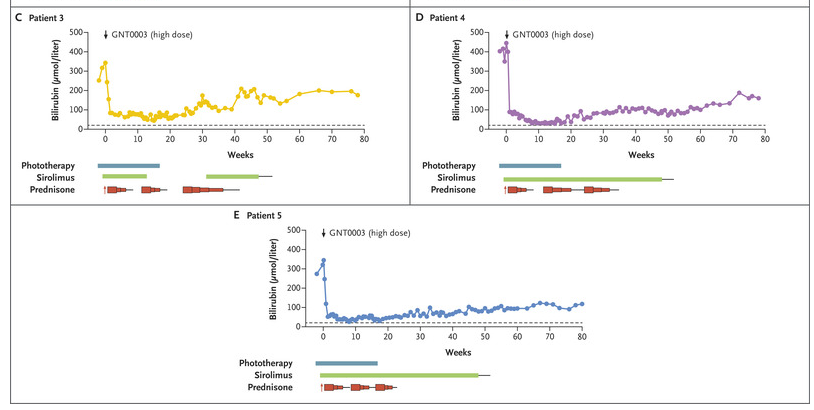
This figure shows the response of the serum bilirubin in patients receiving the higher dose of the infusion.

My take: This study shows that the GNT0003 increased UGT1A1 activity to levels that permitted cessation of phototherapy; this persisted for 18 months after treatment. Further studies are needed.

Related blog posts:

Liver Shorts July 2020

KA Strauss et al. Hepatology 2020; 71: 1923-39. Crigler-Najjar Syndrome Type 1: Pathophysiology, Natural History, and Therapeutic Frontier. This chart review  provides long-term data on phototherapy for  CN1 (n=28) over 30 years, bilirubin metabolism, and results from 17 who underwent liver transplantation at a median age of 16 years.  Background: “In 1952, John Crigler and Victor Najjar described 7 infants from 3 families who developed intractable nonhemolytic jaundice within the first week of life.”  Disorder is due to deficiency of uridine 5′-diphosphate glucuronyltransferase (UGT1A1, OMIM 218800). The report’s Table 1 provides management guidelines. 12 (43%) of patients developed cholelithiasis (pigmented stones) which exacerbated hyperbilirubinemia and resulted in cholecystectomy.

H Dang et al. Hepatology 2020; 71: 1910-22.  This multinational consortium retrospective study reviewed 1676 patients with HCV-related HCC.  They found that in patients who achieved a sustained virological response (SVR) after direct-acting antiviral (DAA) therapy had a significantly higher 5-year survival: 88% vs 66%, P<0.001; after regression analysis, SVR was independently associated with a 63% lower risk of 5-year all-cause mortality.  My take (borrowed from authors) Patients with HCV and HCC who are eligible for HCC therapy should also be considered for DAA therapy.

M Noureddin et al. Hepatology 2020; 71: 1940-52.  This study, a nested case-control analysis, examined a subset from a large prospective cohort of >215,000 adults in Hawaii and California for diet associations with nonalcoholic fatty liver disease (NAFLD); the subset consisted of 2974 patients with NAFLD and 29,474 matched controls.  Key findings: Red meat, processed read meat, poultry and cholesterol consumption were positively associated with NAFLD while dietary fiber was inversely associated with risk. My take: While sugar/fructose intake has been a dietary concern for NALFD, this study indicates that decreasing meat/cholesterol consumption and increasing fiber consumption would be beneficial to reduce risk of NALFD and advanced liver disease.