Picking the Wrong Health Insurance Policy

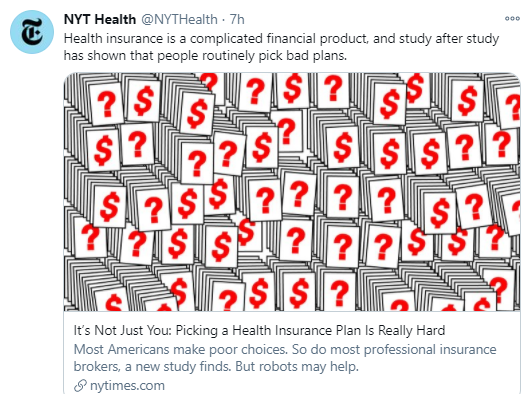
NY Times: It’s Not Just You: Picking a Health Insurance Plan Is Really Hard

An excerpt:

Health insurance is a complicated financial product, and study after study has shown that people routinely pick bad plans, even choosing options that leave them worse off financially in every possible scenario…

 Many Americans don’t understand terms like “deductible” or “coinsurance” very well. And few are good at predicting what sort of health care needs they will have in the coming year…

A recent study in the Netherlands, which offers insurance to everyone through an Obamacare-like marketplace, found that only 5 percent of Dutch customers did a better job at choosing an ideal plan than they would have by choosing a plan at random… People with less education and income, who tend to be in worse health, were very likely to choose a plan that cost them more to cover their health care — a situation that might leave them skimping on needed medicine or procedures.

My take: This article is so true. When I choose health insurance, this is always a complicated task despite my familiarity and expertise. I would expect that computer-aided decision-making could be developed and be helpful.

Related blog posts:

What’s at Stake with “Repeal and Replace”

Full Link from NEJM: The Mirage of Reform — Republicans’ Struggle to Dismantle Obamacare

Here’s an excerpt:

The [AHCA] bill distinguishes itself from the ACA largely by its commitment to regressive redistribution: it would give wealthier Americans more money (mainly through sizable tax cuts) while reducing government support to help low-income Americans afford insurance. Relative to the ACA, premium subsidies for the uninsured would decrease substantially, on average by 40% in 2020 and reaching 50% by 2026.1 Those cuts would fall heavily on lower-income people, with middle- and upper-income Americans receiving higher subsidies.1,3 The ACA’s subsidies to assist low-income persons with deductibles and copayments would be eliminated altogether. By 2026, for a person earning $26,500 a year and buying individual coverage, insurance plans’ actuarial value — which measures the share of costs that plans pay for covered services — would fall from 87% under the ACA to 65% under the GOP plan…

In addition to unified Democratic and significant Republican opposition in Congress and among governors, key stakeholders — including the American Medical Association, the American Hospital Association, and the seniors advocacy group AARP — oppose the bill. Furthermore, as its potential demise draws nearer, the popularity of the ACA, now part of the status quo, is growing. In the Republican imagination, Obamacare has been a disaster. The GOP’s problem is that in reality Obamacare has substantially expanded health coverage, with 20 million Americans gaining insurance. Rolling back the ACA means making insurance less affordable for low-income Americans, increasing the uninsured population, and taking vast funds away from states and medical providers. The GOP health plan neither fully repeals the ACA nor provides a compelling replacement. Instead, in my opinion, it offers only a mirage of reform.

Another analysis indicates significantly higher deductibles are likely under the GOP plan:

Link: Why dedcuctibles would increase under the GOP health plan

Do deductibles work to improve smart spending on health care?

According to a recent NY Times article –the answer is no.

The problem:

  • With high deductible plans, people reduce both high-value and low-value care
  • Many people cannot afford very valuable care due to their deductibles

Link: The Big Problem With High Health Care Deductibles

Here’s an excerpt:

Some health economists say the solution to the problem may be smarter but more complicated forms of health insurance that provide patients with important care free, but charge them for treatments with fewer proven benefits. Mr. Chernew, for one, argues that ordinary deductibles are too “blunt” an instrument, but smarter insurance plans could harness economic incentives to reduce wasteful health spending without discouraging needed care. If such plans held down costs as well as deductibles, they could keep insurance affordable without as many risks. The theory behind such plans is compelling, but given how bad people are at shopping for health care, more empirical evidence is needed to know how well it works in practice.

US Infinity Pool