Competition for Competitive Acid Blockers

Thanks to Ben Gold for the reference in today’s post.

J-H Oh et al. Am J Gastroenterol 2025; DOI: 10.14309/ajg.0000000000002929 Randomized, Double-Blind, Active-Controlled Phase 3 Study to Evaluate Efficacy and Safety of Zastaprazan Compared With Esomeprazole in Erosive Esophagitis

Introduction: “Unlike PPIs, metabolism of zastaprazan in not dependent on CYP2C19, and it does not require enteric coating due to its acid stability. While PPIs bind irreversibly only to active proton pumps, zastaprazan can bind reversibly and competitively to both active and inactive proton pumps. Moreover, as prodrugs, PPIs necessitate activation into their active form within acidic conditions, typically requiring a regimen of 3-5 consecutive days of dosing…By contrast, P-CABs deliver a rapid onset of action and complete efficacy from the initial dose, as they can directly inhibit proton pumps.”

Methods: A phase III, multicenter, randomized, double-blind, noninferiority clinical study was conducted with 300 subjects (>19 yrs) with confirmed erosive esophagitis compared daily zastaprazan (20 mg) to esomeprazole (40 mg)

Key findings:

  • The cumulative healing rate at week 8 were 97.92% (141/144) for zastaprazan and 94.93% (131/138) (P = 0.178) for esomeprazole.
  • The healing rate at week 4 in the zastaprazan group was higher than the esomeprazole group (95.14% [137/144] vs 87.68% [121/138]; P = 0.026)
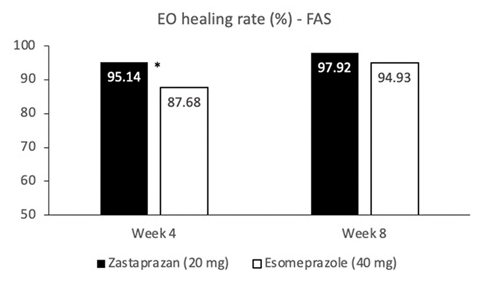
My take: Zastaprazan had higher healing rates at 4 weeks; results at 8 weeks were similar. This phase 3 study suggests that there will be other CABs besides vonoprazan approved for treating acid-related disorders.

Related blog posts:

NYC view from Brooklyn

Improved Efficacy with Vonoprazan for Severe Esophagitis

Briefly noted:

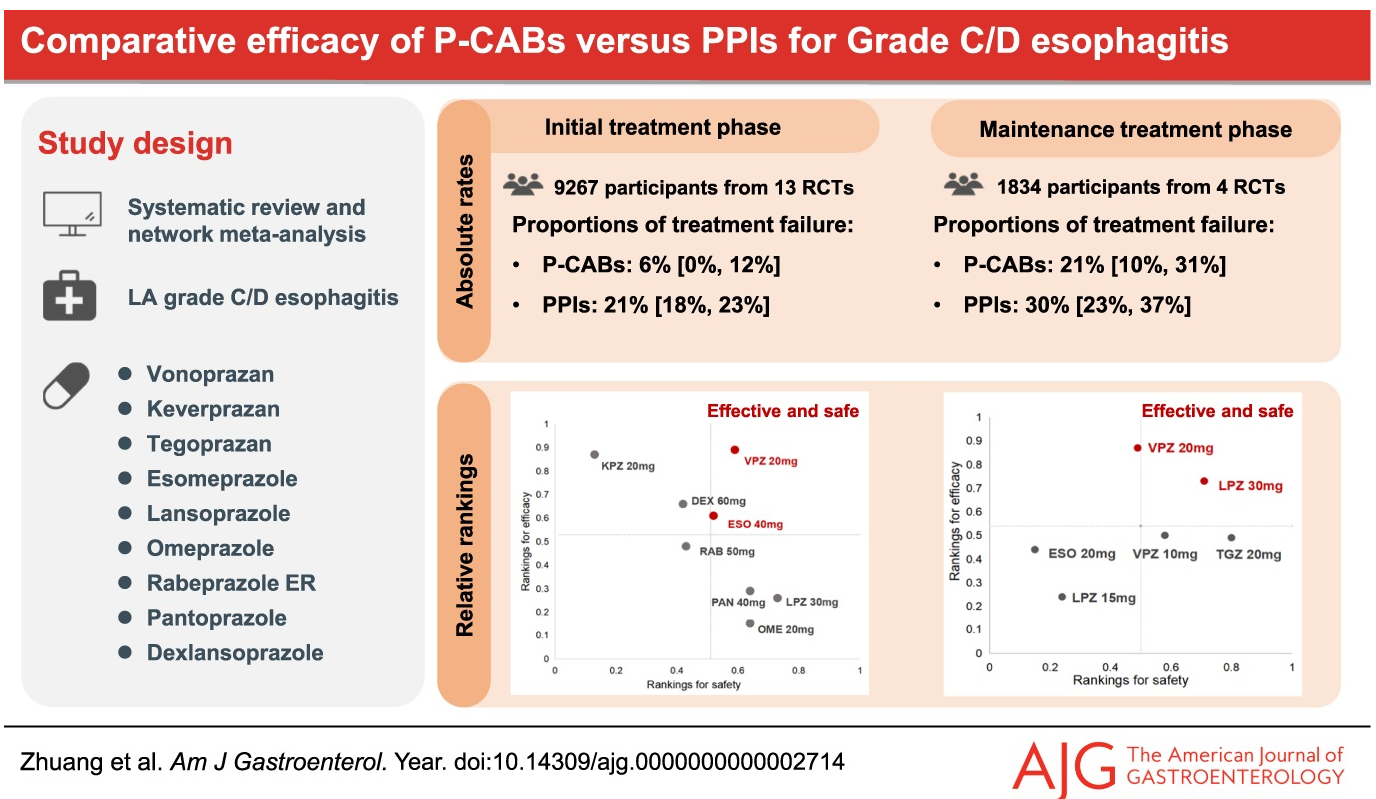
Q Zhuang et al. The American Journal of Gastroenterology  :10.14309/ajg.0000000000002714, March 22, 2024. Comparative Efficacy of P-CAB vs Proton Pump Inhibitors for Grade C/D Esophagitis: A Systematic Review and Network Meta-analysis

In this meta-analysis, 24 studies met criteria. Key findings:

  • Vonoprazan (20 mg) had the lowest rates of treatment failure: 6% in the initial treatment phase, and 21% in the maintenance phase of healing of grade C/D esophagitis
  • Vonoprazan had similar risk of incurring adverse events, severe adverse events, and withdrawal to drug when compared with PPI.

Related blog posts:

Why Vonoprazan Is More Effective For Erosive Esophagitis Than a Proton Pump Inhibitor

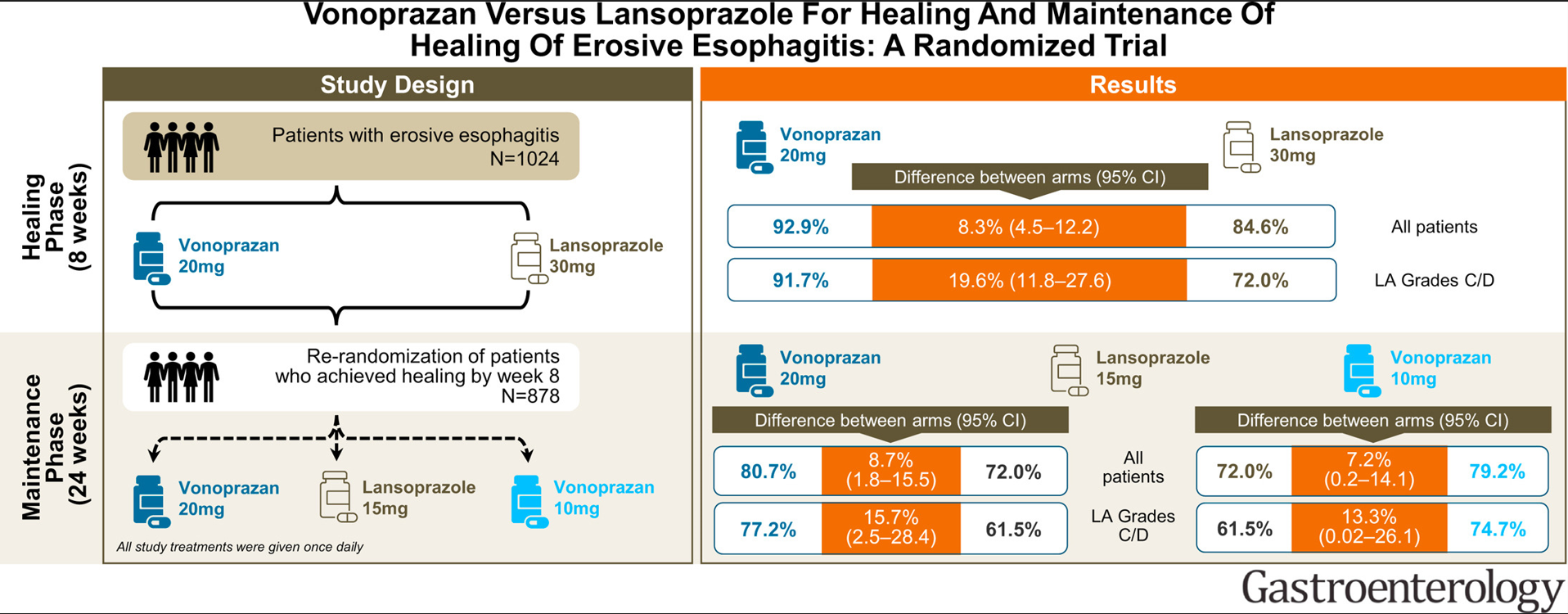
L Laine et al. Gastroenterol 2023; 164: 61-71. Open Access! Vonoprazan Versus Lansoprazole for Healing and Maintenance of Healing of Erosive Esophagitis: A Randomized Trial

Editorial: DA Katzka, PJ Kahrilas. Gastroenterol 2023; 164: 14-15. Open Access! Potassium-Competitive Acid Blocker Suppression of Gastric Acid in Erosive Esophagitis: Is Stronger and Longer Better?

Methods: Adults with erosive esophagitis were randomized to once-daily vonoprazan, 20 mg, or lansoprazole, 30 mg, for up to 8 weeks (healing phase, n=1024). Patients with healing were rerandomized to once-daily vonoprazan, 10 mg, vonoprazan, 20 mg, or lansoprazole, 15 mg, for 24 weeks (maintenance phase, n=878). 

Key findings: (see graphical abstract)

  • In the healing phase, vonoprazan was noninferior to lansoprazole in the primary analysis and superior on the exploratory analysis of healing: 92.9 vs 84.6% (difference, 8.3%). It is noted that studies in Asian populations found smaller differences in healing between these medications.
  • Vonoprazan had superior healing Los Angeles Classification Grade C/D esophagitis at week 2 (difference, 17.6%)
  • Vonoprazan was superior with regard to maintenance of healing Grade C/D esophagitis (20 mg vs lansoprazole (difference, 15.7%) and 10 mg vs lansoprazole (difference, 13.3%).
  • The entire group maintenance healing rates in this trial were lower than in a prior randomized trial in Japan. In the current study at 24 weeks, vonoprazam 20 mg, vonprazan 10 mg and lansoprazole 15 mg had maintenance of healing in 81%, 79%, and 72% respectively compared with 98%, 95%, and 83% in the trial from Japan

The editorial provides a lot of insight into this now FDA-approved therapy for H pylori. Vonoprazan’s application to expand FDA approval is underway: FDA Accepts Review of NDA for Vonoprazan From Phathom Pharmaceuticals (June 3, 2022).

Key points from editorial:

  • Among their shortcomings, PPIs are far from perfect in healing high-grade (Los Angeles class C and D) esophagitis, resulting in the common practice of twice-daily dosing. Furthermore, up to 35% of patients with Los Angeles class C and D esophagitis remain unhealed at 8 weeks, even with twice-daily PPI use.5,6
  • Mechanism of action: Vonoprazan is a potassium-competitive acid blocker (PCAB) . It, reversibly binds to the α-subunit of H+, K+-ATPase to compete with potassium binding. Vonoprazan is acid stable, eliminating the need for enteric coating and allowing for rapid onset of action. Because it achieves high and sustained (half-life is approximately 9 hours) concentrations rapidly in the parietal cell secretory canaliculi, maximal acid inhibition is achieved quickly after a single dose.
  • Because it is not metabolized through the hepatic CYP2C19 or CYP3A4 enzymes, vonoprazan is much less prone to drug–drug interactions.
  • Safety: For the issue of long-term adverse events associated with PPI use…, the proposed mechanisms for these primarily relate to the effects of chronic acid inhibition and/or hypergastrinemia, and there is no reason to think that a PCAB would be any different than a PPI.

My take: There are a lot of individuals with ongoing heartburn & reflux despite PPI treatment. It is likely that vonoprazan will be targeted for patients with more severe erosive esophagitis and refractory symptoms. It is likely that the cost to U.S. patients will be substantially higher than the cost of PPIs.

Related blog posts: