Predicting Intestinal Failure After Gastroschisis Repair

N Vinit et al. J Pediatr 2022; DOI:https://doi.org/10.1016/j.jpeds.2021.11.004 (Ahead of print) Predicting Factors of Protracted Intestinal Failure in Children with Gastroschisis

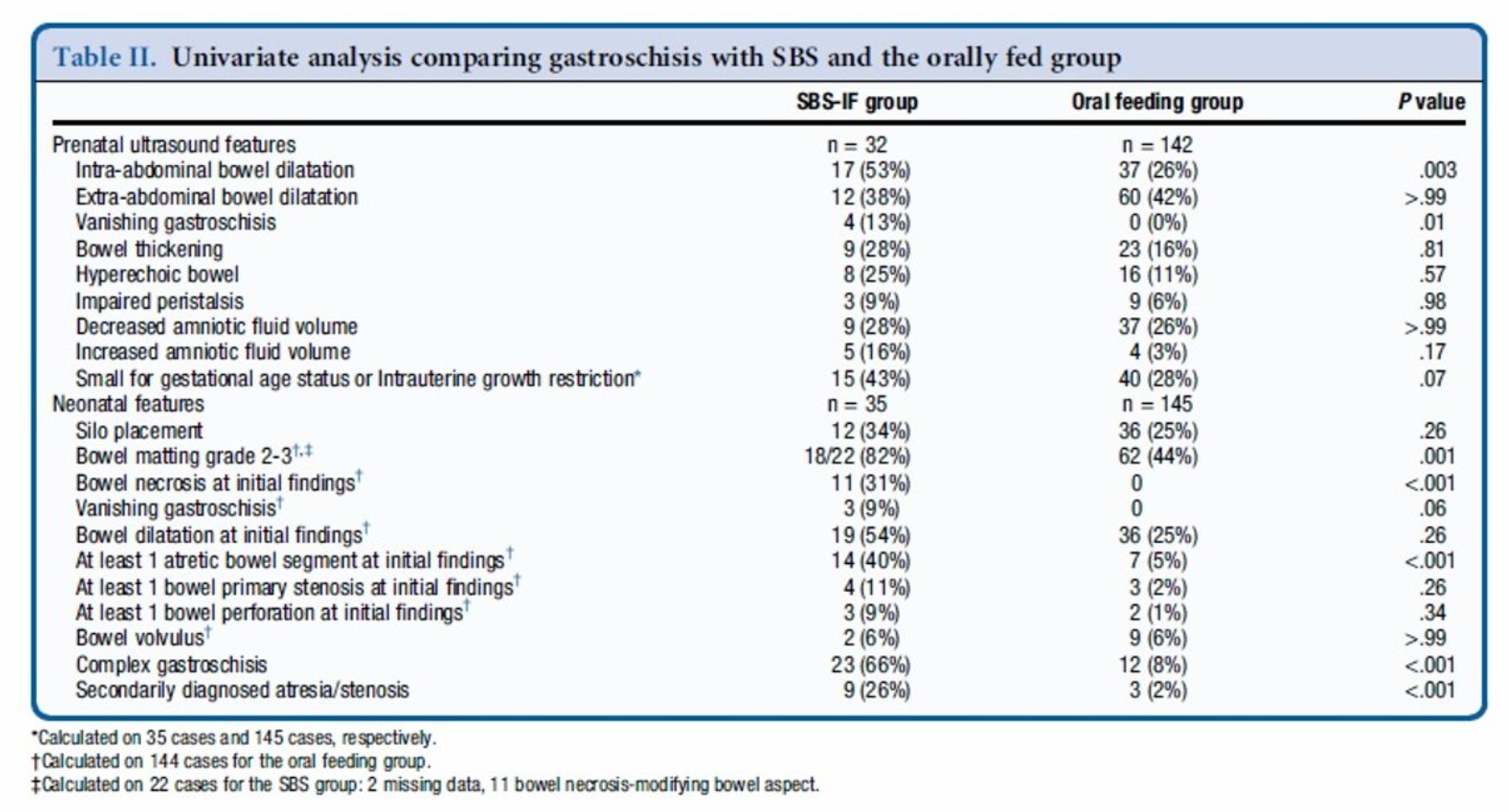
Methods: Retrospective study. Among 180 patients, 35 required long-term parenteral nutrition (SBS-IF group) and 145 acquired full oral feeding within 6 months (oral feeding group) over mean f/u of 7.9 years.

Key findings:

  • Both bowel matting (OR, 14.2, P = .039) and secondarily diagnosed atresia or stenosis (OR, 17.78, P = .001) were independent postnatal predictors of SBS-IF.
  • An initial residual small bowel length of more than 50 cm was the best predictive cut-off for nutritional autonomy, with a sensitivity of 67% and a specificity of 100%

My take: This study identifies bowel matting and atresia/stenosis as additional factors in predicting nutritional autonomy.

Related blog posts:

Prospective Outcome Data for Infants with Gastroschisis

A recent study (BS Fullerton et al. J Pediatr 2017; 188: 192-7) reports outcome data from 4420 neonates with gastroschisis from 175 North Amercan centers.

This study, using prospectively-collected data from the Vermont Oxford Network, was restricted to infants with birth weights >1500 g and gestational age >28 weeks.

Key findings from this cohort:

  • Survival was 97.8%
  • Length of stay (LOS) 37 day median
  • Sepsis, confirmed with either positive blood culture or CSF culture, “was the only independent predictor of mortality.”
  • In addition to gastroschisis repair, abdominal surgery was needed in 22.3%
  • At discharge, 57.0% were <10% weight for age; whereas, only 37.2% were born small for gestational age.
  • There were no outcome differences based on mode of delivery (eg. vaginal vs. cesarean)
  • Other congenital anomalies were noted in many infants, with 5.8% had an intestinal atresia: 4.6% jejunal/ileal, 1.9% colonic, 0.4% duodenal atresia.

My take: This contemporary study shows excellent survival of neonates with gastroschisis.  Sepsis, need for additional surgery, and poor growth remain important challenges.

Related blog posts:

Patient with FeedingTubeAwareness.org Tshirt

Increasing Rates of Abdominal Wall Birth Defect (Gastroschisis)

From NY Times summary of recent study, “Rate of Birth Defect of Abdominal Wall Increasing, CDC Says“:

The prevalence of gastroschisis has increased by about 30 percent, to 4.9 births out of 10,000 during the period from 2006 to 2012, from 3.6 per 10,000 live births from 1995 to 2005, according to the Centers for Disease Control and Prevention.

My take: This epidemiology is definitely concerning.  Though most children with gastroschisis do well over time, some have serious problems and many require prolonged hospitalizations after birth.


An unexpected finding with gastroschisis management

A presumption that paralysis in infants with gastroschisis leads to quicker resolution in silo-assisted closure is not correct (J Pediatr 2012; 161: 125-8).  This presumption had been based on the idea that abdominal muscular relaxation with paralysis would facilitate visceral reduction.

This retrospective Canadian study examined 186 infants with gastroschisis, between 2005-2009.  Standardized data for this study was collected prospectively from 16 perinatal centers in Canada. Findings:

  • 79 had paralysis and 88 did not.  These groups were nearly identical in birth weight, gestational age, and presence of bowel atresia.
  • Paralyzed infants took longer to achieve closure, 8 days versus 5 days.  In addition, the paralyzed group had longer ventilation period, 12 days versus 7 days.
  • These findings persisted after regression analysis/adjusting for other variables.  The analysis included examination of illness severity scores (SNAP-II); it was not simply the sicker infants receiving paralysis.
Besides debunking a false premise with gastroschisis management, this study highlights the necessity of collecting data so that our presumptions can be challenged.

Additional references:

  • -J Pediatr Surg 2011; 46: 801-7.  Outcomes/variation in diaphragmatic hernia and gastroschisis from Canadian Pediatric Surgery network.
  • -J Pediatr Surg 2008; 43: 30-4.  Outcomes in 100 cases of gastroschisis.