#NASPGHAN18 -Our Poster on Antibiotic Stewardship and PEG Placement

Thanks to Chelly Dykes for presenting poster later today and to co-authors for collaborating on this project: Jeffery Lewis, Bonney Reed-Knight and Cate Crenson.

Full abstract below.
ABSTRACT:

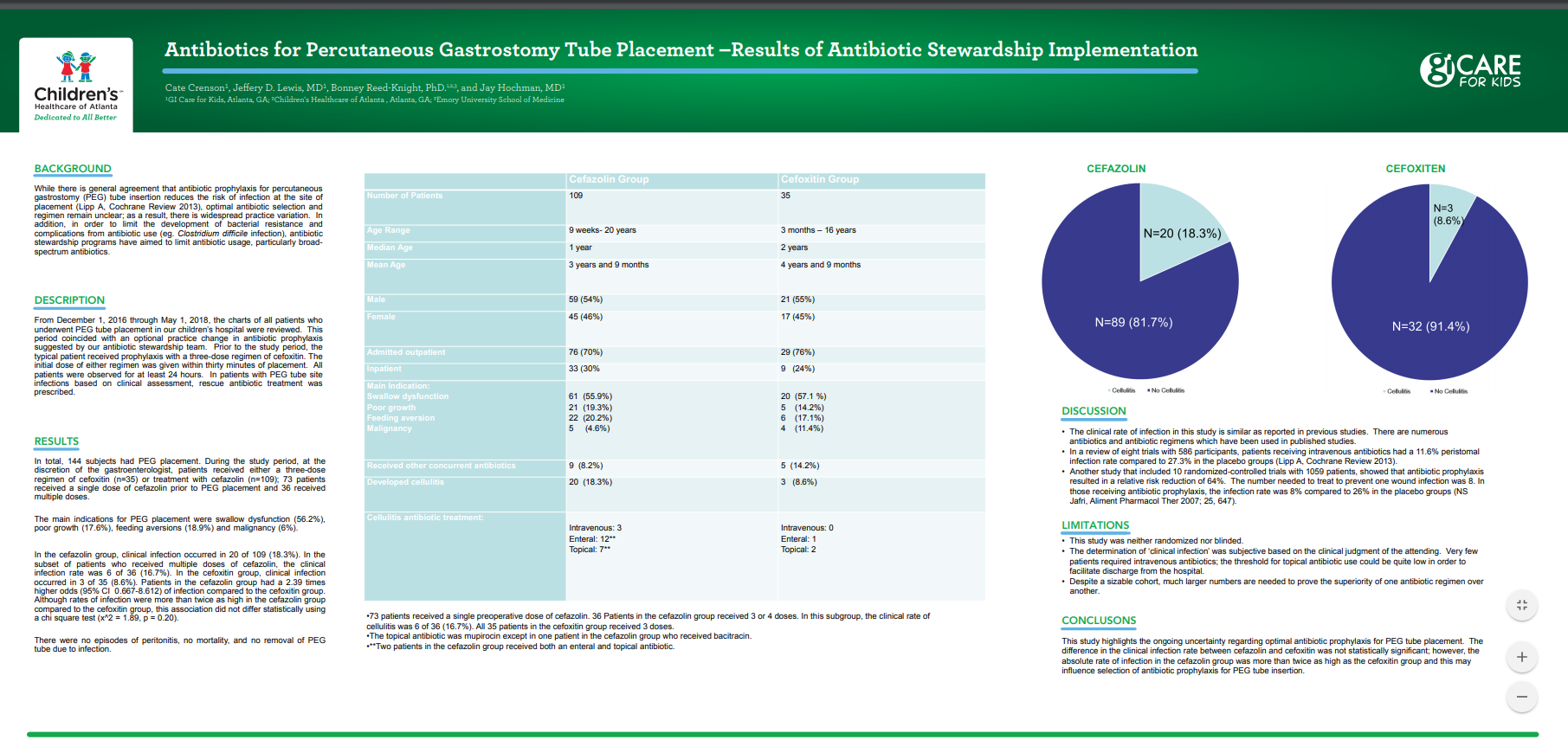
 Background: While there is general agreement that antibiotic prophylaxis for percutaneous gastrostomy (PEG) tube insertion reduces the risk of infection at the site of placement (Lipp A, Cochrane Review 2013), optimal antibiotic selection and regimen remain unclear; as a result, there is widespread practice variation.  In addition, in order to limit the development of bacterial resistance and complications from antibiotic use (eg. Clostridium difficile infection), antibiotic stewardship programs have aimed to limit antibiotic usage, particularly broad-spectrum antibiotics.

Methods: From December 1, 2016 through May 1, 2018, the charts of all patients who underwent PEG tube placement in our children’s hospital were reviewed.  This period coincided with an optional practice change in antibiotic prophylaxis.  Prior to the study period, the typical patient received prophylaxis with a three-dose regimen of cefoxitin.  During the study period, at the discretion of the gastroenterologist, patients received either a three-dose regimen of cefoxitin (n=38) or treatment with cefazolin (n=109); 73 patients received a single dose of cefazolin prior to PEG placement and 36 received multiple doses.  The initial dose of either regimen was given within thirty minutes of placement.  All patients were observed for at least 24 hours.  In patients with PEG tube site infections based on clinical assessment, rescue antibiotic treatment was prescribed.

Results: In total, 144 subjects had PEG placement. The main indications for PEG placement were swallow dysfunction (56.2%), poor growth (17.6%), feeding aversions (18.9%) and malignancy (6%).  In the cefoxitin group, clinical infection occurred in 3 of 35 (8.6%).  In the cefazolin group, clinical infection occurred in 20 of 109 (18.3%). In the subset of patients who received multiple doses of cefazolin, the clinical infection rate was 6 of 36 (16.7%). Patients in the cefazolin group had a 2.39 times higher odds (95% CI  0.667-8.612) of infection compared to the cefoxitin group. Although rates of infection were more than twice as high in the cefazolin group compared to the cefoxitin group, this association did not differ statistically using a chi square test (x^2 = 1.89, p = 0.20).

Conclusion: This study highlights the ongoing uncertainty regarding optimal antibiotic prophylaxis for PEG tube placement.  The difference in the clinical infection rate between cefazolin and cefoxitin was not statistically significant; however, the absolute rate of infection in the cefazolin group was more than twice as high as the cefoxitin group and this may influence selection of antibiotic prophylaxis for PEG tube insertion.


Does Gastrostomy Tube Prolong Life in Rett Syndrome?

A recent study (K Wong et al. J Pediatr 2018; 200: 188-95) examined a longitudinal cohort of 323 females in the Australian Rett Syndrome Study.

Key findings:

  • 30.3% of the cohort underwent gastrostomy placement
  • BMI was greater in individuals with gastrostomy placement
  • Median age of gastrostomy placement was 9 years
  • The all-cause mortality rate was greater in those who had gastrostomy placement compared with those who had not (hazard ratio 4.07, CI 1.96-8.45)
  • Survival: 66.1% of the entire cohort was alive at 20 years of age (median survival was 33 years). The survival was 87.3% in those without a gastrostomy.
  • Placement of a gastrostomy tube was not associated with fewer hospitalizations or improvement in parental physical or mental health

While the mortality was higher in those who received a gastrostomy tube, the study’s nonrandomized design does not allow definitive assessment of whether a gastrostomy tube is detrimental to long-term survival.  Children who received gastrostomy tube may have had additional comorbidities.

My take: In adult medicine, it is generally accepted that Gtube placement does not prolong life (Clin Gastro & Hep 2007; 5: 1372).  This study indicates that a Gtube may not improve longevity in many pediatric disorders as well.

Related blog posts:

Nutrition Week (Day 5) What a Gastrostomy Tube Means for Cognition

Looking at a retrospective cohort of 194 neonates, a recent study (SR Jadcherla et al. J Pediatr 2017; 181: 125-30) showed that infants discharged with a gastrostomy tube (Gtube) had associated lower cognitive outcomes.

The authors examined discharge milestones along with Bayley Scales of Infant Development (3rd edition) at 18-24 months of age.

Key findings:

  • 60% of infants (n=117) were discharged on oral feedings and 96% remained oral-fed at 1 year.
  • 40% (n=77) were discharged on gastrostomy feedings.31 (40%) remained fully Gtube dependent, 17 (22%) were orally-fed, and 29 (38%) were on oral/gtube combination.
  • Gtube feedings at discharge were a marker for lower cognition (P<0.01), communication (P=0.03) and motor (P<0.01) composite scores at 18-24 months of age.
  • Other factors associated with neurodevelopmental delay included intraventricular hemorrhage, younger gestational age, and bronchopulmonary dysplasia.

My take: This study provides evidence for an expected finding –infants who need gtubes have poorer neurodevelopmental outcomes than infants who do not need gtubes.

Related blog posts:

Thanks to an Olive Oyl fan for this picture

Thanks to an Olive Oyl fan for this picture


Nutrition Week (Day 3) Multidisciplinary Feeding Disorders

A recent systematic review/meta-analysis (WG Sharp, VM Volkert, L Scahill, CE McCracken, B McElhanon. J Pediatr 2017; 181: 116-24) by my colleagues at the Marcus Center and Emory indicate that intensive, multidisciplinary treatment for pediatric feeding disorders is a game-changer.

The authors identified 11 studies with 593 patients.

Key finding: After intensive intervention, 71% were successfully weaned off tube feedings at the completion of the intervention and this improved to 80% at last followup. Treatment was also associated with increased oral intake, improved mealtime behaviors, and reduced parenting stress.

Based on the results of their review/meta-analysis, the authors provide a summary of recommendations for “standard of care at intensive day and inpatient programs.”  This lists the professional team which should involve at a minimum: psychology, medicine, nutrition, and speech language/occupational therapy.  Treatment needs active participation of caregivers so that gains will not be lost when intensive treatment is completed. Behavioral intervention is central to success.

In an associated editorial (pg 7-8), the authors (RJ Noel, AH Silverman) explain that the one of the biggest hurdles for intensive treatment is gaining approval from insurance companies. One key point they make: “Their work provides data that will be very useful towards advocacy and improving patient access to such treatment.”

My take: This study provides justification of intensive feeding programs.  That being said, the individuals/programs with the appropriate expertise to achieve these results remain quite limited.

Related blog entries:

A few more slides from my recent PNALD/IFLAD lecture:

screenshot-108

The other subjects discussed for PNALD treatment included management of bacterial overgrowth, possible role of STEP surgery, and lipid management strategies.

screenshot-107


Gastrostomy Tubes: The First 30 Days

A retrospective study (AB Goldin et al. J Pediatric 2016; 174: 139-45) provides a better idea about the likelihood of complications by looking for ED visits and admissions within 30  days of placement.

This study involved 38 Children’s Hospitals and 15,642 patients the Pediatric Health Information System (PHIS) database. Key findings:

  • 8.6% had an ED visit within 30 days
  • 3.9% had an admission within 30 days
  • Common reasons for return visits: infection (27%), mechanical complication (22%) and replacement (19%).

The authors note that risk factors for ED visits and admission were mainly non modifiable like race/ethnicity and medical complexity.  They also note that problems in the early postoperative period are grossly underestimated due to many issues being addressed in the outpatient setting.

This study indicates that there is a tremendous opportunity for improvement.  There is great variation in hospital practices with regard to the type and method of placing gastrostomy tube.  In addition, there is a high variability in the determination of the need for fundoplication which is often undertaken at the time of gastrostomy tube placement.

My take:  Understanding these risks is important to give families accurate information prior to placement of gastrostomy tubes.  In addition, these high rates of complications indicate the need for head-to-head prospective trials comparing types of gastrostomy tube placement and education efforts.

Related blog posts:


betterbirthrate

Lower Teen Birth Rates

teen birth rate

Parent Perspective, Pediatric Nutritionist and Traci Nagy

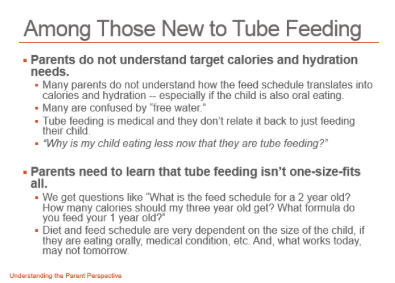
A recent post on The Pediatric Nutritionist blog (Kipp Ellsworth) provides a wealth of useful information for clinicians taking care of children with enteral tubes: Understanding the Parent Perspective: Communicating with Parents and Caregivers about Tube Feeding

The presentation was given by Traci Nagy who founded the FeedingTubeAwareness website, which I have been a big fan for several years.  I probably recommend this website at least once everyday at work.  Of course, I am not the only one familiar with this website which is why it has had more than 200,000 hits last year.

This post includes a 37 slide lecture and links to previous publications.  The “open letter number one” is particularly useful and is reviewed in the slide presentation.  The “open letter number two” also has some useful points, though many would disagree on the utility of testing gastric emptying before fundoplication.

My take: Look at this post -it will help you be a more effective clinician if you take care of kids with enteral tubes.

A few of the slides:

Screen Shot 2016-05-06 at 3.13.34 PM

Screen Shot 2016-05-06 at 3.28.53 PM Screen Shot 2016-05-06 at 3.27.36 PM Screen Shot 2016-05-06 at 3.27.24 PM

Which kids who aspirate need a gastrostomy tube?

While some may think all children who aspirate should have a gastrostomy tube, a recent study (ME McSweeney et al. J Pediatr 2016; 170: 79-84) indicates a more selective approach is appropriate.

This retrospective review of 114 patients (2006-2013) compared patients fed by gastrostomy tube (g-tube) and those who were fed orally.  In their introduction, the authors note, “there has been a practice shift at many institutions away from g-tube placement and more toward continuing to feed children with aspiration orally.”  All patients in the study had aspiration and/or penetration with thin liquids and/or nectar thick liquids on a videofluoroscopic swallow study (VFSS).

There were 61 who aspirated only thin liquids and 53 who aspirated thin and nectar thick liquids.  All patients were divided into two groups: a g-tube group which did not have a preoperative trial of thickened feeds and an orally-fed group.  Patients who had a fundoplication or post-pyloric feeds were excluded from this study.

Key findings:

  • There were no significant differences in admissions among those who aspirated thins compared with those that aspirated thin & nectar thick liquids.
  • Patients fed by gastrostomy were hospitalized more frequently (median 2 times compared to once with orally-fed) and for longer duration (median 24 days compared with median 2 days for orally-fed)
  • No differences in total pulmonary admissions were noted between gastrostomy-fed and orally-fed group

The authors advocate a trial of oral feeding in all children cleared to take nectar or honey thick liquids prior to g-tube placement.


While the authors note that g-tube placement did not result in fewer pulmonary admissions, in their discussion, they also reviewed studies which showed that fundoplication (with g-tube) was not associated with a reduced risk of respiratory complications and in fact, had higher rehospitalizations.

This current study, and previous studies, are limited by their design.  Patients were not randomized and g-tube-fed patients may have had more comorbidities, biasing the results.  The authors note that there were 11 children who failed oral thickening trials and needed g-tube placement.  At the same time, there are substantial numbers of children whose swallow function improve.  Also, the authors note that thickening agents have not been shown to lead to dehydration risk.

My take: the widespread availability of swallow studies has likely led to some children undergoing g-tube placement who may have been fine with ongoing orally-thickened feeds.  Avoiding g-tube placement for children who can tolerate and thrive on thickened feeds is worthwhile.

Related blog posts:

Walnut Street Bridge & Tennessee River

Walnut Street Bridge & Tennessee River

Complications with G-tube Placement

Two recent studies highlight the risks with gastrostomy tube (G-tube) placement.

  • McSweeney ME, et al. J Pediatr 2015; 166: 1514-9.
  • Jacob A, et al. J Pediatr 2015; 166: 1526-8.

The first study, a chart review of 591 patients, identified a 10.5% major complication rate and ~25% complication rate overall.  By far the most common complication for both major and minor complications was stoma infections.  In this study, the g-tube used was the Corflo PEG tubes using a pull-procedure.  Perioperative antibiotics (i.e. cefazolin for 24 hrs) were administered. Exchange of g-tubes (to a skin-level device) took place at 6 months in most patients.  Major complications were defined as an unplanned adverse event necessitating additional hospitalization, surgery or interventional procedure.

Key findings:

  • Cumulative incidence of major complications was 2.4% within 48 hours, 5.8% with 1 month, 9.2% within 6 months, and 14.7% at 12 months post-G-tube placement
  • Among the 62 patients experiencing major complications, 55 of the 72 were due to infections, 6 were dehiscence of PEG at exchange, 2 were due to granulation needing surgery, 2 were due to colon perforation, and 1 due to pneumoperitoneum.  Other major complications included: 1 aborted PEG procedure, 1 post-PEG cardiopulmonary arrest, 3 malfunctioning PEG tubes, and 1 failure to exchange PEG tube for a skin-level device.

Overall, this study shows a fairly high rate of significant complications and that their occurrence was usually not in the immediate post-operative period.

The second study was a prospective study of 183 children undergoing a one-step percutaneous G-tube using the MIC-KEY introducer kit.  This one-step button requires insertion of three gastropexy anchors, dilatation of gastrostomy tract, and button measurement.  The authors evaluated the safety technique and the learning curve.

Key Findings:

  • In the first 6-month period, the authors noted a 17% failure rate; this declined to 0-7% in the following 6-month study periods.
  • The time for placement improved from 21 minutes during the first 6-months to 12 minutes during the sixth 6-month study period
  • The authors highlighted several advantages: 1. lower peristomal infection rate (10.6% compared to their historical control of 29% with pull-PEG); the PEG avoids need to bypass the oropharynx. 2. One procedure/anesthetic for a skin-level device.
  • In the article, the results indicate that there are clearly tradeoffs for these advantages: after the initial learning curve, their remained complications in the majority (65%), mostly mild complications which included accidental button removal (35%), gastric heterotopy (24%), and peristomal leakage (15%).  Also, 35% of patients returned for a replacement tube before the planned date because of intragastric balloon deflation.
  • The cost savings with this one-step button were estimated to be 11% lower.

Bottomline: While g-tubes remain important in caring for children with feeding problems, there is not a magic bullet to eliminate complications.  Understanding the frequency of these problems and discussing them with families will help them be addressed promptly.

Related blog posts:

Resource:

www.feedingtubeawareness.com  This site contains a terrific PDF download which explains enteral tubes in an easy to understand style along with good graphics. “What You Need to Know Now, A Parent’s Introduction to Tube Feeding is the guidebook that every parent wished they had when they were first introduced to feeding tubes.”

NASPGHAN Postgraduate Course 2014 -Nutriton Module

Thanks to those who attended yesterday’s talk (10/24/14) at the clinical practice session and to those who provided helpful feedback.

This blog entry has abbreviated/summarized the presentations. Though not intentional, some important material is likely to have been omitted; in addition, transcription errors are possible as well.  If you make it to the bottom of this post, you will find some useful patient resources along with previous related blog entries.

Diet and the Microbiome –Robert Baldassano (CHOP) pg 140 in Syllabus

This was a very effective lecture; it brought together a lot of useful information.

Trying to sort out balance between health and disease and role of dysbiosis (altered microbiome)

  • Things that we ingest such as food (diet), antibiotics, and xenobiotics shape the composition of the gut microbiota and serve as substrates for the gut microbiota to produce metabolites
  • We are not the only organism consuming what we eat

Specific studies:

  • Wu G, et al. Science. 2011 Oct 7;334(6052):105-8  The Bacteroides enterotype was highly associated with animal protein and saturated fats, which equates to frequent meat consumption as in a Western diet. The Prevotella enterotype high values for carbohydrates and simple sugars, indicating association with a carbohydrate-based diet more typical of agrarian societies.
  • De Filippo C, et al. PNAS 2010: 14691-96: African children (compared with European) with more bacterial diversity & richness along with higher levels of short-chain fatty acids
  • Holmes et al. Cell Met 2012; 16: 559. Diet serves as a substrate for the microbiota to produce certain metabolites.

IBD and diet (Hou JK et al. American Journal of Gastro 2011;106:563-73)

  • High dietary intakes of total fats, PUFAs, omega-6 and meat were associated with an increased risk of CD and UC
  • High fiber and fruit intakes were associated with decreased CD risk
  • High vegetable intake was associated with decreased UC risk.
  • Consumption of meat, particularly red and processed meat increased the likelihood of relapse (Jowett et al Gut 2004)
  • Enteral diet for IBD can improve stool calprotectin within 1-2 weeks.

Take-home messages: Don’t tell your patients with non-stricturing IBD to eat a low fiber diet.  Reduced red meat and reduced oral iron may be helpful.  Vegetarian diet and Mediterranean diets may be helpful.

Related blog posts:

FODMAP: Navigating this Novel Diet –Bruno Chumpitazi, MD, MPH (Texas Children’s Hospital) -page 152 in Syllabus

  • Fermentable Oligosaccharides Disaccharides and Polyols (FODMAPs): Poorly absorbed, osmotically active, rapidly fermented (produce gas)
  • Higher FODMAPs increase breath hydrogen (Murray K et al. Am J Gastroenterol 2014;109:110-9)
  • Higher FODMAPs increase stool/ileostomy output (Barret JS et al. Aliment Pharmacol Ther 2010;31:874-882,Halmos EP J Gastroenterol Hepatol 2013;28(Suppl4):25-28)

Evidence for use of low FODMAPs diet is best in adult irritable bowel syndrome.

  • Shepherd SJ et al. Clin Gastroenterol Hepatol 2008;6:765-71
  • Staudacher HM et al J Nutr 2012;142:1510-18
  • Ong DK et al. J Gastroenterol Hepatol 2010;25:1366-1373
  • Halmos EP et al. Gastroenterology 2014;146:67-75

Limited studies in children.

  • Chumpitazi BP et al. NASPGHAN 2014 abstract n=33 pediatric IBS.  Favorable response noted to low FODMAP diet.

Dietary recommendations were reviewed along with the caveat that obtaining the assistance of a dietician/nutritionist is recommended.

Resources:

Related blog posts:

Nutrition in the Child with Neurological Disabilities –Kathleen Motil (Baylor College of Medicine) pg 162 in Syllabus

  • Nutritional disorders are highly prevalent in children with neurological disabilities: 29-46% are underweight; 8-14% are overweight.
  • Improved nutrition improves behavior, activity level, improves growth, and reduces infections.
  • Cause of nutritional disorders mostly related to inappropriate dietary intake but other factors can play a role
  • Growth/anthropometric measures are key determinant of nutritional assessment
  • Key questions: Is child taking all day to eat? Is child choking with feedings?
  • Critical BMI <12 kg/m-squared
  • Goal for BMI ~25%

Reasons for gastrostomy:

  • Flat growth >6 months/weight below curve
  • Parental request
  • Medication administration
  • Aspiration

Resource:

www.feedingtubeawareness.com  This site contains a terrific PDF download which explains enteral tubes in an easy to understand style along with good graphics. “What You Need to Know Now, A Parent’s Introduction to Tube Feeding is the guide book that every parent wished they had when they were first introduced to feeding tubes.”

Related blog posts:


Why I’m Not a Fan of the “1-Step” PEG

A recent article describes a single-center retrospective review of the 1-Step Low-Profile percutaneous gastrostomy (PEG) tube (“EndoVive” from Boston Scientific) (JPGN 2014; 58: 616-20).  The potential rationale for the 1-Step PEG tubes:

  • 1-time procedure for a low-profile device

My personal experience with these devices is quite limited.  However, I did have one patient who resumed walking after placement of a 1-step dome device gastrostomy tube. He had stopped walking several months before, mainly due to some mild neurological problems.  After receiving this PEG tube, he said he was in so much pain when he was sitting down that he started walking again.  He was able to continue walking after switching to a different gastrostomy tube.  This particular ‘miracle’ explains one of the pitfalls of this device.  This patient had an embedded bolster.

In the current series, the authors’ conclusion was that the 1-step PEG “has complication rates and outcomes comparable with standard PEGs.”  However, their reported results suggest a higher rate of complications: embedded bolster occurred in 5%, cellulitis in 23% (6.6% needing IV antibiotics), and perforation occurred in 0.8%.

Given the relatively small number of patients (n=121 who met inclusion) and retrospective nature of the study, whether these complication rates are significantly higher is a matter of debate.  It should be noted that there may have been some selection bias given that there were only 31 patients less than one year in the study.

With regard to embedded PEG tubes, the authors note that this complication rate typically is 2.3% with a traditional PEG.  The authors minimize the discrepancy of their higher rate, noting the “importance of choosing the right size of the 1-step PEG.”  For those who perform this procedure, this admonition sounds easy but in practice can be problematic.  In addition, the main advantage of this procedure is the “1-step” procedure.  Yet  in Figure 2, the authors note that 67 (more than 50%) underwent a change to a balloon device.

Bottomline: The authors state that the 1-step PEG, “in our opinion, is a preferable PEG technique for children who need long-term enteral feeds.”  My opinion: I’m not a fan and think the 1-step, for initial placement, is less safe overall.

Related blog entries: