“Big Improvements for Smallest Recipients” with Bad Liver Disease

A recent study (M Kasahara et al. Liver Transplantation 2017; 23: 1051-7, editorial 977-8) indicates improvement in survival among the smallest liver transplant patients. In this study of 12 patients less than 3 months of age, the cumulative 10-year patient and graft survival for both was 90.9%.

These patients received living donor liver transplantation. Living donors likely contributed to the excellent outcomes both in terms of enhancing the timing of transplantation and also with regard to size.  Whole organs are not likely to fit well in these small abdomens. The size of the patients ranged from 2.8 kg (at 29 days) to 5.5 kg).  11 of 12 had fulminant hepatic failure with 6 of these cases being considered unknown etiology.

Limitation: This was a very small sample size.

Liver Briefs -April 2017

JA Flemming et al. Hepatology 2017; 65: 804-12.  This cohort study (2003-2015) of 47,591 adults wait-listed for liver transplantation, using the SRTR registry, showed that the era of direct-acting antivirals for hepatitis C was associated with a drop of 32% for HCV patients who were listed compared to the numbers listed during the interferon era.

AG Feldman et al. J Pediatr 2017; 182: 217-22. This retrospective study showed that elevated lactate levels (≥2.5 mmol/L) and elevated lactate to pyruvate ratio (≥25) were NOT predictive of mitochondrial diseases in pediatric patients who presented with acute liver failure.

AG Feldman et al. J Pediatr 2017; 182: 232-38. This retrospective cohort study showed a high rate of vaccine preventable illnesses (VPIs) following liver transplantation (n=2554), occurring in 1 of 6 liver transplant recipients. Most common infections was RSV; most common VPIs: rotavirus and influenza

Saint Chappelle, Paris

Opioid Use and Liver Transplantation Outcomes

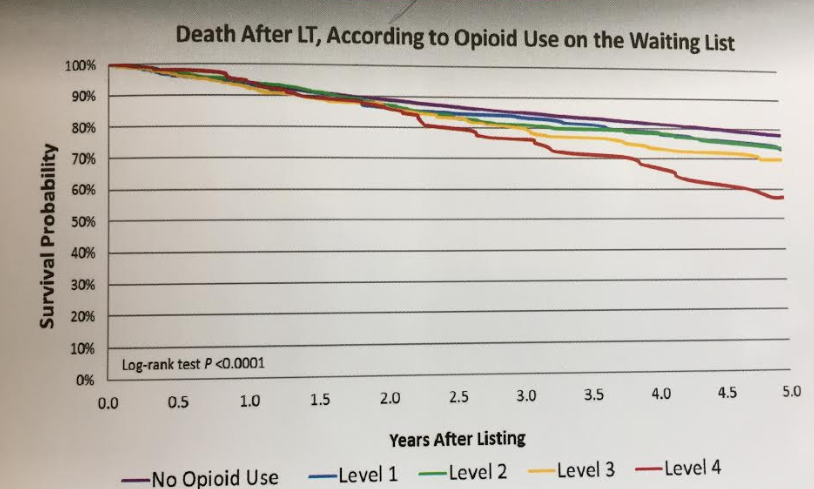
Not surprisingly, a recent study (HB Randall et al. Liver Transplantation 2017; 23: 305-14) has found that use of opioid medications prior to liver transplantation (LT) increased mortality over 5 years after transplantation.

This retrospective cohort study with data from nearly 30,000 patients correlated outcomes with pre-LT opioid exposure.  Overall, 9.3% of recipients filled opioid prescriptions while on the waiting list. Adjusted hazard ratios for death were 1.28 and 1.52 respectively for opioid use of level 3 and level 4.
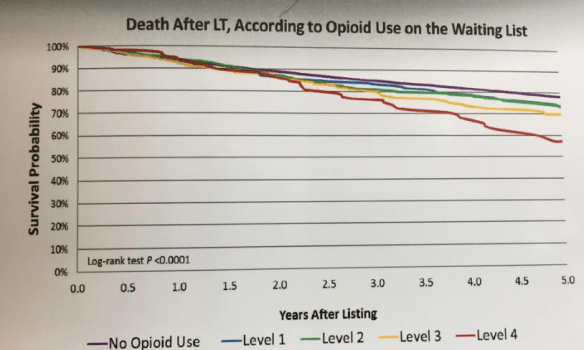
In the associated editorial (pg 285-7), the authors note that animal models have shown direct hepatotoxic effects of opioid use, though they speculate that the driver for mortality could be due to “sustained opioid use over time or return to illicit drug use.”

A unrelated commentary by CDC director Tom Frieden (AJC “Protect Ga. families from opioid overdose”, March 18, 2018) explains the scope of the opioid epidemic.  “Since 2000, more than 300,000 of our sons, daughters, brothers, sisters, mothers, fathers, and friends have been killed by opiates.  In 19999, approximately 6,000 Americans died from opiate overdose –including both prescription pain medicines … and heroin.  By 2015 that number increased to more than 33,000.”  This is more than a five-fold increase.

He emphasized that opiates serve as a gateway drug for those addicted to heroin; that is, the majority of those hooked on heroin were started on an opioid medication.

My take: The worsened outcomes of LT due to opioids are unfortunately a tiny part of an enormous tragic problem of the opioid epidemic.

Related posts:

Finding Residual Hepatitis C Virus in Liver Explants

A recent report (M Gambato et al. Gastroenterol 2016; 151: 633-6) provides some insight into the importance of the presence of residual hepatitis C virus (HCV) RNA in the liver of patients undergoing liver transplantation.

The authors note that many patients with cirrhosis due to HCV do not complete a full course of antiviral therapy before liver transplantation as the waiting time is unpredictable.  The authors studied whether there was HCV RNA in the liver of 39 of these patients and tried to assess whether its presence was associated with relapse after liver transplantation.

Background:

  • Only 6 patients (15%) had completed treatment prior to liver transplantation.
  • Most patients (68%) had undetectable serum HCV RNA.
  • Treatment was most commonly sofusbuvir/ribavirin (n=30)

Key findings:

  • HCV RNA was detected in 26 of 39 liver explants (67%). Higher levels were detected in those who had received a shorter course of treatment at time of liver transplantation. Interestingly, HCV RNA was also detected in 2 (20%) of controls who had an SVR after completing an interferon-free treatment regimen.
  • 33 of 39 (85%) achieved a post-transplantation virologic response (pTVR) and 6 (15%) had recurrent HCV infection.  Thus, the persistence of HCV RNA in liver explant did not preclude pTVR.
  • Among the 26 patients with residual HCV RNA in the liver explant, a HCV RNA concentration was higher in the 4 patients that relapsed (23 vs 3 median copies/mcg total RNA).
  • Another unexpected finding was that among the 6 who relapsed, two had undetectable HCV RNA in liver explant –both patients carried mutations which could have rendered treatment less effective.  The authors note that HCV RNA could have been present at concentrations below detection or distributed unevenly (which could have affected testing).

The authors speculate that the presence of HCV RNA may have been sequestered in membranous webs which allowed the virus to avoid degradation/host defenses.

My take (borrowed from the authors): The presence of HCV RNA in the liver explant does not seem to be associated with treatment failure/virologic relapse after liver transplantation, except in case with high concentrations.

Maine’s oldest lighthouse: Portland Head Light

Portland Head Light

Portland Head Light

First-Hand Account: Living-Donor Liver Transplantation

From NY Times: Donating an Organ to My Son

An excerpt:

It has been a year and half since the surgery. Sammy looks great and is on minimal medication. He goes to school full time, and most people have no idea what he went through. The scar on his abdomen has mostly faded, and we aren’t sure if he even has any memories of this experience.

My liver has grown to full size and my scars are nearly invisible. But that doesn’t mean I am entirely recovered. There are moments, and they are less frequent and further between, that I get spontaneously choked up. This experience was both frightening and inspiring. I had to briefly give up being both doctor and a mother to become a patient. It was as a living donor that I was able to help my son the most.

Another comic account of living liver donation:

Chattahoochee River

Chattahoochee River

Need Liver, Will Travel

A recent commentary (G Cholankeril et al. Gastroenterol 2016; 151: 382-86) provides a succinct summary regarding the trends in liver transplantation multiple listing and its implications on notions of utility and justice.

Key points:

  • UNOS was established based on Congressional act in 1984: 42 U.S.C. § 274.  The principles of “justice” and “utility” were to be key in governing an equitable  allocation system.
  • Due to allocation inequities, however, some prospective liver transplant candidates seek multiple listings. From 2010 to 2015, 1082 of 70,080 (2%) liver transplant candidates on the waitlist had multiple listings. During that same time frame, 862 (multiply-listed) of 32,431(total transplants) (3%) underwent liver transplantation.
  • Candidates who migrated had “shorter waiting time before liver transplantation and higher probability of receiving an organ (multiple listings 80% versus primary listing 46%; P<.001)”
  • Multiple listing candidates had lower severity of illness and lower MELD score at time of liver transplantation (multiple listings 25 versus primary listing 28; P<.001)

Regional distribution:

  • 46% of the 862 multiply-listed patients who underwent liver transplantation received their organ in UNOS region 3 (Alabama, Arkansas, Florida, Georgia, Louisiana, Mississippi, Puerto Rico)
  • 67% of those 862 emigrated away from Regions 2, 5, and 9 -which have the longest waiting times. Figure 1 shows the 11 Regions.  Region 2 & 9 include New York, New Jersey, Delaware, West Virginia, Maryland, and Pennsylvania.  Region 9 includes California, Nevada, Arizona, New Mexico, and Utah.

My take: Under the current system, liver transplant candidates capable of travelling/multiple listing, are rewarded with earlier liver transplantation & higher likelihood of receiving a liver transplant.  Thus, until inequities in organ distribution are better addressed, patient’s may need to consider telling their transplant team: ‘Need Liver, Will Travel’

Related blog posts:

Public Art, New Orleans

Public Art, New Orleans

Intellectual Disability in Pediatric Liver Transplantation

A recent study (A Wightman et al. JPGN 2016; 62: 808-12) describes the prevalence of intellectual disability in a retrospective cohort from 2008-2013. The importance and the discomfort of the topic is referenced in the introduction:

  • “A 2005 survey of pediatric liver transplant programs (n=12) found that 33% of centers reported that cognitive disability was “always or usually” considered in their decision. No pediatric centers, however, considered mild or moderate cognitive disability alone (IQ 35-70) to be a relative or absolute contraindication to transplantation.”
  • The 2005 AASLD guideline states that “children with mental retardation pose significant logistical and ethical challenges” but does not comment on whether this is a contraindication.

This retrospective study of children who underwent an isolated liver transplant from 2008-2013 (n=254).

Key findings:

  • 15% of all first pediatric liver transplantation recipients have intellectual disability
  • Graft function and patient survival were similar among those with and without intellectual disabilities.  Metabolic disease, as the indication for liver transplantation, was the etiology more commonly among children with intellectual disability.

This study had numerous limitations.  Due to these limitations (eg. selection bias, lack of a standardized mechanism of measuring intellectual disability), it is likely that intellectual disability occurs more commonly than in 15% of pediatric liver transplant recipients. In fact, a previous study showed 42% of recipients required special education and 29% had IQ <85 (Cognitive Outcomes after Liver Transplantation | gutsandgrowth).

Related neurocognitive recommendations from the 2014 AASLD Pediatric Liver Transplantation Guidelines:

  • 28. “Neurocognitive testing should be performed in children awaiting LT to identify areas warranting early intervention to minimize later cognitive diffi- culties (2-B).”
  • 75, 76, and 92. LT is contraindicated with Alper’s disease, multiorgan mitochondrial disease, and Niemann-Pick type C.
  • In nearly 40 pages of recommendations, this guideline offers very little guidance on this topic.
AASLD 2014 Pediatric Transplantation Guidelines

AASLD 2014 Pediatric Transplantation Guidelines

Liver Transplant Recipients Are Getting Older

Data(F Su et. al. Gastroenterol 2016; 150: 441-53) from 2002 thru 2014 indicate that liver transplant recipients are getting older.

The researchers reviewed data from the United Network for Organ Sharing (UNOS), including 60,820 adults who underwent liver transplantation and 122,606 listed for transplantation. Key findings:

  • Mean age of those listed increased from 51.2 to 55.7 years.  This trend was more prominent among those with hepatitis C (50.9 –>57.9).
  • The proportion of listed patients ≥60 years increased from 19% to 41%.
  • There were no differences in 5-year transplant-related survival “benefit”

The topic of survival “benefit” is reviewed in the discussion and the associated editorial (pg 306).  The survival benefit is calculated as the difference between life expectancy with and without liver transplantation. So, even though older transplant recipients have worse post-transplantation survival, this is counterbalance by the increased risk of waitlist mortality.  It is quite likely, however, that with more time (>5 year followup) that the survival benefit for younger patients would be more apparent.  In addition, the idea that the survival benefit could be equivalent could be influenced by selection bias.  Many transplant centers may be more selective when deciding to place older patients (>70 years) on the waitlist.

My take: The steady increase in age in adult liver transplant recipients is a concern due to worse outcomes in older patients.  This trend could be reversed if hepatitis C becomes a less frequent indication for liver transplantation.

Related blog posts:

Living Liver Donors: 97% Would Do It Again

A recent study (VR Humphreville et al. Liver Transpl 2016; 22: 53-62) indicates that living liver donors report a high satisfaction following donation.

The authors examined a cohort of 127 living liver donors from the University of Minnesota; donation had occurred between 2 years and 16 years previously.  In addition to a donor-specific survey (DSS) completed by 107, the participants completed the short-form 36 health survey to assess health-related quality of life.

Key findings:

  • Almost all donors reported that they would donate again (97.2%)
  • Satisfaction rate correlated with the outcome of the liver transplant recipient along with pain after donation and vitality after donation. 91.6% rated their satisfaction with the donation process as >8 on a 10 -point scale, with 10 being “extremely satisfied”
  • Health-related quality of life was higher among donors than the general population (though they likely had higher scores than the general population at baseline)

The study elaborates on the potential complications with the most frequent  being incisional discomfort in 34%.

My Take: this information on high satisfaction will be useful for transplant programs and those considering living liver donation.