Living-Donor Transplant Availability Lifts All Boats

“A rising tide lifts all boats” has been used to express the sentiment that a good economy is beneficial to all. However, this has been criticized as not all boats are lifted equally and some boats are a lot nicer than others. I was thinking about this expression with these recent publications. The articles indicate that the availability of living donor liver transplant (LDLT) is clearly beneficial to the recipients but also is helpful, in a lesser way, to others on the transplant list as well.

Researchers analyzed data from 474 pediatric candidates listed for liver transplants at a single center from 2001 to 2023 (Toronto).

Key findings:

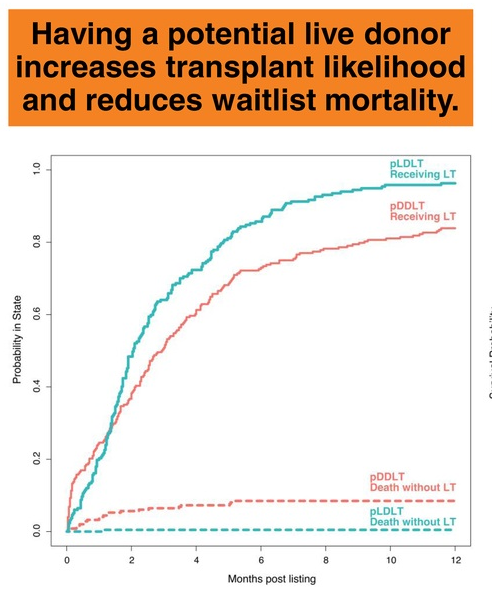
  • The pLDLT group had a higher likelihood of receiving a liver transplantation (adjusted HR: 1.38)  a lower risk of dying without a transplant (adjusted HR: 0.11)
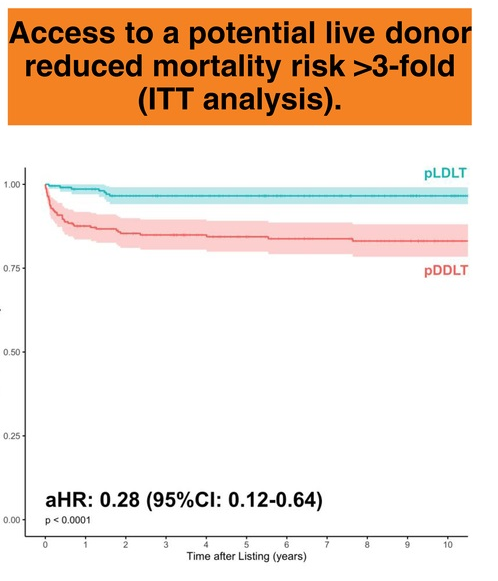
  • Survival rates from the time of listing were significantly better in the pLDLT group compared to the pDDLT (on live donor) at 1—(98.6% vs. 87.6%), 5—(96.6% vs. 84.4%), and 10—(96.6% vs. 83.1%) years
  • Having a potential live donor was linked to a 72% reduction in mortality risk (adjusted HR: 0.28)
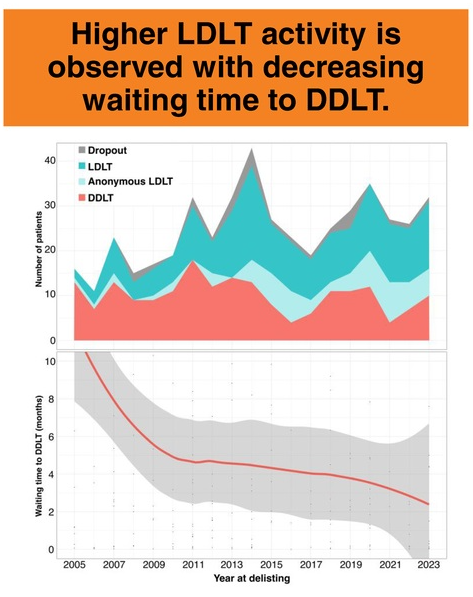
  • The waiting time for deceased donation shortened. This correlated with increased LDLT utilization, suggesting LDLT not only improved outcomes but also shortened wait times even for pDDLT patients
From the associated editorial:

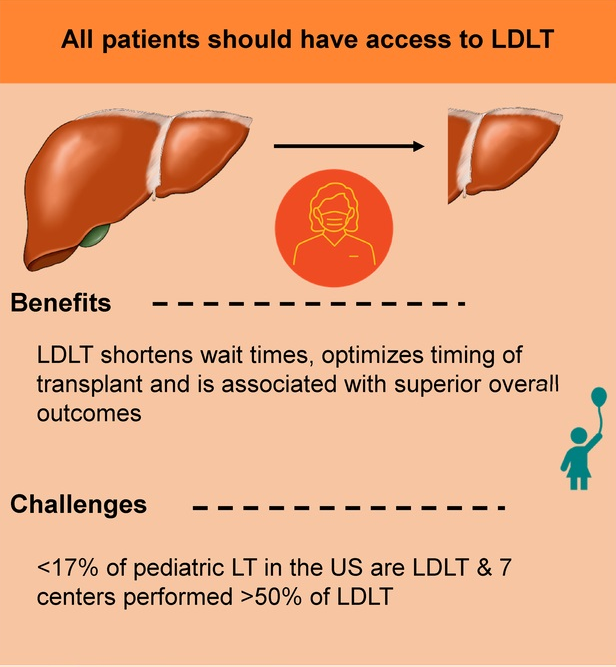
  • “LDLT continues to be underutilized in the United States with only 15% of all pediatric LTs being LDLTs.1… In 2024, only 6 pediatric centers across the United States performed 5 or more LDLTs.6…”
  • “Black and African-American and Hispanic candidates and those with public insurance are half as likely to undergo LDLT compared with Caucasian candidates and those with private insurance.7,8
  • “In a survey of over 200 parents of pediatric candidates and recipients of LT, only 72% reported knowing the steps to gain access to LDLT, and only 69% knew that donor costs were covered by the recipient’s insurance.7
  • The authors recommend collaboration between centers offering LDLT and those that don’t so that more patients could benefit

My take: More use of LDLT will result in better outcomes.

Related blog posts:

PRO and CON: All Pediatric Transplant Centers Should Have Living Donor Liver Transplant Option

S Zielsdorf et al. Liver Transplantation 2025; 31: 832-835. PRO: All pediatric transplant centers should have LDLT as an option

Zielsdorf et make a compelling argument that all liver transplant patients should have access to LDLT. By improving access to transplantation, transplant recipients are in better health at the time of LDLT and have better outcomes. This also results in fewer deaths on the waiting list, even for patients who do not receive a LDLT.

The authors note that “whether LDLT is a superior option in and of itself or is instead a proxy for higher volume and more experienced centers, with associated better outcomes, may not be entirely feasible to tease out from the data.”

N Galvan et al. Liver Transplantation 2025; 31: 836-839. CON: LDLT should not be a requirement for pediatric transplant programs

Galvan et al counter with their good statistics from their large-volume center in Houston. In their center, 91% of the liver transplants performed over a decade were size-matched, whole organ allografts. They attribute some of their success to their central U.S. location allowing them to access more donors without compromising warm ischemia time. Other factors that make LDLT less viable at their center include lack of Medicaid reimbursement for living donor operations (51% of their patients rely on public insurance) and concern that the donor is oftentimes a primary caregiver.

They note that most programs in U.S. “are low-volume centers, that is, <5 pediatric liver transplants/year, making up 75% of the pediatric centers in the country that account for 38.5% of the pediatric cases…Experience is garnered by volume, and so the question,…is whether it is worth consolidating small-volume programs.”

My take: LDLT is an important tool to improve outcomes. The ability to access LDLT and technical variant grafts could be life-saving for a patient. Thus, from a public policy standpoint, it would make more sense to have fewer high-volume liver transplant centers that offer these options. Centers, like Houston, which have improved organ availability/acceptance and main high-volume, are the exception and not the rule with regard to outcomes.

Related blog posts:

What Can Go Wrong with Living Liver Transplantation for the Donor

J Xiao et al. Liver Transplantation 2024; 30: 493-504 The incidence of adverse outcome in donors after living donor liver transplantation: A meta-analysis of 60,829 donors

This meta-analysis consisted of eighty-seven articles involving 60,829 living liver donors.

Key findings:

  • The overall pooled incidence of complications in LDLT donors was 24.7%
  • The incidence of minor complications was 17.3%
  • The incidence of major complications was 5.5%
  • The overall incidence of donor mortality was 0.06% in 49,027 individuals**. 
  • Psychological complications 7.6% were the most common complications among LDLT donors. This was followed by wound-related complications 5.2%
  • Table 2 (below) gives an extensive list of potential complications and their incidences in this cohort

**In the discussion, the authors note that “donor mortality is a devastating outcome in LDLT…Our study found that Asian countries reported a lower rate…For example, in Japan, the rate of donor mortality was 0.3 deaths per 1000 donors, while in the United States and Europe, donor mortality rates were 1.7 and 2.3 deaths per 1000 donors, respectively. While this observation may be attributed to greater experience in LDLT in Asian centers, it is also possible that underreporting in Asian centers might play a role. Mortality in donors…may result in the suspension or termination of an LDLT program.”

My take: Even with potential underreporting, this study highlights the very real risks associated with trying to save a life via LDLT.

Related blog posts: