Exploring Walgreens’ Collapse: The Role of PBMs

This newsletter explains why Walgreens is collapsing. My concern is that even a company as big as Walgreens had hardly any control over the declining reimbursements for their pharmaceutical sales. They had to accept the reimbursement due to a lack of leverage related to the consolidation of insurance companies and pharmacy benefit managers (PBMs). Without intervention to reverse the ongoing consolidation of these companies (as well as hospitals), patients will face fewer choices and higher costs. Physician groups will face existential business threats.

Here’s an excerpt from the newsletter:

Walgreens is America’s second-largest drug store chain, and has been a public company for more than 100 years… it has closed a thousand stores since 2018, and plans to shut 1,200 more this year…

The real reason Walgreens, and the pharmacy business in general, is dying, is because of a failure to enforce antitrust laws against unfair business methods and illegal mergers…Moreover, even today, the other financial numbers from Walgreens aren’t bad. Sales aren’t going gangbusters, but the number is basically increasing, and so are the number of 30-day prescriptions, even though they’ve cut the number of stores every year since 2017…

But in its main line of business – pharmaceuticals – Walgreens doesn’t set prices. Insurance companies do. And there’s the rub…Walgreens gets a set reimbursement from that consumer’s insurance company for that medication. How much does it get? Well, those insurance company’s contract with what’s called pharmacy benefit managers (PBMs) to manage negotiations with pharmacies…

Theoretically, both sides have some leverage in this negotiation. If a pharmacy chooses not to accept the prices and terms offered by those PBMs, then consumers who have an insurance company that uses that PBM just won’t go there…Pricing wasn’t a big problem for Walgreens when there were lots of PBMs, because it had the ability to say no if the deal was unreasonable, and still maintain a flow of customers…Today, there are really only three PBMs – Express Scripts, Caremark and OptumRx – serving 80% of customers…

In 2015, the big three, with their market power, began lowering reimbursement rates on pharmacies and charging a host of new fees…

PBMs, however, are engaged in a sort of industry-specific arson. And we can see this dynamic by looking at independent pharmacies writ large, nearly one in three of whom have closed in the last ten years. Today, 46% of U.S. counties now have pharmacy deserts, meaning no pharmacies at all…

326 pharmacies have closed since December of 2024. Why is that month significant? Well, that’s the month Elon Musk tanked legislation to address some of the monopolistic squeezing that PBMs are putting on pharmacies and consumers.

Related explanation of PBMs (Dr.Glaucomflecken): The Middlemen of Healthcare (includes useful organizational flowchart)

Related blog posts:

Islands/Karsts in the Andaman Sea
Bangkok Canal

Delays by Insurance Companies Result in Worse Outcomes for Children with Inflammatory Bowel Disease

Briefly noted: Brad D. Constant MD, MSCSJeremy Adler MD, MScBenjamin D. Gold MD, et al. JPGN Reports. 2025;1–11. Open Access! National perspectives of barriers by insurance and pharmacy benefit managers in pediatric inflammatory bowel disease

Key findings:

  • In this sample of 113 pediatric patients with IBD, 77% of initial denials for biologic therapy were ultimately approved.
  • The median time to receiving medication was 18 days, with administrative time (prior authorization and appeal) requiring a median of 180 min.
  • More than half (60%) of patients experienced adverse outcomes or worsened quality of life due to delays in treatment.

My take (borrowed in part from authors): “Barriers to treatment by payors, of which 77% are ultimately approved, result in substantive treatment delay, patient harm, and hospitalization.” While 18 days (or more) may not seem like a lot, it is when you know the right therapy at the outset and delays lead to suffering and worsened outcomes. In addition, the insurance companies and PBMs (pharmacy benefit managers) know that exhausting valuable physician/office staff time is a disincentive. It makes physicians determine whether it is worth the fight.

Related blog posts:

Wat Arun (Temple of Dawn), Bangkok

“Denials, Dilly-dallying and Despair”

Knik River Glacier, AK

SA Kahn, A Bousvaros. JPGN 2022; 75: 418-422. Denials, Dilly-dallying, and Despair: Navigating the Insurance Labyrinth to Obtain Medically Necessary Medications for Pediatric Inflammatory Bowel Disease Patients

This is a very useful review article detailing efforts of insurance companies and pharmacy benefit managers to create hurdles to try to limit the utilization of expensive new medications and how physicians can respond on behalf of their patients.

Key points:

  • Pharmacy Benefit Managers: “Typically, third-party payers utilize a pharmacy benefit manager (PBM, middleman) to determine whether a drug will be included in their formulary. In the United States, PBMs include Express Scripts, CVS Caremark, or Optum…[these three] control 89% of the market…these companies restrict access to costly medications and generate a profit for themselves.”
  • Lack of FDA Pediatric Indication: “In pediatrics, the average lag time from approval in adults is 9 years…At this time, none of the newer [IBD] agents such as certolizumab, golimumab, vedolizumab, tofacitinib, ustekinumab, and ozanimod are FDA approved for children.”
  • Dose Optimization: “TDM [therapeutic drug monitoring] and dose optimization often requires higher doses than those approved by the FDA…result in higher costs for the payer.”
  • Step Therapy: “A number of insurance companies follow a “step therapy” algorithm, otherwise known as “fail first formularies…cheaper medication is required before use of a more expensive medication.” Two problems with this approach: these policies in essence force clinicians to “prescribe medications they do not feel are appropriate” and “the majority of these policies are inconsistent with IBD treatment guidelines.”
  • Biosimilar/Non-medical switches: “We generally try to educate patients about the clinical data, and endorse switching to biosimilars without appealing the denial.”
  • Site of care: “The authors oppose insurance mandated home infusions and suggest appeal of “site of care” switches” due to safety concerns (increase ED visits, infusion reactions), lack of communication with home infusion providers (who often lack pediatric expertise), potential for critical labs not being drawn, and reports of increased loss of response with home infusions.
  • Peer-to-peer: “The “peer” may not have the appropriate background…Therefore, …it is very important to inform the peer that the discussion will be documented in the medical record. The clinician should ask for the reviewer’s credentials, specialty, and employer (insurance company, pharmacy benefit manager, or third-party review company).”
  • Next Steps: beyond appeal letters (templates at NASPGHAN & CCFA) and peer-to-peer discussions, next steps include an internal appeal (patient files a formal grievance with insurance provider) or external appeal (State Insurance Commissioner). In addition, treatment can be started in the hospital if there are delays in approvals. Though, this could result in the hospital ‘eating’ the cost, the hospital has extensive resources to advocate for coverage and can utilize charitable funds if needed.

My personal experience with appeals:

  • For appeal letters, besides including important clinical details, I always try to engage a reviewer’s humanity by explaining how important this approval is for the health of this young boy/girl who faces a lifelong serious illness.
  • Most peer-to-peer calls go well but tend to be inconvenient. Lately, I have had several “peer-to-peer” calls with pharmacists who are not authorized to approve the treatment and insist that I schedule a 2nd call with another “peer.”
  • Filing a complaint with the State Insurance Commissioner can be very helpful in getting a quick response. In Georgia: Consumer Complaints. It is important to keep the family informed about the status of authorization. A few families have been more successful/persistent at navigating this process than those with years of experience.

My take: This is a helpful and timely article. Trying to quickly get medications authorized is needed to avoid delays in patient care that could result in harm.

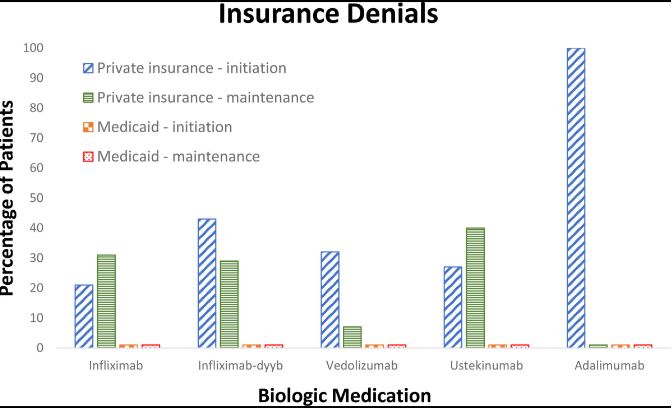
Related article: CA Lepus, JS Hyams. JPGN Reports. 2022; doi: 10.1097/PG9.0000000000000215. Open Access! Barriers From Third-Party Payers to Biologic Use in Pediatric Inflammatory Bowel Disease This study prospectively identified pediatric patients with IBD who were started on a biologic medication at our institution, and third-party payer decisions were recorded:

  • “The average time between TPI (therapy plan initiation) and biologic initiation (first infusion) was 9.7 days (±3.7 days) for patients with Medicaid, 11.3 days (±5.2 days) for patients with private insurance who had approvals, and 18.8 days (±7.6 days) for patients with private insurance who initially had denials”
  • “Reasons for denial are generally for use of a specific off-label agent or dosing of an approved agent. These denials lead to delayed treatment, nonmedically sound changes in therapy, and increased administrative burden on providers.”
  • “Despite the growing body of literature supporting use of [proactive] TDM (therapeutic drug monitoring), third-party private payers customarily deny adjustments unless the patient is symptomatic, a situation that clinicians try to avoid.”

Related blog posts: