Meta-Analysis: PPIs Did Not Increase Risk of Cardiovascular Events

Briefly noted -thanks to Ben Gold for this reference

AD Mosholder et al. The American Journal of Gastroenterology 2025; 120(2):p 362-369, Proton-Pump Inhibitors and Cardiovascular Adverse Events: A Meta-Analysis of Randomized Controlled Trials

Background: “Protopathic bias may result from the use of PPIs for cardiac symptoms mistaken for gastrointestinal symptoms (e.g. heartburn), producing a spurious association between cardiac events and PPI use. In addition, some cardiovascular risk factors may be more prevalent among users of PPIs eg. smoking, obesity) but may not be well captured in observational data sets, resulting in confounding.”

Methods: This meta-analysis included randomized trials with at least 100 subjects, treatment duration >30 days, and a non-PPI comparator (active or placebo). In total, this study examined 164 trials including 52 trials with PPI (n=14,998) vs placebo (n=8,323), 61 trials with PPI (n=12,505) vs any active comparator (n=8,566), and 51 trials with PPI (n=9,430) vs H2 receptor antagonist (n=6,050).

Key finding:

  • Cardiovascular outcomes were infrequent in randomized trials of PPIs, and our primary analysis found no overall association (summary incident rate ratio, MACE+ events, PPI:placebo, 0.72)

My take: This study found no clear association of cardiovascular events with PPI treatment.

Related blog posts:

Andaman Sea, Thailand

How a Study on Stress Ulcers in the PICU Can Change Clinical Practice

D Cook et al. NEJM 2024; 391: 9-20. Stress Ulcer Prophylaxis during Invasive Mechanical Ventilation

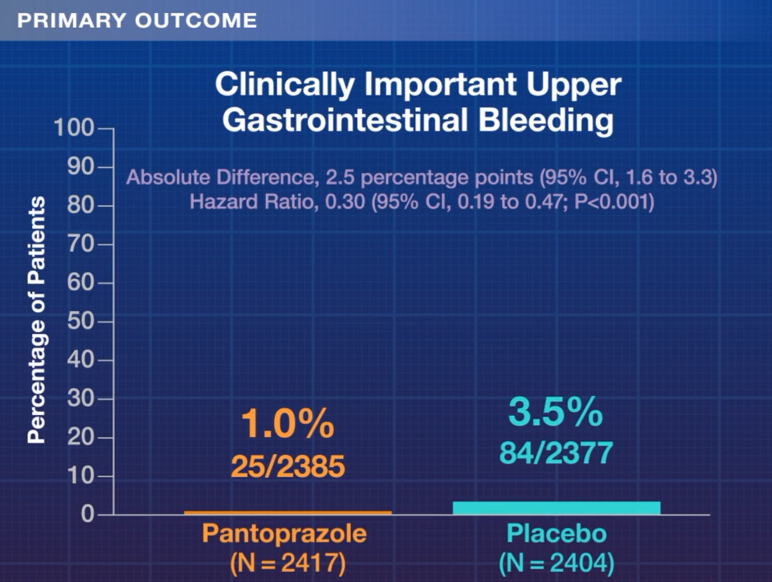
This  international, randomized trial assigned critically ill adults (n=4821) who were undergoing invasive ventilation to receive intravenous pantoprazole (at a dose of 40 mg daily) or matching placebo. Both groups included ~22% who had had PPIs prior to hospitalization. The primary efficacy outcome was clinically important upper gastrointestinal bleeding, identified locally as overt gastrointestinal bleeding with evidence of hemodynamic compromise or leading to therapeutic interventions in the ICU (or resulted in readmission to the ICU during the index hospital stay) up to 90 days after randomization.

Key findings:

  • Clinically important upper gastrointestinal bleeding occurred in 25 of 2385 patients (1.0%) receiving pantoprazole and in 84 of 2377 patients (3.5%) receiving placebo (hazard ratio, 0.30;  P<0.001)
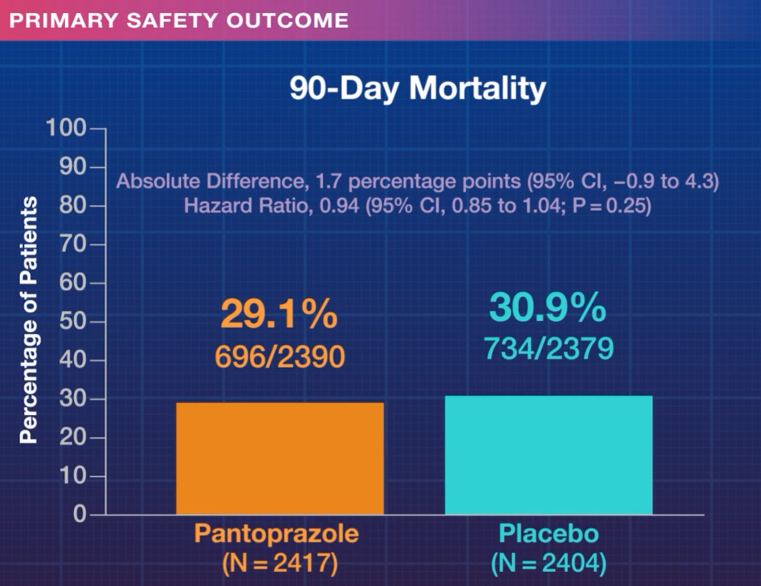
  • At 90 days, death was reported in 696 of 2390 patients (29.1%) in the pantoprazole group and in 734 of 2379 patients (30.9%) in the placebo group (hazard ratio, 0.94; P=0.25)
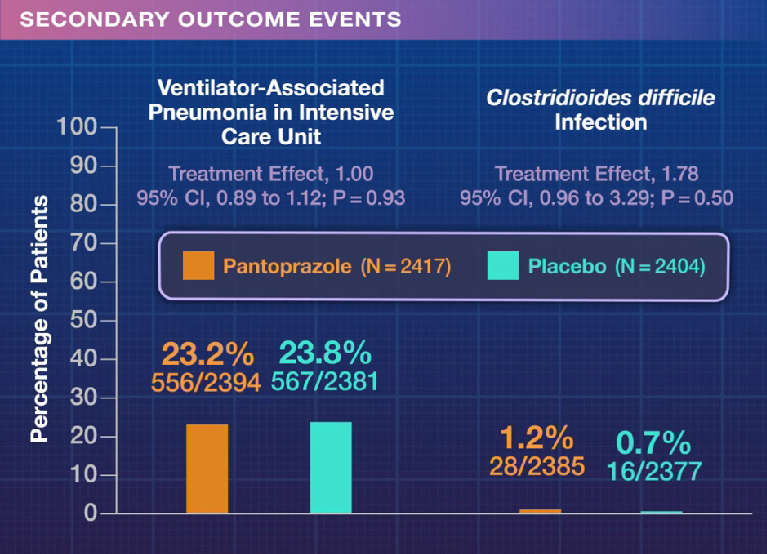
  • PPI-treated patients had similar rates of ventilator-associated pneumonia and C diff infection

In the associated editorial, (SM Brown. NEJM 2024; 391: 78-79) noted that “two previous trials, SUP-ICU1 and the cluster-randomized PEPTIC2 (which compared proton-pump inhibitors with placebo and H2-receptor blockade, respectively), suggested that the effects on mortality may differ according to patients’ disease severity — and that the drugs were potentially less safe in more severely ill patients.”

“Proton-pump inhibitors slightly but significantly decrease the risk of important gastrointestinal bleeding and have a decent chance of slightly decreasing mortality in less severely ill patients during mechanical ventilation. Moreover, we can be certain that proton-pump inhibitors do not decrease — and may slightly increase — mortality in severely ill patients…For sicker patients, I would probably reserve the use of proton-pump inhibitors for those who are being treated with antiplatelet agents, especially in the presence of therapeutic anticoagulants.” 

My take: This study and editorial helps provides insight into the narrow path of benefit that PPIs may provide for ventilated adults in the ICU. This study reinforces my view that there are few circumstances where adding empiric PPIs in children would be beneficial. Children are less likely to have significant GI bleeding than adults and have fewer comorbidities. Thus, PPIs in pediatrics need to be used mainly in the context of active GI bleeding and in children needing treatment for specific etiologies. PPIs have low value in most children as prophylaxis (e.g. children with IBD receiving steroids).

Related blog posts:

Disclaimer: This blog, gutsandgrowth, assumes no responsibility for any use or operation of any method, product, instruction, concept or idea contained in the material herein or for any injury or damage to persons or property (whether products liability, negligence or otherwise) resulting from such use or operation. These blog posts are for educational purposes only. Specific dosing of medications (along with potential adverse effects) should be confirmed by prescribing physician.  Because of rapid advances in the medical sciences, the gutsandgrowth blog cautions that independent verification should be made of diagnosis and drug dosages. The reader is solely responsible for the conduct of any suggested test or procedure.  This content is not a substitute for medical advice, diagnosis or treatment provided by a qualified healthcare provider. Always seek the advice of your physician or other qualified health provider with any questions you may have regarding a condition.

PPIs: Good News on Safety (Part 2)

Earlier this year, I noted that a recent publication provided reassurance on PPI safety. (related blog post: PPIs: Good News on Safety).  In the journal issue with the printed version, a detailed editorial provides useful context.

DA Corley. Full Text Link:Safety and Complications of Long-Term Proton Pump Inhibitor Therapy: Getting Closer to the Truth” Gastroenterol 2019; 157: 604:-7.

The Table 1 contrasts the useful information from this large double-blind randomized study and prior data/data quality.

The new study found NO ASSOCIATION between PPI use and kidney disease, dementia, bone fractures, myocardial infarction, pneumonia, or gastrointestinal malignancies.

An excerpt:

Recent publications have summarized both the evidence and evidence-based approaches toward teasing out whether proton pump inhibitors cause certain diseases or are only associated with them through other pathways (e.g., confounding).  Helpful strategies include using the classic criteria for evaluating causation such as the:

  • strength of the association
  • consistency of the findings between studies
  • specificity when an outcome happens almost exclusively from a specific exposure
  • temporality such that the exposure comes before the outcome
  • biological gradient whereby higher exposure doses or longer durations increase risk of the outcome
  • biological plausibility for the proposed association
  • coherence such as between observed effects and known biology of disease
  • experiment such as randomized trials that decrease confounding; and
  • analogy to similar exposure–disease associations known to be causal…

This massive undertaking included >17,000 patients from 33 countries who were randomized to pantoprazole versus placebo, followed for a median of approximately 3 years, and evaluated prospectively for potential complications. The study found an increased risk of enteric infections among pantoprazole users, a result found in both the intention-to-treat and “as-treated” analyses, which excluded people who stopped their medications. This association makes sense—stomach acid markedly decreases bacterial load in food, so decreasing stomach acid may increase the risk of enteric bacterial infections. The authors found no increased risk for several of the most feared associations previously reported, such as cardiovascular disease, kidney disease (directly measured using estimated glomerular filtration rate), dementia, pneumonia, fracture, and all-cause mortality.

My take: (borrowed from editorial): The current study would indicate, from the strongest study design available,… that there is an increased risk of gastrointestinal infections and no detectable excess risk for several other potentially important clinical events…Given known problems with overprescribing and overuse, patients and clinicians should maintain appropriate vigilance in prescribing acid suppression only to persons with defined indications and at the lowest effective dose and duration.

Lava Cave -near Bend, OR