How Procedure Volume Affects Pediatric Colonoscopy Success Rates

J Huang et al. J Pediatr Gastroenterol Nutr. 2025;81:1488–1495. Open Access! Numbers matter: How pediatric endoscopy quality varies with annual procedural volume

In this retrospective study with 985 ileocolonoscopies (2021-2024):

Methods:  “Quality indicators were compared across groups using Kruskal–Wallis analyses. Multivariate modeling was performed to identify variables predicting terminal ileal intubation and TIIR ≥ 85%.”

Key findings:

  • Overall ileal intubation rate (TIIR) and cecal intubation rate (CIR) were 86.3% and 91.6%, respectively
  • Annual procedure volume ( APV ≥ 40) was identified as predictive for TIIR ≥ 85% (p < 0.01)
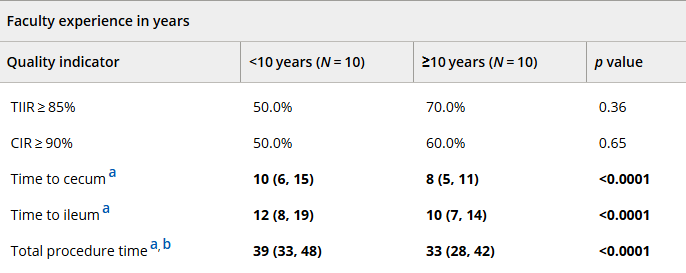
  • Faculty years’ experience (≥10 vs. <10 years) predicted shorter procedure duration (adjusted hazard ratio [confidence interval]: 1.40)
  • Adequate bowel prep was associated with higher TIIR (901% vs 76.7%), CIR (93.8% vs 86.0%) and shorter duration procedures (34 min vs 41 min)
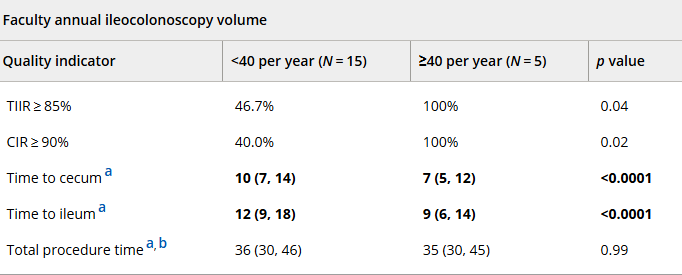
a Presented as median (IQR) in minutes. b Includes only 967 combined esophagogastroduodenoscopy/ileocolonoscopy procedures without multiservice involvement.
Bolded text and numbers reflect results demonstrating statistical significance

My take (borrowed in part from the authors): The authors state that “our findings suggest that a threshold of 40 annual procedures [ileocolonoscopies] is necessary to maintain high pediatric endoscopic quality.” While I agree that adequate procedural volume is helpful, there is a great deal of individual variation/ability. Particularly if the endoscopist has a lower procedural volume, metrics like ileal intubation rate can be useful to assure good quality.

Related blog posts:

PEnQuIN and Improving the Quality of Pediatric Endoscopy

Several articles in a recent JPGN supplement issue describe the efforts to develop quality standards and indicators for pediatric endoscopy. All of these articles are open access.

The overview article (CM Walsh et al. JPGN 2022;74: S3–S15) is the most important: Open Access: Overview of the Pediatric Endoscopy Quality Improvement Network Quality Standards and Indicators for Pediatric Endoscopy: A Joint NASPGHAN/ESPGHAN Guideline

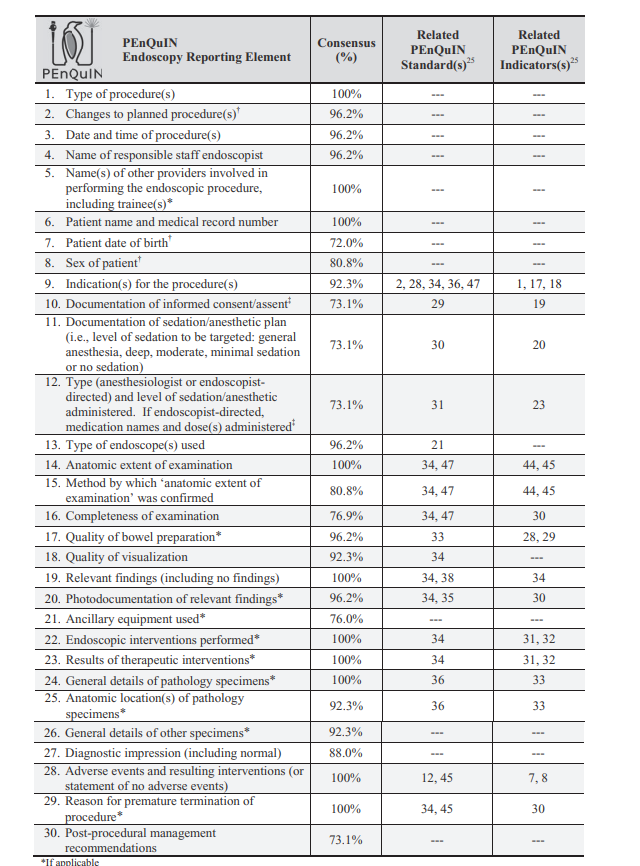
The reporting article (CM Walsh et al. JPGN 2022;74: S53–S62) lays out the details that should be included in an endoscopy procedure note: open access PDF: Pediatric Endoscopy Quality Improvement Network Pediatric Endoscopy Reporting Elements: A Joint NASPGHAN/ESPGHAN Guideline

The other articles:

JR Lightdale et al. JPGN 2022;74: S16–S29 Open Access: Pediatric Endoscopy Quality Improvement Network Quality Standards and Indicators for Pediatric Endoscopy Facilities: A Joint NASPGHAN/ESPGHAN Guideline

JR Lightdale et al. JPGN 2022;74: S30-S43 Open Access: Pediatric Endoscopy Quality Improvement Network Quality Standards and Indicators for Pediatric Endoscopic Procedures: A Joint NASPGHAN/ESPGHAN Guideline

CM Walsh et al. JPGN 2022;74: S44–S52. Open Access: Pediatric Endoscopy Quality Improvement Network Quality Standards and Indicators for Pediatric Endoscopists and Endoscopists in Training: A Joint NASPGHAN/ESPGHAN Guideline

My view: These detailed articles provide a good framework for improving pediatric endoscopy. After assuring that the facility and personnel are high quality, the pediatric endoscopist has the important responsibility of providing a high quality endoscopy. We need to strive to provide the best care for every single child entrusted in our care. In my view, the most important step is having an appropriate indication and despite guidelines, this remains highly subjective.

Related blog posts:

Doctor Scorecards: Affecting Care (but not in the way you think)

A recent perspective article (L Rosenbaum. NEJM 2015; 373: 1385-8) explains how the use of physician scorecards are negatively affecting patients and the pitfalls in their interpretation. Her article describes a situation, that is ‘not uncommon,’ in which a higher risk cardiology patient will not have a surgical consult for a few days because most surgeons “wouldn’t touch our patient with a 10-foot pole.”  In several states, the increase reports of cardiac surgery outcomes has resulted in surgeons avoiding the sickest patients. The author notes that transparency/public reporting needs to be balanced against the potential harms. Other key points:

  • The public reporting thus far has been deeply flawed, based on insurance claims that are “notoriously inaccurate.”  The reports have poor reliability, in part, due to too few surgeries to make accurate conclusions.
  • The public reports amount to “fear mongering” rather than the “professed commitment to protecting patients.”
  • “The key question, then, is less about transparency with regard to quality than it is about what constitutes quality in the first place.”
  • “The irony in hailing the scorecard as a victory for transparency is that its purported objectivity obscures its methodologic limitations.”

My take: While you are looking a surgeon’s scorecard, keep in mind, he/she may decide to not operate on you when he/she looks at your scorecard (of illness). Related blog posts:

Understanding the Problem Physicians Have With Retail Clinics

Two articles highlight the upside and downside of retail clinics.

  • Iglehart JK. NEJM 2015; 301-3
  • Chang JE et al. NEJM 2015; 382-8

Currently, there are ~1900 retail clinics with four main ‘players:’ CVS, Walgreens, Kroger, and Target.  However, Target has recently made a deal with CVS and Walmart is expanding into retail clinics as well.  Almost all of these clinics accept private insurance and medicare; growing numbers accept medicaid too.

Retail clinics offer a limited scope of care and typically are staffed by midlevel providers (nurse practitioners or physician assistants).  In contrast, urgent cares offer more complex services and typically are staffed by physicians.

Upside:

  • For consumers, the key advantages of retail clinics: lower costs with transparent pricing, convenience due to extended hours and locations, and often short wait times.

Downside:

  • Potential disruption in longitudinal care (“medical home”)

What about quality?

  • “Research has not found that retail clinics deliver poor quality care, overprescribe antibiotics, or adversely impact delivery of preventive care.”

Do Retail Clinics Enhance Access?

  • Yes but these clinics are disproportionately located in areas with relatively high income.  Nevertheless, “approximately 61% of retail-clinic visits and 37% of urgent care visits involve patients without a primary care provider.”

Patient navigation:

  • “One study …showed that patients did properly self-triage, with more than 88% of retail-clinic episodes resolved in one visit. Another study showed that 2.3% of retail-clinic patients were triaged to an emergency department or physician’s office.”

Why Would Physicians Oppose These Retail Clinics?

  • While primary care organizations have raised concerns about quality and continuity of care, a basic economic issue is likely at work as well.  “The current reimbursement system renders simple acute health problems high-margin work that can offset losses from treating more complex problems.

Bottomline: Retail clinics are filling a need for many patients in terms of cost and convenience for simple acute problems.

Related blog post: AAP -Behind the Scenes (Part 1)

Leek's Marina, Grand Tetons

Leek’s Marina, Grand Tetons