Medical Imaging of Children/Adolescents and Risk of Cancer (2025)

R Smith-Bindman et al. NEJM 2025; 393: 1269-1278. Medical Imaging and Pediatric and
Adolescent Hematologic Cancer Risk

Methods: This was a retrospective cohort of 3,724,623 children born between 1996 and
2016 in six U.S. health care systems and Ontario, Canada, until the earliest of cancer
or benign-tumor diagnosis, death, end of health care coverage, an age of 21 years, or December 31, 2017.

Key findings:

  • During 35,715,325 person-years of follow-up (mean, 10.1 years per person), 2961 hematologic cancers were diagnosed, primarily lymphoid cancers (2349 [79.3%]), myeloid cancers or acute leukemia (460 [15.5%]), and histiocytic- or dendritic-cell cancers
    (129 [4.4%]).
  • The excess cumulative incidence of hematologic cancers by 21 years of age among children exposed to at least 30 mGy (mean, 57 mGy) was 25.6 per 10,000
  • The authors estimated that 10.1% of hematologic cancers may have been attributable to radiation exposure from medical imaging, with higher risks from the higher-dose medical-imaging tests such as CT
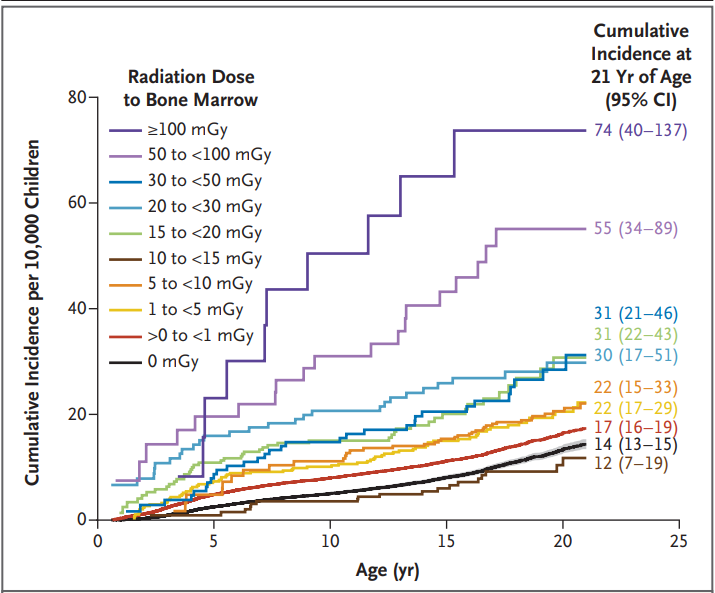
Cumulative Incidence of Hematologic Cancer According to Attained Age and
Radiation Dose to Bone Marrow among Children without Down’s Syndrome

Discussion Points:

  • “A 15-to-30-mGy exposure equivalent to one to two CT scans of the head was associated with an increased risk by a factor of 1.8”
  • “Although CT and other radiation-based imaging techniques may be lifesaving, our
    findings underscore the importance of carefully considering and minimizing radiation exposure during pediatric imaging to protect children’s long-term health”
  • “Research on Japanese atomic-bombing survivors showed that leukemia rates peaked 6 to 8 years after exposure, with excess risk lasting for more than five decades, particularly for acute myeloid leukemia”
  • This study tried to avoid concerns about reverse causation — in which imaging is performed because of existing cancer symptoms –by lagged exposures by 6 and 24 months
  • “The increasing use of low-value imaging in children and excessive radiation doses in CT are well documented…In many cases, reducing the imaging dose or substituting magnetic resonance imaging or ultrasonography may be more feasible than avoiding imaging altogether”

While the risks in aggregate appear quite substantial, the editorial (L Morton. NEJM 2025; 393; 1337-1339.Studying Cancer Risks Associated with Diagnostic Procedures –Interpret Wisely) makes the point that the risks for the individual are very small. “Fewer than 1% of youths in this study accumulated doses of 30 mGy or more from medical imaging and even at this exposure level, the excess cumulative incidence of hematologic cancers was low (25.6 per 10,000)…we need to ensure that all involved in medical imaging…wisely interpret the results…to understand the balance of the very small risks and the notable benefits of necessary imaging examinations to provide optimal patient care.”

My take: This study is a reminder to carefully evaluate the benefits, risks and alternatives when using ionizing radiation studies.

Related blog posts:

CT Imaging and Projected Cancer Risks: 2025 Analysis

Smith-Bindman R, Chu PW, Azman Firdaus H, et al.  JAMA Intern Med. Published online April 14, 2025. doi:10.1001/jamainternmed.2025.0505. Open Access! Projected Lifetime Cancer Risks From Current Computed Tomography Imaging

Methods: Lifetime radiation-induced cancer incidence and 90% uncertainty limits (UL) were estimated by age, sex, and CT category using National Cancer Institute software based on the National Research Council’s Biological Effects of Ionizing Radiation VII (BEIR VII) models and projected to the US population using scaled examination counts.

Key findings:

  • Ninety-three million CT examinations were performed in 61 510 000 patients in the United States in 2023, including an estimated 3,069,000 CTs (3.3%) in 2,570,000 children (4.2%) and 89,931,000 CTs (96.7%) in 58,940,000 adults (95.8%) 
  • In this risk model, the 93 million CT examinations performed in 62 million patients in 2023 were projected to result in approximately 103,000 future cancers
  • Estimated radiation-induced cancer risks were higher in children and adolescents, yet higher CT utilization in adults accounted for most (93,000) radiation-induced cancers
  • “If current practices persist, CT-associated cancer could eventually account for 5% of all new cancer diagnoses annually”

Discussion: “The projected number of radiation-induced cancers in this analysis is 3 to 4 times higher than the earlier assessment of CT exposure for several reasons”

  • CT use is 30% higher today than in 2007
  • Dose modeling in this study accounted for multiphase scanning
  • Substantially higher organ doses in this study were reconstructed using newer dosimetry methods
  • More granular CT categories reflecting imaging indications that have important dose differences
  • “Many of the model assumptions were conservative” and could underestimate the risk

My take (borrowed from authors): “Even very small cancer risks will lead to a significant number of future cancers given the tremendous volume of CT use in the United States…CT could be responsible for approximately 5% of cancers diagnosed each year. This would place CT on par with other significant risk factors, such as alcohol consumption (5.4%) and excess body weight (7.6%)”

Related blog posts:

Kiawah Beach, SC

Risk from CT scans -Best Data to Date

Thanks to Mike Hart for forwarding the following reference:

BMJ 2013; 346: f2360 doi: 10.1136/bmj.f2360

This study examines the risk of cancer among a cohort of nearly 11 million Australian children and adolescents since 1985.  Among this cohort, 680,000 (6.2%) pediatric patients were identified who had been exposed to a CT scan. This study was accomplished by analyzing CT scans funded by the Australian Medicare system which provides health services for all Australians.

One of the remarkable aspects of this study was the efforts the authors took to exclude reverse causation.  First of all, the data was analyzed with an exclusion period of a year “because of the possibility that the scan was part of the cancer diagnostic procedure…but we repeated the main analyses with lag periods of five and 10 years to explore the possibility of reverse causation.”  In addition, the authors analyzed all non-brain cancers in patients who had had cranial CT scans.  Despite all of the parameters, an increased risk of cancer was maintained among those who had prior CT and the risk was heightened by obtaining studies at younger ages and by having increased number of CT scans.

Key findings:

  • Almost 60% of CT scans were of the brain. Only 5% of CT scans were of abdomen or pelvis.
  • CT scan incidence increased over time.  Between 1985-89, 95,249 (14%) CT scans were ordered.  Whereas between 2000-2005, 266,971 (39%) were ordered.
  • The average CT dose was about 4.5 mSv per scan.
  • The increased relative risk (IRR) for brain cancers after a scan to a site other than the brain was 1.51 (confidence interval 1.19-1.91).
  • Each seivert (Sv) of effective dose was associated with 0.125 cancers; thus, by 2007, with average followup of 9.5 years, one cancer resulted from every 1800 CT scans.  This number is likely to climb with more time.
  • Among brain CT scans, the numbers are trickier due to the possibility of slow-growing tumors (which could trigger symptoms for imaging and still be difficult to detect).  However, up to one excess brain cancer would occur for every 4000 brain scans.
  • All solid cancers IRR 1.25, All lymphoid/hematologic cancers IRR 1.19, Brain cancers after CT IRR 2.44, Brain cancer after other scans 1.51.

There are several limitations to the study including the difficulty of knowing specific doses of radiation at various CT scanners, the possibility of CT scans funded outside the Australian Medicare system, or obtaining screening scans due to precancerous genetic conditions. Nevertheless, the magnitude of the cohort in this study along with its general agreement with a number of other studies provide ample evidence that these risks are real.

Take-home point: While CT scans have the potential for great benefits, they increase the risk of developing cancer; in many cases, an MRI or an ultrasound can provide similar information without this risk.  In this study, for lag (exclusion) period of one, five, and 10 years, the incidence rate for all cancers combined increased by 24%, 21%, and 18% respectively in the CT exposed group.  Eventual lifetime risk is likely to climb with longer followup.

Related blog posts:

“Beyond the bombs: cancer risks of low-dose medical radiation”

The catchy title comes from a Lancet editorial (Lancet 2012; 380: 455-57); the related article (Lancet 2012; 380: 499-505) details the radiation risk posed by CT scans.

While concerns about imaging radiation exposure have become commonplace, the evidence for the risk has been more in the theoretical realm rather than proven.  That is, the risk projection models were based on studies of survivors of the atomic bombs in Japan.

The retrospective study in Lancet examines 178,604 children who underwent CT between 1985-2002.  Typical followup was 10 years (maximum followup of 23 years).  None of these children had cancer at the time of CT.  The study determined the number of leukemias that developed more than 2 years following CT and brain tumors which occurred more than 5 years after CT.  This lag time was done to avoid any confounding of cancer that may have been present and not detected at time of CT.

Key results:

  • 74 patients developed leukemia and 135 developed brain tumors.  There was a dose-related risk: 0.036/mGy for leukemia and 0.023/mGy for brain tumors.  Thus, the relative risk of leukemia in patients who had at least 30 mGy was 3.18; whereas, brain cancer risk for a cumulative dose of > 50 mGy was 2.82. [1 mGy=1 mSv]
  • If typical doses of CT administered, 2-3 head CTs could triple the risk of a brain tumor and 5-10 head CTs could triple the risk of leukemia.
  • The absolute risk remains low.  In patients less than 10 years, one excess case of leukemia and one brain tumor would be expected for 10,000 head CT scans.

Goal with CT scans:

  1. ALARA: as low as reasonably achievable –for every study.  Newer protocols allow lower radiation doses while preserving good image quality.
  2. Think carefully about each CT.  It is estimated that 20-50% of CTs could be replaced with another type of imaging or not done at all.

For the skeptics about the risk of CT scans, the editorialist concludes that this study confirms “that CT scans almost certainly produce a small cancer risk…we must redouble our efforts to justify and optimize every CT scan.”

Related blog entries:

How much radiation from your CT scanner? | gutsandgrowth

More imaging needed? | gutsandgrowth

Magnetic resonance enterography for Crohn’s disease 

Additional references:

  • -AJR 2001; 176: 289-96. Estimated risks of radiation-induced fatal cancer from pediatric CT
  • -Br J Radiol 2012; 85: 523-28.  Justification of CTs -some not needed
  • -AJR 2010; 194: 868-73.  Lower CT radiation doses in pediatric patients.  ‘Image gently’
  • -Arch Intern Med 2009; 169: 2078-86.

How much radiation from your CT scanner?

Our children’s hospital, along with many others, has made a concerted effort to reduce radiation exposure by adjusting CT scan settings.  Even a single abdominal CT scan may confer a small but real risk of developing cancer.  The trade-off with low-dose CT techniques has been a concern about poor image quality.  New research indicates that low-dose CT scan is not inferior to standard-dose CT with respect to detecting appendicitis (NEJM 2012; 366: 1596-605).

This single-center study examined 441 patients assigned in a single-blind fashion to low-dose CT (median dose: 116 mGy-cm) in comparison to 447 patients receiving a standard-dose CT (median dose: 521 mGy-cm).  All patients had CT for suspected appendicitis.  The negative appendectomy rate was 3.5% in the low-dose group and 3.2% in the standard-dose group.  There was no significant difference in appendiceal perforation rate or proportion of patients needing more imaging.

How much radiation do your patients receive with a CT scan?

Related newspaper article:

FDA issues guidelines to lower radiation exposure in children:

http://www.ajc.com/health/child-sizing-radiation-doses-1434081.html

Related posts:

Magnetic resonance enterography for Crohn’s disease

More imaging needed?

Additional references:

  • -NEJM 2010; 363: 1, 4. Safety of CT.  Can have overdose of radiation and even standard doses could cause complications.  Also, a big issue is downstream unnecessary testing due to incidental findings.
  • -JPGN 2011; 52: 280. Documents high exposure to radiation in large IBD pediatric cohort.
  • -J Clin Gastroenterol 2011; 45: 34-39. High levels of ionizing radiation thru CT scan in pts with IBD.
  • -Pediatr Radiology 2002; 32: 217-313. Minimizing radiation exposure, risk/benefit of CT. Proceedings from conference.
  • -Pediatr Radiology 2002; 32: 700-706. Risk of CT for young child: ~ 1 in 1000 risk of fatal cancer later in life.