Long-term Efficacy and Safety of Upadacitinib for Ulcerative Colitis

R Panaccione et al. The Lancet Gastroenterology & Hepatology. 2025; 10: 507 – 519. Open Access! Long-term efficacy and safety of upadacitinib in patients with moderately to severely active ulcerative colitis: an interim analysis of the phase 3 U-ACTIVATE long-term extension study

Methods: U-ACTIVATE is an ongoing, 288-week, phase 3, long-term extension study that enrolled patients (n=369) aged 16–75 years with a confirmed diagnosis of moderately to severely active ulcerative colitis; patients who had a clinical response in the induction studies were eligible to enter the U-ACHIEVE maintenance study. Patients not in clinical remission originally randomly assigned to upadacitinib 15 mg were eligible to escalate to upadacitinib 30 mg, those originally randomly assigned to upadacitinib 30 mg continued on upadacitinib 30 mg, and those originally assigned to placebo were eligible to escalate to upadacitinib 15 mg in a masked way

Key findings:

  • In the as-observed population, 84 (71%) of 118 patients receiving upadacitinib 15 mg were in clinical remission at week 48, as were 130 (67%) of 193 receiving upadacitinib 30 mg
  • By week 96, 69 (76%) of 91 patients receiving upadacitinib 15 mg and 104 (74%) of 141 of those receiving upadacitinib 30 mg were in clinical remission
  • The most common adverse events of special interest were hepatic disorder, lymphopenia, creatine phosphokinase elevation, serious infection, neutropenia, and herpes zoster
mNRI indicates modified non-responder imputation analysis response

My take: This study shows a good durable (3 year) response to upadacitinib treatment with both 15 mg and 30 mg dosing.

Related blog posts:

    Upadacitinib Works Quickly and with High Response

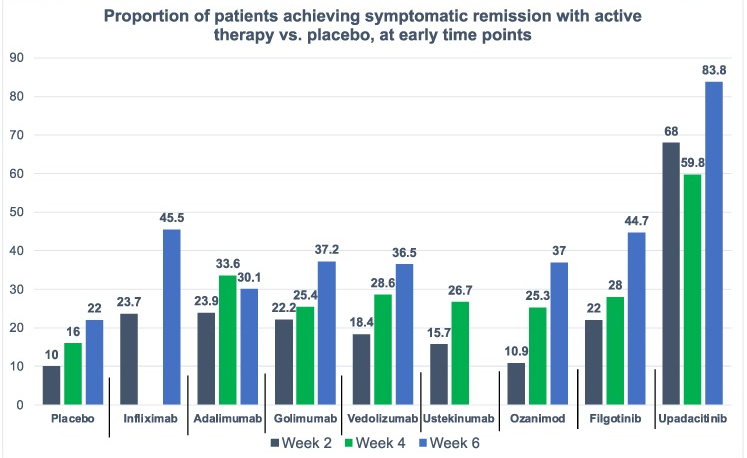
    D Ahuja et al. Am J Gastroenterol 2023; Open Access! Comparative Speed of Early Symptomatic Remission With Advanced Therapies for Moderate-to-Severe Ulcerative Colitis: A Systematic Review and Network Meta-Analysis Thanks to Ben Gold for this article.

    Key findings:

    • On network meta-analysis of 14 RCTs, upadacitinib was more effective than all agents in achieving symptomatic remission at weeks 2 (range of RR, 2.85–6.27), 4 (range of RR, 1.78–2.37), and 6 (range of RR, 1.84–2.79). 

    This study has a number of limitations including the following:

    • Potential differences in patient-level characteristics between these trials
    • Symptoms may not always correlate with endoscopic findings
    • Data from some medications (eg. tofacitinib) were incomplete and not included

    My take: This study indicates an impressive early symptomatic response to upadacitinib compared to other agents for ulcerative colitis.

    Related blog posts:

    Landmark Study: Oral Biologic for Crohn’s –Upadacitinib

    EV Loftus et al. N Engl J Med 2023; 388:1966-1980. Upadacitinib Induction and Maintenance Therapy for Crohn’s Disease

    This study is the basis for the FDA’s approval of updacitnib (Rinvoq) for Crohn’s disease in adults: New FDA Rinvoq (upadacitinib) Indication: Oral Treatment For Crohn’s

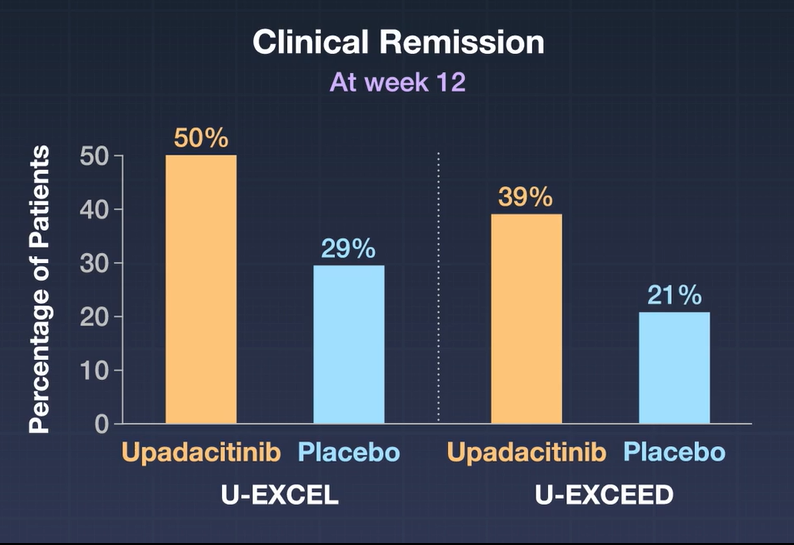
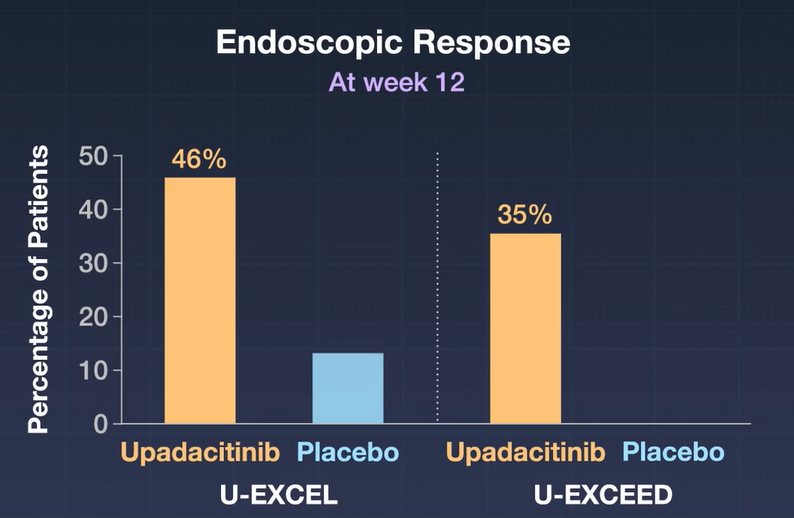
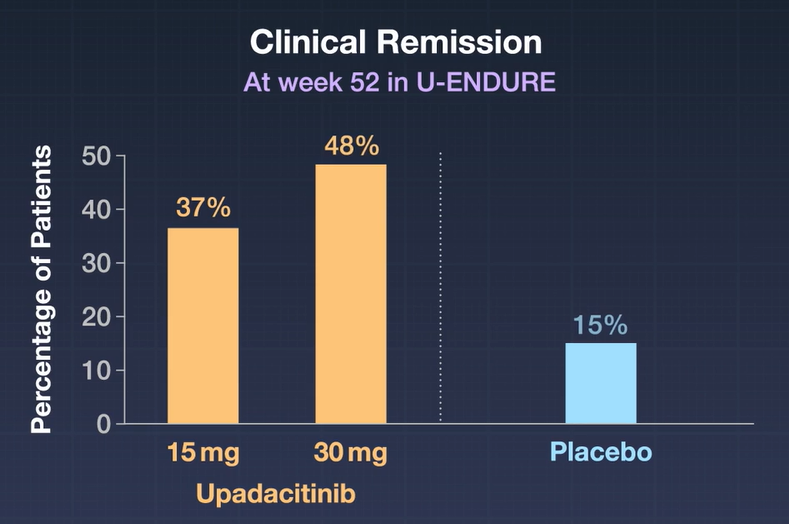
    This publication describes the results of two multicenter, double-blind, randomized, placebo-controlled induction trials (n=1021 adults,U-EXCEL, U-ECEED) and one maintenance trial (n=502, U-ENDURE) with Upadacitinib (Rinvoq). The induction trials involved an early mandatory glucocorticoid taper.

    Key findings:

    • A significantly higher percentage of patients who received 45-mg upadacitinib than those who received placebo had clinical remission (in U-EXCEL, 49.5% vs. 29.1%; in U-EXCEED, 38.9% vs. 21.1%) and an endoscopic response (in U-EXCEL, 45.5% vs. 13.1%; in U-EXCEED, 34.6% vs. 3.5%) (P<0.001 for all comparisons).
    • There was a rapid onset of action with a difference in clinical response compared to placebo at 2 weeks
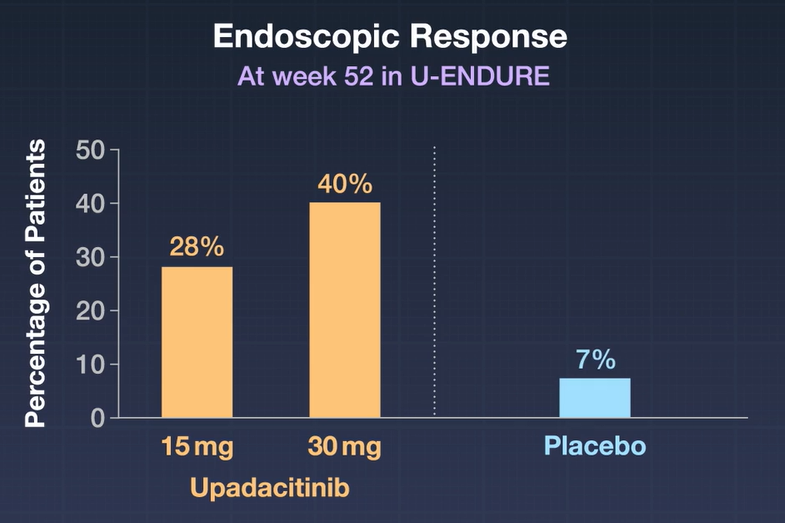
    • Maintenance Trial of clinical responders: At week 52 in U-ENDURE, a higher percentage of patients had clinical remission with 15-mg upadacitinib (37.3%) or 30-mg upadacitinib (47.6%) than with placebo (15.1%), and a higher percentage had an endoscopic response with 15-mg upadacitinib (27.6%) or 30-mg upadacitinib (40.1%) than with placebo (7.3%) (P<0.001 for all comparisons).
    • Adverse effects included gastrointestinal perforations (6 in study medication, 1 in placebo), neutropenia in up to 2.6%, and increased Herpes Zoster infections in patients receiving study medication (1.5% to 3%).

    A good commentary of this study is in the same issue: M Abreu. N Engl J Med 2023; 388:2005-2009. It is noted that upadacitinib showed a good response even though a different JAK inhibitor, tofacitinib, had disappointing results for patients with Crohn’s disease. Other points:

    • “It is hard to compare findings across studies because of differences in the characteristics of patients and end points. That being said, the incidences of clinical remission observed by Loftus et al. were greater than those observed in most studies of biologic drugs to treat Crohn’s disease. Moreover, upadacitinib was more likely than placebo to resolve extraintestinal manifestations.”
    • “They did not find evidence of cardiovascular or thromboembolic complications, which were previously observed in patients with rheumatoid arthritis treated with tofacitinib and which led to a black-box warning.10 However, the treatment of greater numbers of patients for a longer duration will be required to determine whether upadacitinib is asssociated with a risk of such complications.”
    • “Among the most common upadacitinib-specific adverse events were anemia [6.9%] and acne [6.3%]. The increase in anemia may be due to off-target effects of upadacitinib on erythropoietin signaling through JAK2.”

    My take: This is great news for patients with Crohn’s disease. In addition to having a new option for refractory disease, this option does not require IV administration. When will pediatric data be available?

    New FDA Rinvoq (upadacitinib) Indication: Oral Treatment For Crohn’s

    5/18/23: FDA approves first oral treatment for moderately to severely active Crohn’s disease

    “Patients should start with 45 mg of Rinvoq once daily for 12 weeks. Following the 12-week period, the recommended maintenance dosage is 15 mg once a day. A maintenance dosage of 30 mg once daily can be considered for patients with refractory, severe, or extensive Crohn’s disease.”

    “The most common side effects of Rinvoq as indicated for Crohn’s disease are upper respiratory tract infections, anemia, fever, acne, herpes zoster, and headache…. Serious infections, mortality, malignancy, major adverse cardiovascular events, and thrombosis have occurred with JAK inhibitors such as Rinvoq.”

    Tucson Botanical Gardens