Virtually everyday pediatric gastroenterologists like myself see children with constipation problems; managing constipation is often a Sisyphean task. Recent articles (JPGN 2011; 53: S2: 49, 55) reiterate what all pediatric gastroenterologists already know –constipation is almost always a management problem and only rarely a diagnostic problem. Rarely do children with constipation need diagnostic tests. These articles recommend testing only if alarm features are present, including the following:
- Delayed meconium passage at birth
- Bilious vomiting
- Bloody stools
- Fever
- Bladder disorders
- Poor response to conventional treatment
- Abnormal exam
Additionally, these articles state that about 25% of functional constipation problems may persist into adulthood. Among the patients who respond poorly to treatment, constipation, especially if associated with soiling (aka. encopresis), can be very detrimental for obvious social reasons. This group of patients can be very challenging. Many of the patients do not perceive the problem to be as severe as their parents and may be unwilling to work on fixing the problem.
Clinical experience has been that younger children respond better than older children. Perhaps, this is due to a greater ease of imposing a specific treatment plan in younger children along with the fact that the physiological and behavioral changes associated with chronic constipation are not as well-established.
Other pertinent aspects of treatment and diagnosis include the following:
Abdominal xrays are not very helpful (JPGN 2010; 51: 155.) and should mainly be reserved for those in whom a rectal examination cannot adequately be performed, such as very uncooperative patients, and in patients with concerns about abuse (or concerns about psychologic impact of exam).
Also, despite earlier reports of potential sacral abnormalities in children with chronic constipation or non-retentive soiling, a fairly large prospective MRI study (J Pediatr 2010; 156: 461-5) (n=158) found that only 3% had lumbar sacral abnormalities and none required neurosurgery (1 with spina bifida occulta, 3 with terminal filum lipomas).
In addition to the scholarly references below, some useful practical sources of information can be identified by going to my office website, http://www.gicareforkids.com and clicking “constipation.”
Additional references:
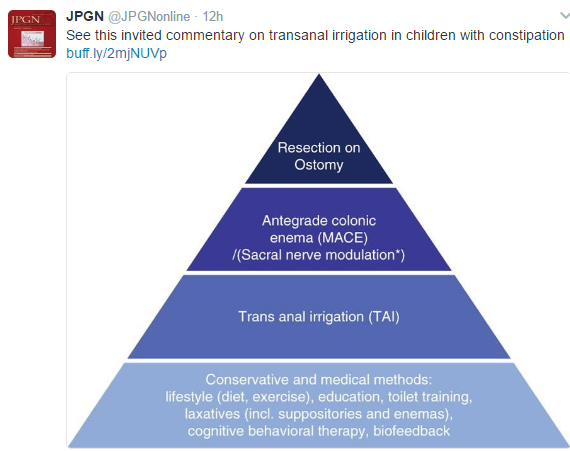
- -JPGN 2011;52: 574. n=117. Describes outcome with placement of a cecostomy/appendicostomy for irrigations of colon. 69% success with antegrade enemas.
- -Gastroenterology 2009; 137: 1963. Increased rectal compliance not associated with treatment response.
- -J Pediatr 2009; 154: 258. Constipation associated with 3-fold increase in health utilization/cost.
- -Clin Gastro Hep 2009; 7: 20. Review of complications associated with constipation in adults.
- -Pediatrics 2008; 121: e1334. In this study, behavioral therapy was ineffective in treating childhood constipation.
- -JPGN 2007; 44: 5. Review of nonretentive fecal incontinence.
- -J Pediatr 2006; 148: 62. Higher compliance is noted in children with functional fecal retention/encopresis; thus, larger stool volume need to reach intrarectal pressure of the urge to defecate.
- -J Pediatr 2005; 147: 700-04. 69% of infants with constipation recovered within 6 months (then 15% relapsed).
- -Gastrointestinal Endoscopy 2004; 60(1):39–43. A new technique for management of intractable constipation in children: percutaneous endoscopic colostomy of the left colon
- -JPGN 2004; 38: 75. Colostomy in 10 children with intractable constipation.
- -J Clin Gastro 2003; 36: 386-389. Safety of stimulants for long-term use.
- -Am J Gastro 2005; 100: 232-242. Myths about constipation. Stimulants have not been proven to cause a “cathartic colon”
- -JPGN 2004; 39: 448. review
- -J Peds 2004; 145: 409. 8/88 patients with intractable constipation with spinal cord lesions (6 with tethered cords). 6/7 better p surgery. Intractable was defined as <2BMs/week x 3 months despite laxative treatment. Only one patient had physical exam finding. This was a retrospective study.
- -Gastroenterology 2003; 125: 357. Long-term constipation followup. One-third had persistent constipation; 60% better at 1 year. (tertiary referral group)
- -Pediatrics 2004; 113: 1753 & e520. When constipation & toileting difficulties both occur, constipation usually precedes toileting problems.
- -NEJM 2003; 349: 1360. Review.
- -Arch Pediatr Adolesc Med 1999; 153: 377. Digital exam performed in only 23% at time of referral to specialist.


 gutsandgrowth