Instagram: ZaPoop Nation Holding a Poop (~2 minutes, 2 million views) This is a “behind” the scenes conversation between poop and the anus.
You do not need an account or to login to view.


Instagram: ZaPoop Nation Holding a Poop (~2 minutes, 2 million views) This is a “behind” the scenes conversation between poop and the anus.
You do not need an account or to login to view.
A Almallouhi et al. J Pediatr Gastroenterol Nutr. 2025 DOI: 10.1002/jpn3.70316. Clinical outcome of constipation as the presenting symptom in children with celiac disease
Background: “It is not clear if CeD prevalence is higher in children with refractory and chronic constipation or not.11–15 The current guidelines from the American Gastroenterological Association (AGA) and the North American Society for Pediatric Gastroenterology, Hepatology, and Nutrition (NASPGHAN) do not consider constipation an indication for CeD testing in the absence of suggestive family history, growth, or developmental delay.”
Methods: This was a retrospective study (1994-2024) of children (<18 years) who presented with constipation and then diagnosed with celiac disease (CeD). There were 248 children with CeD, 177 (71%) had biopsy-confirmed CeD, and 56 (23%) were diagnosed with serology-only criteria
Key findings:

My take:
Related blog posts:
Also, Dr. Balistreri gives a Bowel Sounds Podcast on Hep B. Here’s the link: https://t.co/BmEUoC9YQt

Related blog posts:
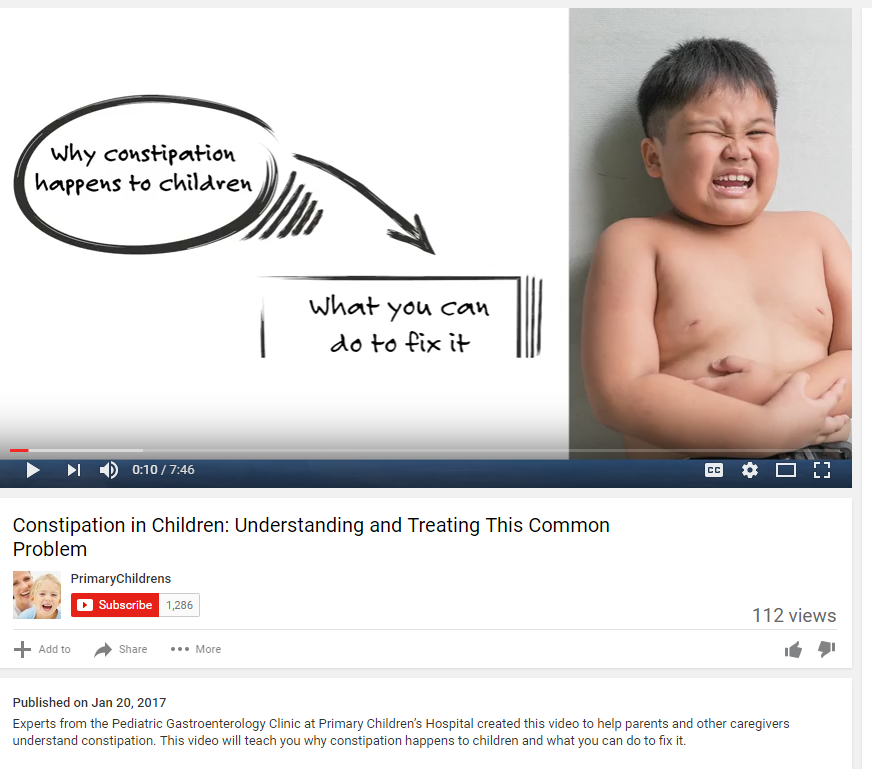
This is a really good educational video (< 8min) -now on YouTube: Constipation in Children: Understanding and Treating This Common Problem (Thanks to John Pohl’s twitter feed for this resource)
Related blog posts:
The initial title of this post was too boring: “Documenting the Detrimental Effects of Fecal Incontinence on Quality of Life”
In perhaps one of the least surprising conclusions, the authors of a recent study (Kovacic K, et al. J Pediatr 2015; 166: 1482-7) have shown that “fecal incontinence significantly decreases quality of life compared with functional constipation alone in children.” This multicenter prospective study surveyed families of 410 children (2-18 years).
Despite the obvious findings, I still think that the burden of fecal incontinence is underestimated by families and practitioners. Here is an excerpt from this article’s discussion:
“Fecal incontinence impairs general functioning for children and their families…[it] is an insidious burden with substantial economic impact and adverse effects on quality of life…this effect increases as children approach adolescence…The devastating effect of fecal incontinence on quality of life and social functioning make it imperative that health professionals address defecation disorders proactively. When aggressive and appropriate medical therapies are unable to provide a satisfactory outcome, then a multidisciplinary approach or a surgical option (e.g. cecostomy tube for antegrade enema) may be justified.”
Bottomline: Soiling stinks! We need to keep working on this problem even if aggressive interventions are needed.
Related blog posts:

Not Letting Go of a Log -Can Lead to Problems
New “Poo in You” education video for constipation / encopresis available through YouTube channel: http://www.youtube.com/NASPGHANencopresis
I took a look at this 5 minute video and it explains why kids soil and the basics of treatment; in addition, there is a “wah-wah-wah” sound effect at 2:29 in video when soiling occurs. Probably worth including this link on an after visit summary:
Related blog posts:
No –according to a recent study (J Pediatr 2013; 162: 1023-7).
In this study, 71 children (76% boys, median age 9 years) with functional nonrententive fecal incontinence (FNRFI) were randomized to receive conventional therapy (control group) or conventional therapy along with daily enemas for 2 weeks. Conventional therapy was considered education, toilet training, behavioral strategies, and a daily bowel diary with reward system. All children were instructed to defecate on toilet for 5 minutes after each meal. Treatment success was defined as <2 episodes of fecal incontinence (FI) per month. Outcomes were measured at 6 weeks, 12 weeks, 6 months, and 12 months after the start of treatment.
Results:
In the discussion, the authors note that a longer course of enemas (> 3 months) could be needed to improve long-term outcomes. They also note a high rate of daytime (31%) and night time (35%) urinary incontinence in these children; “we hypothesize that children with FNRFI not only deny or neglect their urge to defecate but exhibit the same behavior toward micturation.”
Take-home message: Both treatments improved the frequency of FI (and urinary incontinence); however, neither were highly effective. Short-term use of enemas is not likely to have a meaningful effect. Better treatment strategies are needed.
Related blog links:
So many parents misinterpret withholding behavior in children. Many indicate that their child is trying to go but cannot and others indicate that their child does not feel an urge to defecate. Now more insight into this common issue has emerged (JPGN 2013; 56: 19-22).
The authors reviewed their experience with colonic manometry (n=410). 150 patients were identifed as having functional constipation. Among this group, 56 patients volunteered that they had no urge to defecate.
Yet, during colonic manometry, when the first high-amplitude propagating colonic contraction (HAPC) occurred, this was associated with retentive posturing, grimacing or denial of sensation. When the HAPC occurred, the examiner would explain that it was causing pain that would improve if the child defecated. Ultimately, “every patient acknowledged an urge to defecate and successfully defecated.”
One other interesting part of this publication is the discussion of psychological aspects. Do you remember Erikson’s stages (Erik Erikson – Wikipedia, the free encyclopedia)? The authors note, “if toilet training is not achieved or the process involves negative experiences including being shamed into the process, shame and doubt will persist. Shame, according to Erikson, is an infantile emotion and leads to secretive behavior. Therefore, children who failed toilet learning may deny sensations of the urge to defecate…all the while having shame and embarrassment.”
These psychological issues are important in the propagation of constipation. The authors note that, even in children with rectal distention due to chronic constipation which could result in decreased sensation, studies have shown rectal compliance was not associated with treatment failure. Therefore, constipation and soiling are not simply due to a mechanical issue of not knowing when to go.
Related posts:
Overall, 12-19% of Americans are affected by chronic constipation (Am J Gastroenterol 2004; 9: 750-59). Despite the fact that constipation problems are widespread, the amount of useful research available to guide treatment is quite limited. Two recent articles do offer some information:
The first reference examined the use of bisacodyl in a randomized, double-blind placebo-controlled study in the UK. During the 4-week treatment period, patients receiving 10mg/day bisacodyl (n=247) had increased stools, from 1.1 per week to 5.2 per week. Stool frequency also increased to 1.9 per week in the placebo group (n=121). All secondary endpoints including constipation-associated symptoms (eg. quality of life indices, physical discomfort) improved significantly compared to placebo. Average age of patients in this study was 55 years. The main adverse effect was diarrhea –mainly during the 1st week of therapy.
A selected summary in Gastroenterology (Gastroenterology 2012; 142: 402-404) reviews the first study and makes several useful points:
The second reference is a systematic review and meta-analysis of randomized controlled trials (RCTs) of pharmacologic therapy for chronic idiopathic constipation. Twenty one eligible RCTs were identified: eight laxative studies (n=1411), seven prucalopride studies (n=2639), three lubiprostone (n=610), and three linactolide trials (n=1582). All of these studies showed treatment was superior to placebo. These studies involved subjects who were mainly adults (>90% older than 16 years).
The results showed benefit from both stimulant and osmotic laxatives. Overall, the osmotic and stimulant laxative studies showed higher response than the pharmacologic agents like prucalopride, lubiprostone, and linaclotide. Nevertheless, between 50% and 85% of patients did not fulfill criteria for response to therapy.
Additional references:
Virtually everyday pediatric gastroenterologists like myself see children with constipation problems; managing constipation is often a Sisyphean task. Recent articles (JPGN 2011; 53: S2: 49, 55) reiterate what all pediatric gastroenterologists already know –constipation is almost always a management problem and only rarely a diagnostic problem. Rarely do children with constipation need diagnostic tests. These articles recommend testing only if alarm features are present, including the following:
Additionally, these articles state that about 25% of functional constipation problems may persist into adulthood. Among the patients who respond poorly to treatment, constipation, especially if associated with soiling (aka. encopresis), can be very detrimental for obvious social reasons. This group of patients can be very challenging. Many of the patients do not perceive the problem to be as severe as their parents and may be unwilling to work on fixing the problem.
Clinical experience has been that younger children respond better than older children. Perhaps, this is due to a greater ease of imposing a specific treatment plan in younger children along with the fact that the physiological and behavioral changes associated with chronic constipation are not as well-established.
Other pertinent aspects of treatment and diagnosis include the following:
Abdominal xrays are not very helpful (JPGN 2010; 51: 155.) and should mainly be reserved for those in whom a rectal examination cannot adequately be performed, such as very uncooperative patients, and in patients with concerns about abuse (or concerns about psychologic impact of exam).
Also, despite earlier reports of potential sacral abnormalities in children with chronic constipation or non-retentive soiling, a fairly large prospective MRI study (J Pediatr 2010; 156: 461-5) (n=158) found that only 3% had lumbar sacral abnormalities and none required neurosurgery (1 with spina bifida occulta, 3 with terminal filum lipomas).
In addition to the scholarly references below, some useful practical sources of information can be identified by going to my office website, http://www.gicareforkids.com and clicking “constipation.”
Additional references:

