
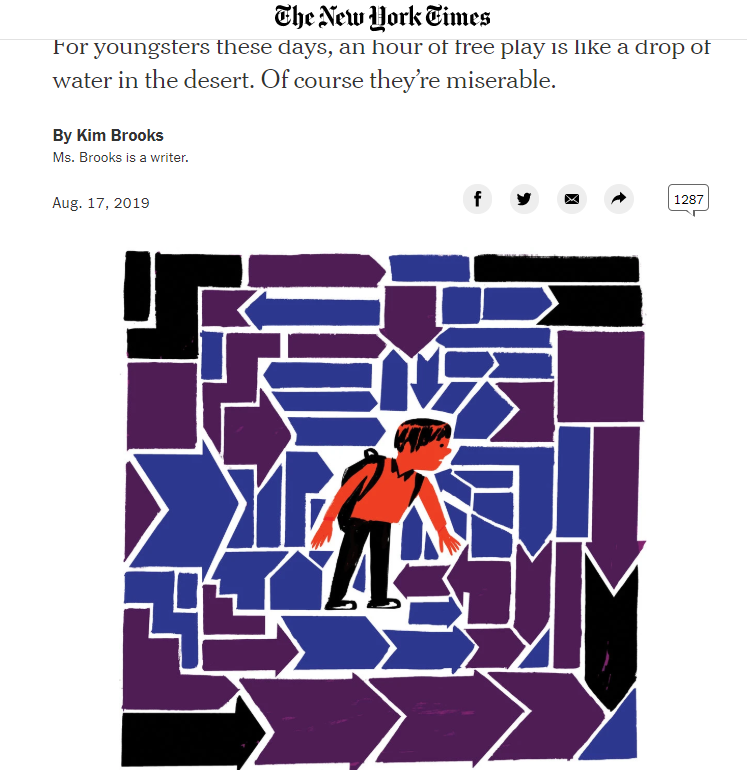
A recent NY Times commentary (We Have Ruined Childhood) details the rising rates of depression, anxiety, and suicide and suggests a link between these mental health issues and a lack of childhood free play.
An excerpt:
No longer able to rely on communal structures for child care or allow children time alone, parents who need to work are forced to warehouse their youngsters for long stretches of time. School days are longer and more regimented…
The role of school stress in mental distress is backed up by data on the timing of child suicide. “The suicide rate for children is twice what it is for children during months when school is in session than when it’s not in session,..
For many children, when the school day is over, it hardly matters; the hours outside school are more like school than ever…
The areas where children once congregated for unstructured, unsupervised play are now often off limits. And so those who can afford it drive their children from one structured activity to another. Those who can’t keep them inside. Free play and childhood independence have become relics, insurance risks, at times criminal offenses…
Many parents and pediatricians speculate about the role that screen time and social media might play in this social deficit. But it’s important to acknowledge that simply taking away or limiting screens is not enough. Children turn to screens because opportunities for real-life human interaction have vanished.
Related blog posts:
A recent commentary (recommended by one of my sons) by Eric Topol discusses how doctors could be organized to advance the practice of medicine, address the deterioration in doctor-patient relationships, and focus on the needs of patients, whereas current medical organizations are mainly focused on the business interests of medical practice.
An excerpt from Why Doctors Should Organize:
“It’s possible to imagine a new organization of doctors that has nothing to do with the business of medicine and everything to do with promoting the health of patients and adroitly confronting the transformational challenges that lie ahead for the medical profession. Such an organization wouldn’t be a trade guild protecting the interests of doctors. It would be a doctors’ organization devoted to patients. Its top priority might be restoring the human factor—the essence of medicine—which has slipped away, taking with it the patient-doctor relationship. It might oppose anti-vaxxers; challenge drug pricing and direct-to-consumer advertisements; denounce predatory, unregulated stem-cell clinics; promote awareness of the health hazards of climate change; and call out the false health claims for products advocated by celebrities such as Gwyneth Paltrow and Mehmet Oz. This partial list provides a sense of how many momentous matters have been left unaddressed by the medical profession as a whole…
Because of the unique technological moment at which we live, we may not see an opportunity like this one for generations to come. We have a chance to affect the future of medicine; to advocate for patient interests; to restore the time doctors need to think, to listen, to establish trust, and build bonds, one encounter at a time. For these purposes, and in these times, an organization of all doctors is necessary. Rebuilding our relationships with our patients: that is our lane.”

“Pistol Butt” Pine. Tree takes on this shape due to heavy snowfall leaning on tree at early stage. Crater Lake, Oregon.
A recent article (L Skinner et al NEJM 2019; 381: 299-301) provided data regarding the worsening disparity in physician availability in rural areas.
Key points:
My take: This report highlights the current disparity in rural health care and how this is worsening as the rural physician population ages.
Related blog posts:
A recent case report described a patient who developed acute pancreatitis and acute kidney injury folllowing a competitive eating contest.


A recent commentary (A Sarpatwari et al NEJM 2019; 381: 106-8) details the need for reforming the Orphan Drug Act (passed in 1983). To promote drugs for rare diseases, this act offered incentives including exclusive marketing rights for 7 years, a 50% tax credit for costs with clinical testing (reduced to 25% in 2017) and grants for clinical trials.
The problems that need to be addressed related to this act:
Key points:
My take (borrowed from the authors): “The status quo increasingly threatens public health, as rising drug prices present growing access challenges for patients and indication slicing hampers collection of critical preapproval information on safety and efficacy when used in ways that will reflect their most common use in the market.”
Related blog posts:


Park Guell, Barcelona

Park Guell, Barcelona
A recent commentary, “Mistrust in Science –A Threat to the Patient-Physician Relationship” (RJ Baron, AJ Berinsky. NEJM 2019; 381: 182-5), addresses the deterioration of trust in the patient-physician relationship and potential ways to improve this.
Shortly before reading this, I read a newspaper article titled “Newtown Parents Fight Back” in Sunday’s AJC (related article online: Newton Parents Score a Win…). In this article, some of the parents of the 20 children who were killed in Newton, Connecticut have brought successful lawsuits against ‘hoaxers’ who claimed that the “rampage had been staged, with crisis actors.” Some of the parents have received death threats subsequently.
In this ‘misinformation’ age, it would be naive to expect that medicine and science would be spared. The alluded commentary makes the following points:
“Given the decline in trust in the institution of medicine, simply asserting medical authority or citing evidence is unlikely to win adherents…Skepticism…is a widespread phenomenon…appealing to a neutral or independent ‘referee’ of the truth…on a given subject–does not actually change minds…attempts by experts to correct misinformation may further entrench erroneous beliefs.”
Pathways to Trust
My take: The authors note that in this age, science s devalued and relationships are more influential. Thus, creating trust goes back to Peabody’s 1927 admonition: “The secret of the care of the patient is in caring for the patient.”
In the newspaper article, a book publisher involved in the promoting the Sandy Hook conspiracy had to meet one of the parents as part of a lawsuit. “At the end of the day, Gahary shook Pozner’s hand and apologized. He offered condolences for Noah’s death.” As in medicine, getting to know each other is the surest way to garner trust.
Related blog posts:
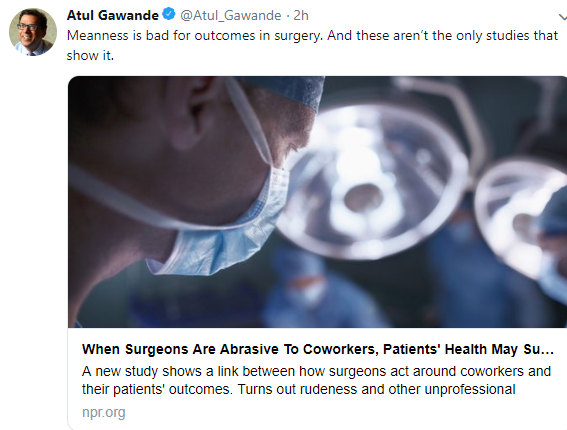
NPR: When Surgeons Are Abrasive To Co-Workers, Patients’ Health May Suffer
An excerpt:
A study published Wednesday in JAMA Surgery challenges these ideas. The study, which looked at interactions between surgeons and their teams, found that patients of surgeons who behaved unprofessionally around their colleagues tended to have more complications after surgery. Surgeons who model unprofessional behavior can undermine the performance of their teams, the authors write, potentially threatening patients’ safety.
For the study, researchers gathered data on nearly 13,700 patients and 202 surgeons from the National Surgical Quality Improvement Program, a system designed to track and improve surgical care…
The researchers found that when surgeons had one or more reports of unprofessional behavior over the previous 36 months, their patients were 12% to 14% more likely to experience complications in a 30-day period following surgery. These complications included infections, pneumonia, stroke and kidney failure.
Full text article: Association of Coworker Reports About Unprofessional Behavior by Surgeons With Surgical Complications in Their Patients WO Cooper et al. J
My take: It is interesting to speculate about why rude behavior may affect long-term outcomes. My suspicion would be that team members would be more hesitant to offer advice or to call quickly if concerns arose. Alternatively, it could be that if someone is not considerate enough to work well with their colleagues/other health professionals that they could be less attentive in their care.
Related blog post: How Rudeness Affects Performance in Medicine (and probably elsewhere)
A recent cross-sectional study (RMC Kagawa et al. J Pediatr 2019; 209: 198-203) shows a high rate of gun carrying among adolescents in the U.S.
Key findings:
My take:
Related blog posts:

El Retiro Park, Madrid

 gutsandgrowth