Tweets only this week.
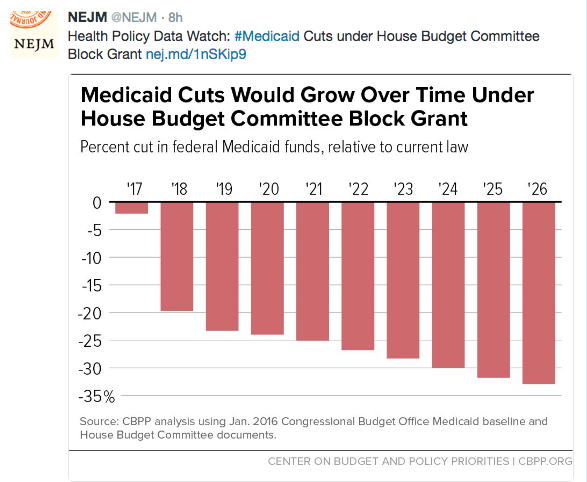

Tweets only this week.

Also -some tweets from IBD meeting:

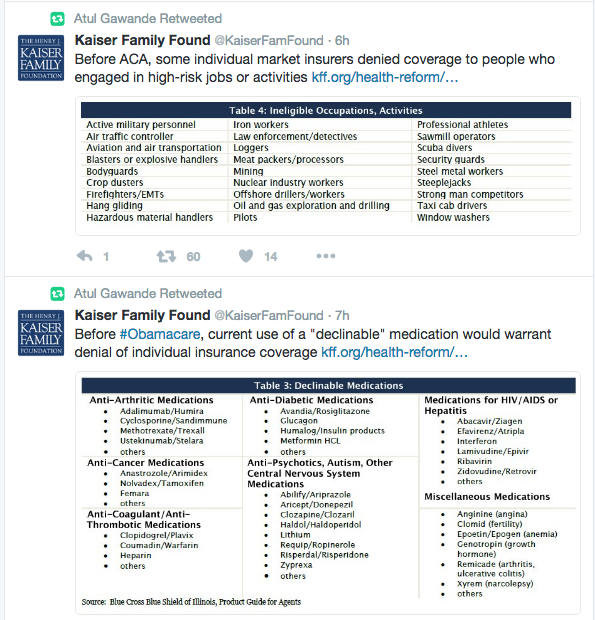
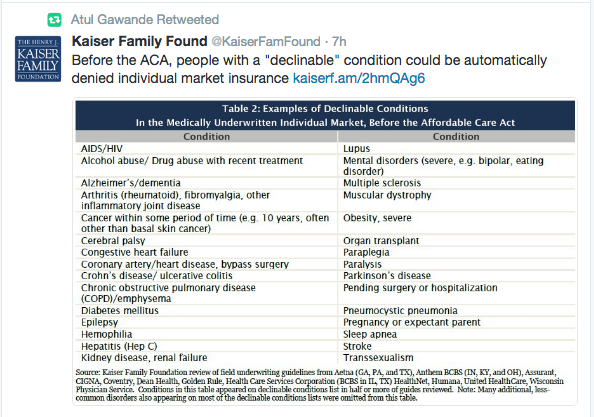
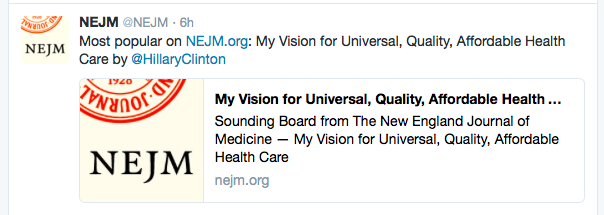
Full text: My Vision for Universal, Quality, Affordable Health Care –NEJM
From NEJM: The editors invited the Democratic and Republican presidential nominees, Hillary Clinton and Donald Trump, to answer the following question for Journal readers: What specific changes in policy do you support to improve access to care, improve quality of care, and control health care costs for our nation? Secretary Clinton responded. Mr. Trump did not respond.
The main topics in Hillary Clinton’s commentary include expanding insurance coverage through the affordable care act (i.e. Obamacare), improve affordability in health care with proposals that affect both insurance companies and pharmaceutical companies, improve access to primary care/community care, and to continue to promote innovation/research.

Not yet according to a recent commentary: BD Sommers. NEJM 2016; 375: 201-3. The graph below provides some perspective. In addition, the author cautions those who have voiced early alarm bells regarding upcoming rates. He notes the same alarms have been raised in the previous 2 years. Though, he notes, “there are reasons to suspect that marketplace premium growth for 2017 will exceed this year’s levels. Two of the law’s provisions designed to reduce financial risk to insurers in the new markets expire after 2016 — the risk corridor and reinsurance provisions…the country’s continued emergence from the aftermath of the Great Recession may well spur increasing rates of health care inflation for the general population, as well as for the ACA exchanges”
“Premium growth — even when it does reach into the double-digit range that sparks such substantial media attention — is a policy challenge to be examined and addressed and is also part of the general historical pattern that precedes the ACA.” Those who argue “the law as a whole should be scrapped ignore the devastating effect that repeal would have on the estimated 20 million Americans who have thus far gained insurance under the law.”
My take (from commentary): “Regardless of what ends up happening this year, it seems likely that next spring will bring renewed claims that the sky is falling — when experience should make clear that it isn’t.”

A recent article & editorial (KJ Wernli et al. Gastroenterol 2016; 150: 888-94 & 801-2) shows that the use of propofol, delivered by an anesthetist, is associated with a small increase risk of adverse events. This finding goes against assumptions that there would be reduced complications with an anesthesia expert in the room who could manage resuscitation and airway problems.
The study analyzed claims data from more than 3 million colonoscopies in the U.S between 2008-2011 in 40-64 year-olds.
Key findings:
This is not the first study to associate anesthesia with increased risk of aspiration and mechanical complications (Cooper G et al. JAMA Intern Med 2013; 173: 551-6). It is certainly possible that the increased risk is due in part to patient selection, despite attempts to control for this.
It is also important to note that better sedation has not resulted in improved colonoscopy outcomes like increased polyp detection.
Will these results change anything? No.
The small increased safety risk (detectable only in studies of millions of patients), if accurate, is not going to stop the use of anesthesia services for two reasons.
Patient satisfaction. Propofol results in excellent sedation, often with complete absence of pain combined with rapid recovery and an antiemetic effect.
Financial incentives. Many endoscopists are able to employ an anesthetist and generate additional revenue by billing for sedation (in addition to the costs of the endoscopist), whereas this is not allowed with the combination of intravenous opioids/benzodiazepines used for ‘deep sedation.’ Even in the many who do not receive revenue for these services, the rapid recovery expedites patient care and room turnover.
My take: While propofol administered by anesthetists is a little less safe and more expensive, it is here to stay, at least until incentives are created to reconsider this approach.

Georgian Terrace
A recent commentary (J Oberlander. NEJM 2016; 374: 1401-3) explains the “virtues and vices of single-payer health care.”
“In a country where nearly 30 million persons remain uninsured, even insured patients face staggering bills, and more money is spent on administration than on heart disease and cancer, it’s no surprise to hear calls for sweeping change.”
Virtues of Single-Payer System:
Vices of Single-Payer System:
It Does Not Matter if Single-Payer is Better:
It would face intense opposition from insurers, medical industry, and would not be adopted by Congress. “In short, single payer has no realistic path to enactment in the foreseeable future.”
My take (in agreement with author): “Preserving and strengthening the ACA [affordable care act] as well as Medicare, and addressing underinsurance and affordability of private coverage is a less utopian cause than single payer. I believe it’s also the best way forward now for U.S. medical care.”
Related blog posts:

Graphic showing association between obesity and asthma
As noted in yesterday’s blog post, after reading these two commentaries I thought a little more about value in pediatric gastroenterology. These articles though focus on other aspects. In the first reference, the authors explain the flaws with moving from volume to value-based care. They note that the medicare physician fee schedule (MPFS) has a powerful influence on physician activities and “their tendency to perform unneeded tests and procedures.” In fact, the fee schedule heavily contributes to growing shortages of primary care physicians. Key points:
The second reference bemoans the fact that the medical system will spend enormous amounts of money to prolong the life of an individual with terminal cancer for a few weeks but will not see the imperative of providing adequate prevention measures. Key points:
My take: At an individual physician level, we need to keep working to utilize our resources more carefully. However, at a policy making level, efforts at improving incentives for primary prevention and primary care are needed.
Related blog posts (see yesterday’s post Why are so many Low Value Endoscopies Performed? for related links as well):

Poster on Front of High Museum is reproduction of Vik Muniz piece created from Jelly and Peanut Butter
 gutsandgrowth