What’s at Stake with “Repeal and Replace”

Full Link from NEJM: The Mirage of Reform — Republicans’ Struggle to Dismantle Obamacare

Here’s an excerpt:

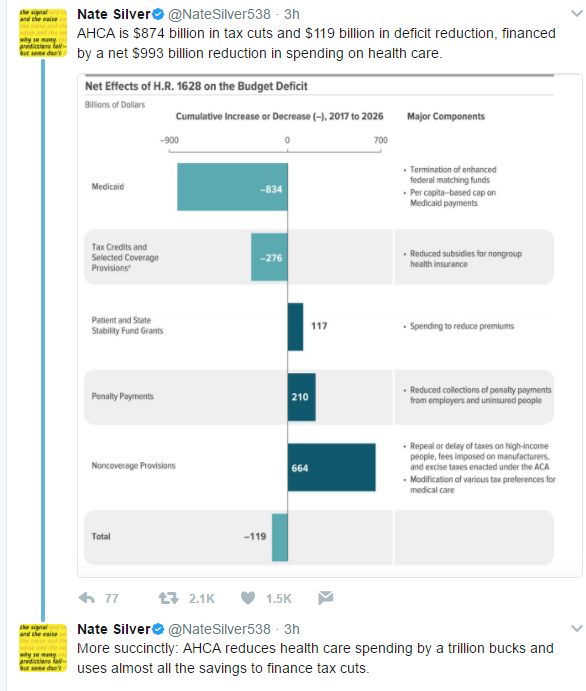
The [AHCA] bill distinguishes itself from the ACA largely by its commitment to regressive redistribution: it would give wealthier Americans more money (mainly through sizable tax cuts) while reducing government support to help low-income Americans afford insurance. Relative to the ACA, premium subsidies for the uninsured would decrease substantially, on average by 40% in 2020 and reaching 50% by 2026.1 Those cuts would fall heavily on lower-income people, with middle- and upper-income Americans receiving higher subsidies.1,3 The ACA’s subsidies to assist low-income persons with deductibles and copayments would be eliminated altogether. By 2026, for a person earning $26,500 a year and buying individual coverage, insurance plans’ actuarial value — which measures the share of costs that plans pay for covered services — would fall from 87% under the ACA to 65% under the GOP plan…

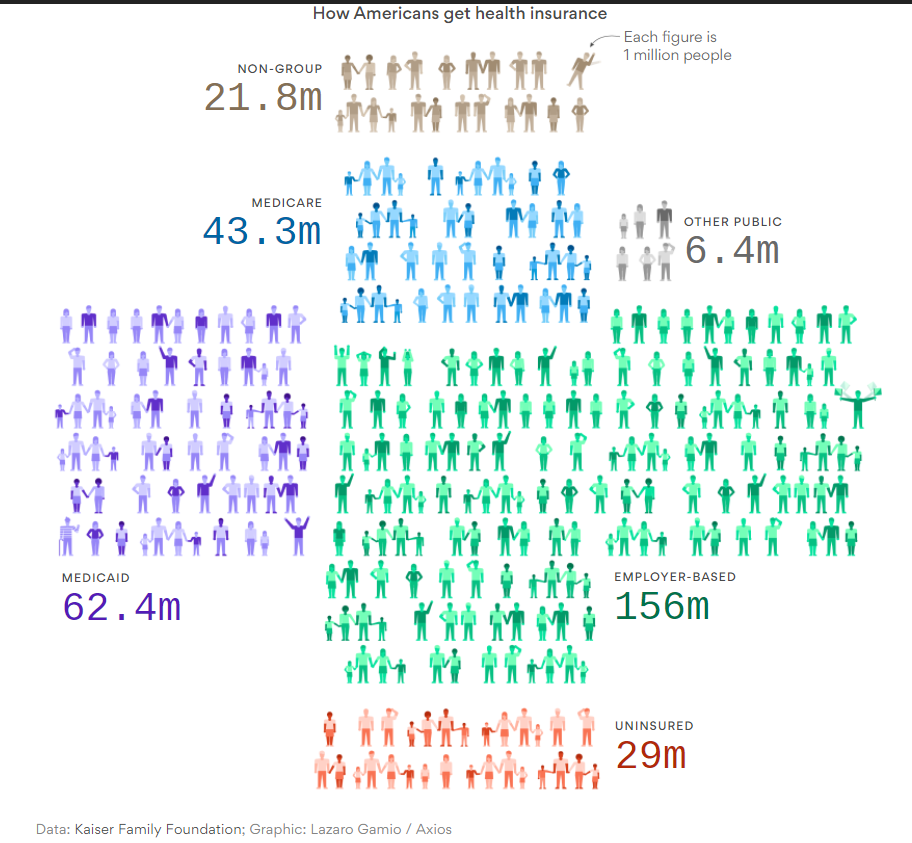
In addition to unified Democratic and significant Republican opposition in Congress and among governors, key stakeholders — including the American Medical Association, the American Hospital Association, and the seniors advocacy group AARP — oppose the bill. Furthermore, as its potential demise draws nearer, the popularity of the ACA, now part of the status quo, is growing. In the Republican imagination, Obamacare has been a disaster. The GOP’s problem is that in reality Obamacare has substantially expanded health coverage, with 20 million Americans gaining insurance. Rolling back the ACA means making insurance less affordable for low-income Americans, increasing the uninsured population, and taking vast funds away from states and medical providers. The GOP health plan neither fully repeals the ACA nor provides a compelling replacement. Instead, in my opinion, it offers only a mirage of reform.

Another analysis indicates significantly higher deductibles are likely under the GOP plan:

Link: Why dedcuctibles would increase under the GOP health plan

Turning Liquid into Gold: A Pharmaceutical Rumpelstiltskin Story

A recent letter to the editor (LA Probst, TR Welch. NEJM 2017; 376: 795-6) provides a sad tale of how well-intended legislation to promote safety and efficacy of pediatric liquid medications has led to both an increased number of liquid formulations approved by the FDA but with a much higher cost than previous extemporaneously compounded formulations.

The liquid version of lisinopril is priced 775 times the cost of the equivalent tablet.  Other medications with high liquid to tablet cost ratios include enalapril (21 times), indomethacin (49 times), glycopyrrolate (14 times), and pyridostigmine (11 times).

The authors note that there are additional costs for developing/manufacturing these liquid formulations.

My take (borrowed from the authors): “there must be a better way to support the costs of developing the drug formulations that many children and some severely impaired adults desperately need.”

Related blog posts:

Chattahoochee near Azalea drive

Chattahoochee near Azalea drive

Atul Gawande: “Tell Me Where It Hurts”

In a recent New Yorker article (Jan 23, 2017, pgs 36-45,LINK:  “Tell Me Where It Hurts” –thanks to Stan Cohen for this article), Atul Gawande provides a compelling narrative on the ‘heroism’ of incremental care.

He starts his narrative with the story of Bill Haynes who had had severe migraines for four decades, but eventually improved under the care of Elizabeth Loder (John Graham Headache Center).  Over the course of four years, her ‘systematic incrementalism had done what nothing else had.’

Dr. Gawande explains that chronic illness is commonplace but “we have been poorly prepared to deal with it.  Much of what ails us requires a more patient kind of skill.  I was drawn to medicine by the aura of heroism–by the chance to charge in and solve a dangerous problem.”

Despite the appeal of dramatic medical moments, bigger impacts are noted with more subtle care. “States with higher ratios of primary care physicians have lower rates of general mortality, infant mortality, and mortality from specific conditions such as heart disease and stroke.”  One of the ways mortality is reduced is getting seen sooner for medical problems. Having a relationship with a physician “has a powerful effect on your willingness to seek care for severe symptoms.”

A parallel narrative in this piece regards the Silver Bridge tragedy in 1967.  This bridge which connected Gallipolis, Ohio and Point Pleasant, West Virginia, over the Ohio River, keeled over and resulted in 46 deaths and dozens more who were injured. This tragedy sparked attention towards infrastructure and trying to address problems before a critical collapse occurs.  “We will all turn out to have –like the Silver Bridge and the growing crack in its critical steel link–a lurking heart condition or a tumor or a depression or some rare disease that needs to be managed. This is a problem for our healthcare system.  It doesn’t put great value on care that takes time to pay off.”

Other points:

  • Incremental medicine is “at odds with our system’s allocation of rewards…the lowest-paid specialties: pediatrics, endocrinology, family medicine, HIV/infectious disease, allergy/immunology, internal medicine, psychiatry, and rheumatology.”
  • “More than a quarter of Americans and Europeans who die before the age of seventy-five would not have died so soon if they’d received appropriate medical care for their conditions.”
  • “Data indicate that twenty-seven per cent of adults under sixty-five…[have] conditions that make them uninsurable without protections” form the Affordable Care Act.

My take: Fixing an aging bridge may not be as exciting as building a new one –unless you are the aging bridge or depend on that bridge.

screenshot-147


NEJM Presidential Candidate Health Proposals

Full text: My Vision for Universal, Quality, Affordable Health Care –NEJM

From NEJM: The editors invited the Democratic and Republican presidential nominees, Hillary Clinton and Donald Trump, to answer the following question for Journal readers: What specific changes in policy do you support to improve access to care, improve quality of care, and control health care costs for our nation? Secretary Clinton responded. Mr. Trump did not respond.

The main topics in Hillary Clinton’s commentary include expanding insurance coverage through the affordable care act (i.e. Obamacare), improve affordability in health care with proposals that affect both insurance companies and pharmaceutical companies, improve access to primary care/community care, and to continue to promote innovation/research.

screen-shot-2016-10-03-at-8-46-34-pm


Is Obamacare Causing Skyrocketing Premiums?

Not yet according to a recent commentary: BD Sommers. NEJM 2016; 375: 201-3. The graph below provides some perspective.  In addition, the author cautions those who have voiced early alarm bells regarding upcoming rates.  He notes the same alarms have been raised in the previous 2 years. Though, he notes, “there are reasons to suspect that marketplace premium growth for 2017 will exceed this year’s levels.  Two of the law’s provisions designed to reduce financial risk to insurers in the new markets expire after 2016 — the risk corridor and reinsurance provisions…the country’s continued emergence from the aftermath of the Great Recession may well spur increasing rates of health care inflation for the general population, as well as for the ACA exchanges”

“Premium growth — even when it does reach into the double-digit range that sparks such substantial media attention — is a policy challenge to be examined and addressed and is also part of the general historical pattern that precedes the ACA.”  Those who argue “the law as a whole should be scrapped ignore the devastating effect that repeal would have on the estimated 20 million Americans who have thus far gained insurance under the law.”

My take (from commentary): “Regardless of what ends up happening this year, it seems likely that next spring will bring renewed claims that the sky is falling — when experience should make clear that it isn’t.”

ACA premiums