Critique of the 21st Century Cures Act

The most compelling article (Avorn J, Kesselheim AS. NEJM 2015; 372: 2473-5) in a recent edition of the NEJM delved into the 21st Century Cures Act which was recently introduced in the U.S. House of Representatives; it was approved 51 to 0 in committee but continues to be debated.

One of the underlying premises of the bill is accelerate approval for new products. Key features:

  1. Increase in National Institutes of Health (NIH) of about 3% per year for 3 years. And, additional $2 billion per year for 5 years to create an “NIH Innovation Fund”
  2. Instructs FDA to consider nontraditional study designs for clinical trials.  This is aimed at shorter, smaller and less expensive studies.  This could allow FDA to rely on “observational studies” and “clinical experience.”
  3. The bill encourages the FDA to rely more on surrogate end points
  4. The bill would allow informed consent to be bypassed if the “proposed testing poses no more than minimal risk.”

Critiques for each point, point by point:

1. The funding increases largely counterbalance stagnating funds at the NIH secondary to sequestration and budget cuts.

2.  The premise that the FDA is inefficient is not accurate.

  • “A third of new drugs are currently approved on the basis of a single pivotal trial” with a median of 760 patients.
  • Most drugs are approved based on studies with a duration of 6 months or less, even medications taken for a lifetime.
  • Evaluation of nearly all new drug applications is completed within 6 to 10 months.

3.  Surrogate markers often overestimate the potential benefit of medications.  The FDA “already uses surrogate end points in about half of new drug approvals.” Specific examples:

  • Bevacizumab has been shown to delay tumor progression in breast cancer “but was shown not to benefit patients.
  • Rosiglitazone “lowered glycated hemoglobin levels in patients with diabetes even as it increased their risk of myocardial infarction.”
  • One new tuberculosis drug improved bacterial counts in the sputum but “the treatment group had a death rate four times that in the comparison group.”

4.  Informed consent has been “sacrosanct, with exceptions made only when consent is impossible or contrary to a patient’s best interests.”  With this new proposal, “it is not clear who gets to determine whether a given trial of a new drug poses “minimal risk.”

Bottomline (from authors): The 21st Century Cures Act’s call for increased NIH funding may prove to be its most useful component.  But political forces…could lead to the approval of drugs and devices that are less safe or effective than existing criteria would permit.”

Audio interview with Jerry Avorn: nej.md/1TPy6Ta

Some pictures from yesterday’s Peachtree Road Race:

Coveted T-shirt -2015 Edition

Coveted T-shirt -2015 Edition

Screen Shot 2015-07-04 at 6.34.03 PM

Rainy Day for a 10K

Largest 10K in U.S

Largest 10K in the World

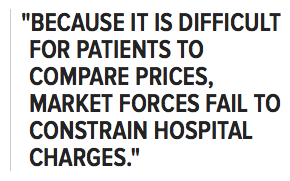
“Some Hospitals Marking Up Treatments By as Much as 1000%”

Why is it that I don’t find the title of a recent NBC report surprising?

NBC Summary of Recent Study: “Some Hospitals Marking Up Treatments By as Much as 1000%”

Here is an excerpt:

Twenty of the hospitals in the top 50 when it comes to marking up charges are in Florida, the researchers write in the journal Health Affairs. And three-quarters of them are operated by two Tennessee-based for-profit hospital systems: Community Health Systems and Hospital Corporation of America…

Hospitals negotiate different rates with different payers.

Screen Shot 2015-06-08 at 5.02.52 PM

Then there are in-network and out-of-network rates. And patients often don’t know until after they’ve received a treatment whether their insurance will pay for it, or for the doctors who delivered it…

States can and should regulate what hospitals charge. Maryland sets hospital rates but is the only state that does. West Virginia regulates rates, while only California and New Jersey have state legislation that requires for-profit hospitals to offer discounts to eligible uninsured patients.

My personal experience

Recently, a hospital on the northside charged my family in excess of $3000 for handling/processing an outpatient biopsy specimen (not pathologist interpretation) which was at least 10-fold what an independent pathology lab charged for the same service.  When I received the bill, I was quite upset.  The physician who sent out the specimen did not inform me that he intended to send the specimen to this hospital and seemed to have no idea about the costs.

I am certain that if I were given the choice of several pathology labs for processing that I would not have been convinced that there was added value in the specimen going to the hospital.

As a physician, when families ask me how much a procedure is going to cost, it is usually not an easy question and often requires a fair amount of research, particularly if the something involves a procedure at the hospital.

Take-home message: How is it that in this information era that medical costs are not transparent?

Unfortunately, you really do not know how good your medical coverage is until you find out through personal experience.

Related blog posts:

Sandy Springs

Sandy Springs


Less Litigation: Better Communication, Not More Testing

A recent NY Times articles sums up articles over more than two decades which show that better communication, rather than more testing, reduce malpractice lawsuits.

To Be Sued Less, Doctors Should Consider Talking to Patients More

An excerpt:

As far back as 1989, a study of obstetricians in Florida found that about 6 percent of obstetricians accounted for more than 70 percent of all malpractice-related expenses over a five-year period… Doctors who are sued are different in some way from those who aren’t…Some doctors were more likely to be sued, regardless of whether the cases against them were eventually found to have merit…

Doctors sued most often were complained about by patients twice as much as those who were not, and poor communication was the most common complaint…

At the University of Michigan about 15 years ago, a program was begun to improve communication around medical errors. When errors occurred, the program encouraged physicians to tell patients about them, how they happened, and what would be done to make them less likely to occur in the future. Doctors were also encouraged to apologize, and offer compensation for harm if it occurred.

study of the program published in 2010 found that in the years after it began claims dropped 36 percent, and lawsuits dropped 65 percent. The monthly cost of total liability and patient compensation dropped 59 percent, and legal costs dropped by 61 percent.

later study, published last year, looked at how the program affected gastroenterology claims and costs. It found that despite a 72 percent increase in clinical activity, the rate of claims per patient encounters dropped 58 percent…The total cost to the health care system of malpractice in gastroenterology decreased by 64 percent.

Related blog posts:

From Hammock

From Hammock

Healthcare Transition: Why Being the Best May Not Work

According to a commentary, “Why Strategy Matters Now,” (NEJM 2015; 372: 1681-4), successful health care organizations are going to need to develop a strategy to provide better value as the key goal.

They note that previous approaches to develop scale and market presence will be trumped by patients choosing insurance products with narrowed provider networks and high deductibles.  With reimbursement decreases and resistance from private insurance companies to ‘cross-subsidize care’ for publicly-insured or noninsured patients, that change is inevitable. Key points:

  • “Having a good brand is no longer enough: patients and payers are looking for good value, service by service.”
  • “Providers that organize themselves to improve outcomes and become more efficient in doing so will be rewarded.”

The authors then detail several questions that healthcare organizations need to answer to develop their strategy for being successful.

My take: While there is an effort to transform health care, a big stumbling block is the ability to measure value and quality.  Until this becomes easier, this transformation will be slow-going.

Related blog posts:


Does it really cost $2.6 billion to bring a new drug to market?

A recent editorial (Avorn J. NEJM 2015; 372: 1877-79) helps provide some perspective on a recent unpublished study that “it costs pharmaceutical companies $2.6 billion to develop a new drug.”  (http://csdd.tufts.edu/files/uploads/cost_study_backgrounder.pdf)

Dr. Avorn notes that when this study is published scrutiny over the methods is needed; however, the authors of the study note that their methods are unchanged from a previous 2003 study (NEJM 2015; 372: 1972). Apparently the analysis was based on data from 10 drug makers regarding compounds that they had ‘self-originated.’

Some preliminary criticisms:

  • Nearly half the costs were attributed to the cost of capitol rather than direct spending. This cost indicates that the money being used for drug development was not available for other purposes (“opportunity costs”); however, the capital costs were assessed at a very generous 10.6% per year, compounded.
  • The analysis did not include the large public subsidies provided to pharmaceutical companies in the form of research-and-development tax credits.
  • Pharmaceutical companies remain highly profitable and only spend a small fraction of their revenues on truly innovative research.
  • Many of the drugs brought to market are not “self-originated.”
  • Many drug costs are borne by the public via research at university-affiliated centers with the pharmaceutical companies taking the new discovery the last mile.  “Gilead Sciences did not invent its blockbuster treatment for hepatitis C, sofosbuvir (Sovaldi)…it acquired the product from a small company founded by the drug’s inventor, a faculty member at Emory University, much of whose work on the usefulness of nucleoside viral inhibitors was federally-funded.”

Bottomline: While pharmaceutical companies invest heavily in new drug development, the huge numbers often attributed to research costs may be overestimates; these type of analysis likely underestimate how much taxpayers have paid in subsidizing the foundation for new treatments.

Related blog post: The Difficulty with Drug Development | gutsandgrowth


The Costs of Unnecessary Care –What’s Wrong with “I want everything ruled out?”

A great article for understanding a lot of what needs to be improved in our health care system –“America’s Epidemic of Unnecessary Care” from Atul Gawande & The New Yorker (Thanks to Kayla Lewis for this reference).  Here are some excerpts:

Well, as a doctor, I am far more concerned about doing too little than doing too much. It’s the scan, the test, the operation that I should have done that sticks with me—sometimes for years…It is different, however, when I think about my experience as a patient or a family member.


Dr. Gawande describes several anecdotes:

  • He relates how his mother had unnecessary testing done and only afterwards was a history and physical completed that would have obviated the need for any testing.
  • He relates a story about his friend Bruce. Bruce’s father had a stroke during cardiac surgery. However, the likelihood of that surgery helping Bruce’s father was much lower than the risk of surgery.
  • Ray from Car Talk: Even reputable professionals with the best intentions tend toward overkill, he said. To illustrate the point, he, too, had a medical story to tell. Eight months earlier, he’d torn a meniscus in his knee doing lunges…Ray went for a second opinion, to a physical therapist, who, of course, favored physical therapy, just as the surgeon favored surgery. Ray chose physical therapy.  What Ray recommended to his car-owning listeners was the approach that he adopted as a patient—caveat emptor. He did his research. He made informed choices. He tried to be a virtuous patient.

Other Important Points:

  • The virtuous patient is up against long odds, however. One major problem is what economists call information asymmetry. In 1963, Kenneth Arrow, who went on to win the Nobel Prize in Economics, demonstrated the severe disadvantages that buyers have when they know less about a good than the seller does.
  • The United States is a country of three hundred million people who annually undergo around fifteen million nuclear medicine scans, a hundred million CT and MRI scans, and almost ten billion laboratory tests. Often, these are fishing expeditions, and since no one is perfectly normal you tend to find a lot of fish.
  • What’s more, the value of any test depends on how likely you are to be having a significant problem in the first place…Experts recommend against doing electrocardiograms on healthy people, but millions are done each year, anyway.
  • Overtesting has also created a new, unanticipated problem: overdiagnosis. This isn’t misdiagnosis—the erroneous diagnosis of a disease. This is the correct diagnosis of a disease that is never going to bother you in your lifetime. 

Dr. Gawande explains how some conditions (including cancers) are more like turtles and some are more like rabbits. Diagnosing a turtle results in increased risk, increased cost and little likelihood of benefit.

  • With regard to cost, he updates the situation in McAllen, Tx: Six years ago, in “The Cost Conundrum,” I compared McAllen with another Texas border town, El Paso. They had the same demographics—the same levels of severe poverty, poor health, illegal immigration—but El Paso had half the per-capita Medicare costs and the same or better results…McAllen, in large part because of changes led by primary-care doctors, has gone from a cautionary tale to something more hopeful.

Take-home point (from article): Right now, we’re so wildly over the boundary line in the other direction that it’s hard to see how we could accept leaving health care the way it is. Waste is not just consuming a third of health-care spending; it’s costing people’s lives. As long as a more thoughtful, more measured style of medicine keeps improving outcomes, change should be easy to cheer for. Still, when it’s your turn to sit across from a doctor, in the white glare of a clinic, with your back aching, or your head throbbing, or a scan showing some small possible abnormality, what are you going to fear more—the prospect of doing too little or of doing too much?

Related blog posts:

Behavioral Economics and Insurance Exchanges

A recent commentary (NEJM 2015; 372: 695-98) explains how information provided on healthcare exchanges influences choices on coverage and what types of modifications could help improve these decisions.

Current plans are categorized as Bronze, Silver and Gold based on monthly premiums and out-of-pocket expenses (Related link: Understanding Plans on Healthcare.gov).  Gold plans are characterized by higher monthly premiums and lower out-of-pocket expenses.  However, the authors sampled a group of people.  They found that plans that are labeled as “gold” were preferred by the majority whether the plans had higher monthly premiums and lower out-of-pocket expenses or the reverse (low monthly premiums and higher out-of-pocket expenses).  Rather than using “gold,'” “silver,” or “bronze,” their recommendation would be to provide more practical information by providing estimates of annual costs with best-case and worst-case scenarios.

On many exchanges, the plans are listed by order of lowest monthly premiums to highest monthly premiums.  “When people make choices, they often settle for options at the top of a menu…for example, all else being equal, politicians listed at the top of ballots receive more votes than those whose names appear lower on the list.” Also, using monthly premium differences rather than weekly premium differences also influences choices. Thus, even the innocuous design of a website, could adversely influence the selection of the best plan for a given participant.

Bottomline: If the affordable care act and health exchanges are not eliminated, improving the presentation of information could help many participants get the health coverage that actually meets their needs.

Related blog posts:

“Why Health Care Tech is Still So Bad” -NY Times

Here’s the link on this thoughtful article: “Why Health Care Tech is Still So Bad

This article highlights the problems including physicians distracted from patients due to data entry, problems with workflow, and alert fatigue. The author argues that we need to keep working on electronic health records; “the digitization of health care promises, eventually, to be transformative.”

Related blog posts:


Marketing to Doctors -Informative Satire

One of my colleagues recently shared a youtube link that I recommend highly to anyone who is concerned about the relationship between pharmaceutical companies and physicians.  As with any good piece of satire, it is both funny and thought-provoking.  As one would question the impartiality of politicians who receive funds from constituents with a specific agenda, likewise patients may question whether physicians are unduly influenced by their relationship with pharmaceutical companies.

For those too busy to enjoy the entire ~17 minutes, watch the last three minutes:


Implementing High-Value Care

A recent commentary (NEJM 2014; 371: 2145-47) describes some early successes and failures with efforts at “getting more performance from performance measurement.”

The authors note that “the current measurement paradigm..does not live up to its potential.”  There have been a proliferation of measurements “without commensurate results.”

Areas of progress:

Reducing hospital readmissions: “national readmission rates, which hovered around 19% between 2007 and 2011, had dropped to approximately 17.5% by 2013…recent research suggests that the measured decrease resulted from actual changes in care and not simply greater use of observation units or emergency department care.”

Rates of early elective deliveries: “the rate of early elective deliveries had stayed fixed for many years, even though there was evidence that the practice led to a greater need for neonatal intensive care, higher risks of maternal and neonatal complications, and health problems later in the children’s lives…the rates of early deliveries fell from 17% in 2010 to 4.6% in 2013 (www.leapfroggroup.org/tooearlydeliveries)”  This change happened due metrics in pay-for-performance or not paying for such deliveries along with educational efforts.

Areas Were Not Helpful (aka The Road Paved with Good Intentions)

“Unfortunately, for every instance in which performance initiatives improved care, there were cases …[that] simply enraged colleagues or inspired expenditures that produced no care improvements.”

Early Antibiotics for Community-Acquired Pneumonia:  Due to data suggesting that antibiotics within 6 hours of presentation positively influenced the outcome of community-acquired pneumonia (i.e. lower in-hospital mortality), this became a Centers for Medicare and Medicaid Services (CMS) metric.  “The measure led to inappropriate antibiotic use in patients without community-acquired pneumonia, had adverse consequences such as Clostridium difficile colitis, and did not reduce mortality.”

Bottomline: More work is needed to avoid needless busy work and improve patient outcomes.

As quoted in a previous blog entry:

“Not everything that counts can be counted, and not everything that can be counted counts.” –Albert Einstein