Increasing Incidence of Hepatocellular Carcinoma in the U.S.

A recent study (DL White et al. Gastroenterol 2017; 152: 812-20) provide data showing a striking increase in the incidence of hepatocellular carcinoma (HCC). Using data from the US Cancer Statistics Registry which covers 97% of U.S. population, the authors found the following:

  • HCC incidence rose from 4.4 per 100,000 in 2000 to 6.7 per 100,000 in 2012
  • The annual rate of increase was 4.5% from 2000-2009, but then 0.7% annually from 2010-2012
  • The greatest increase occurred in 55-59 year olds (8.9% annually) and 60-64 year olds (6.4% annually)

The main HCC risk factors are HCV, HBV, and alcoholic liver disease, though obesity-associated HCC is emerging as an important risk factor as well.  The highest rates of HCC are seen in southern and western states, with Texas having the highest rates overall.  The high rate in Texas is in part due to the higher rates of HCC in Hispanics.

Overall, the authors indicate that the rising HCC rates are most closely tied to the peak HCV cohort (1945-65) and speculate that the arrival of direct-acting antivirals may help. At the same time, this HCV cohort is composed “disproportionately [of] minorities and of lower socioeconomic status” and may have less access to these advances in treatment.  Furthermore, in states like Texas which did not adopt Medicaid expansion as part of the Affordable Care Act, there are more uninsured patients who will be less likely to identify preceding risk factors for HCC.

My take: Perhaps in 20 years, we will see HCC incidence maps that are improving as HCV treatments become more widely available.  This presumes that other HCC risk factors, including obesity and alcohol, do not worsen significantly.

Related blog posts:

Opioid Use and Liver Transplantation Outcomes

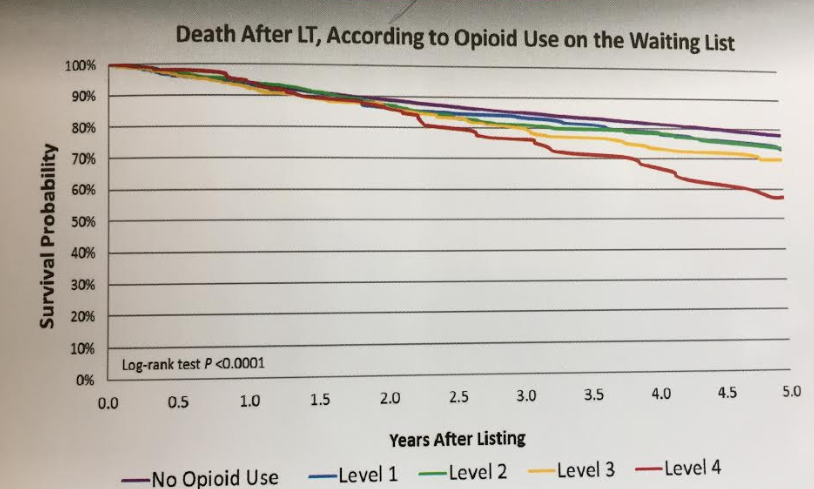
Not surprisingly, a recent study (HB Randall et al. Liver Transplantation 2017; 23: 305-14) has found that use of opioid medications prior to liver transplantation (LT) increased mortality over 5 years after transplantation.

This retrospective cohort study with data from nearly 30,000 patients correlated outcomes with pre-LT opioid exposure.  Overall, 9.3% of recipients filled opioid prescriptions while on the waiting list. Adjusted hazard ratios for death were 1.28 and 1.52 respectively for opioid use of level 3 and level 4.

In the associated editorial (pg 285-7), the authors note that animal models have shown direct hepatotoxic effects of opioid use, though they speculate that the driver for mortality could be due to “sustained opioid use over time or return to illicit drug use.”

A unrelated commentary by CDC director Tom Frieden (AJC “Protect Ga. families from opioid overdose”, March 18, 2018) explains the scope of the opioid epidemic.  “Since 2000, more than 300,000 of our sons, daughters, brothers, sisters, mothers, fathers, and friends have been killed by opiates.  In 19999, approximately 6,000 Americans died from opiate overdose –including both prescription pain medicines … and heroin.  By 2015 that number increased to more than 33,000.”  This is more than a five-fold increase.

He emphasized that opiates serve as a gateway drug for those addicted to heroin; that is, the majority of those hooked on heroin were started on an opioid medication.

My take: The worsened outcomes of LT due to opioids are unfortunately a tiny part of an enormous tragic problem of the opioid epidemic.

Related posts:

Word of Caution with New Hepatitis C Medications

From NY Times: Are New Drugs for Hepatitis C Safe? A Report Raises Concerns

An excerpt:

Drugs approved in recent years that can cure hepatitis C may have severe side effects, including liver failure, a new report suggests. The number of adverse events appears relatively small, and the findings are not conclusive. But experts said the report was a warning that should not be ignored…

The report will be published online on Wednesday [1/25/17] by the Institute for Safe Medication Practices, a nonprofit in Horsham, Pa., that studies drug safety. Its findings are based on the group’s analysis of the Food and Drug Administration’s database of reports from doctors around the world of adverse events that might be related to medications.

In October, the F.D.A. identified the first major safety problem caused by the nine antiviral drugs. In 24 patients, the drugs wiped out hepatitis C — but also reactivated hepatitis B infections that had been dormant. Two of those patients died, and one needed a liver transplant. The agency said there were probably additional cases that had not been reported.

As a result, the agency required that a boxed warning, its most prominent advisory, be added to the labeling of the newer antivirals, telling doctors to screen and monitor for hepatitis B in all patients taking the drugs for hepatitis C. Infection with both viruses is not common, and how the reactivation occurs is not known. The problem was not detected during premarket testing of the drugs because patients who currently had hepatitis B or who had a history of it were not allowed into the studies…

The other cases of liver failure are a separate problem. He said it was important for doctors prescribing the newer drugs to test patients’ liver function thoroughly first, because liver disease can be deceptive

My take: Overall, these newer Hepatitis C medications represent a tremendous achievement.  However, as with most medications, rare serious problems can occur and in some cases may be preventable.

Related blog posts:

From Twitter Feed-Funny Church Signs

From Twitter Feed-Funny Church Signs

Liver Briefs Feb 2017

JB Schwimmer et al. Gastroenterol 2016; 151: 1141-54.  Using a double-masked trial with 169 children with NAFLD, the use of cysteamine bitartrate for 1 year did not reduce histologic activity scores, but did reduce liver aminotransferase levels.

NA Terrault et al. Gastroenterol 2016; 151: 1131-40. The authors collected data from 2099 participants in the HCV-TARGET study who mainly received ledpasvir-sofosbuvir (311 received therapy in combination with ribavirin).  The study included 25% blacks, 66% with genotype 1A, 41% with cirrhosis, 50% with prior treatment, and 30% who were receiving proton pump therapy.  Key finding: SVR12 rates varied from 95% to 97% based on duration of therapy.  Factors that predicted SVR12 included higher albumin (>3.5 g/dL), lower total bilirubin (<1.2), absence of cirrhosis, absence of proton pump inhibitor therapy.

KR Olson et al. NEJM 2017; 376: 268-78.  This case report of an 18 yo woman with acute liver failure provides a helpful review.  For Wilson’s disease, the article reviews rapid diagnostic criteria: “a screen that shows a ratio of alkaline phosphatase (IU per liter) to total bilirubin (mg per deciliter) of lower than 4.0 and then subsequently shows a ratio of aspartate aminotransferase (IU per liter) to alanine aminotransferase (IU per liter) of higher than 2.2 has been described as 100% sensitive and specific for the diagnosis of Wilson’s disease.”  Making this diagnosis quickly is crucial and allows these patients to be UNOS status 1A, “the only cause of acute liver faliure that allows a patient with preexisting liver disease to be listed as status 1A”

Among children older than 10 years of age, Wilson's disease accounted for 90% of metabolic disease.

Among children older than 10 years of age, Wilson’s disease accounted for 90% of metabolic disease.

Cholecardia

An interesting study (MS Desai et al. Hepatology 2017; 65: 189-201) examines the effect of excess bile acids on the heart.  The abstract is listed below -I’ve highlighted what I find fascinating:

Cardiac dysfunction in patients with liver cirrhosis is strongly associated with increased serum bile acid concentrations. Here we show that excess bile acids decrease fatty acid oxidation in cardiomyocytes and can cause heart dysfunction, a cardiac syndrome that we term cholecardia. Farnesoid X receptor; Small Heterodimer Partner double knockout mice, a model for bile acid overload, display cardiac hypertrophy, bradycardia, and exercise intolerance. In addition, double knockout mice exhibit an impaired cardiac response to catecholamine challenge. Consistent with this decreased cardiac function, we show that elevated serum bile acids reduce cardiac fatty acid oxidation both in vivo and ex vivo. We find that increased bile acid levels suppress expression of proliferator-activated receptor-γ coactivator 1α, a key regulator of fatty acid metabolism, and that proliferator-activated receptor-γ coactivator 1α overexpression in cardiac cells was able to rescue the bile acid-mediated reduction in fatty acid oxidation genes. Importantly, intestinal bile acid sequestration with cholestyramine was sufficient to reverse the observed heart dysfunction in the double knockout mice.

CONCLUSIONS:

Decreased proliferator-activated receptor-γ coactivator 1α expression contributes to the metabolic dysfunction in cholecardia so that reducing serum bile acid concentrations may be beneficial against the metabolic and pathological changes in the heart.

My take: There are a lot of reasons why having elevated bile acids is not a good thing. This study provides good evidence that these bile acids have specific cardiac toxicity.

Cozumel

Cozumel

HCV Treatment: Nearing 100% Effectiveness

While access to HCV treatment remains the biggest obstacle, recent studies show that the rates of HCV eradication, even in the toughest cases, now approaches 100%.

  • E Lawitz et al. Gastroenterol 2016; 151: 893-901.
  • EJ Gane et al. Gastroenterol 2016; 151: 902-9.
  • Editorial: M Buti pgs 795-8.

Most prior studies examined the use of two direct-acting antivirals (DAAs) with or without ribavirin.  These DAAs targeted nonstructural (NS) proteins necessary for HCV replication: NS3 protease, NS5B polymerase, and NS5A protein.

These two new studies examined whether treatment with a DAA targeting all 3 NS proteins would be effective and possibly allow shorter treatments.  It is noted that currently only treatment-naive genotype 1 (w/o cirrhosis) patients have a regimen that is recommended for only 8 weeks; these patients also should have HCV-RNA<6,000,000 IU/mL.

Lawitz et al studied the combination of sofosbuvir-velpatasvir and GS-9857 (voxilaprevir) for 6-8 weeks (one treatment group received ribavirin); n=197. Among treatment-naive patients w/o cirrhosis, SVR12 was 100% after 8 weeks of treatment and 94% of treatment-naive patients with cirrhosis.  Among treatment-experienced patients treated for 12 weeks, 100% of all patients (w and w/o cirrhosis) achieved SVR12.

Gane et al studied the effectiveness of the combination of sofosbuvir-velpatasvir and GS-9857 in HCV genotypes 2, 3, 4, and 6 (as well as 1 with 1b); n=128. After 8 weeks of treatment, SVR12s were achieved in 93% of treatment-naive patients with cirrhosis.  After 12 weeks, treatment-experienced patients with and without cirrhosis had SVR12s of 97% and 100% respectively.

My take: This combination of therapies should allow shorter treatment regimens in treatment-naive patients and effective rescue therapy for previous DAA failures. Now that we can cure almost everyone with HCV, how do make therapies affordable and accessible?

Glacier Nat'l Park

Glacier Nat’l Park

Finding Residual Hepatitis C Virus in Liver Explants

A recent report (M Gambato et al. Gastroenterol 2016; 151: 633-6) provides some insight into the importance of the presence of residual hepatitis C virus (HCV) RNA in the liver of patients undergoing liver transplantation.

The authors note that many patients with cirrhosis due to HCV do not complete a full course of antiviral therapy before liver transplantation as the waiting time is unpredictable.  The authors studied whether there was HCV RNA in the liver of 39 of these patients and tried to assess whether its presence was associated with relapse after liver transplantation.

Background:

  • Only 6 patients (15%) had completed treatment prior to liver transplantation.
  • Most patients (68%) had undetectable serum HCV RNA.
  • Treatment was most commonly sofusbuvir/ribavirin (n=30)

Key findings:

  • HCV RNA was detected in 26 of 39 liver explants (67%). Higher levels were detected in those who had received a shorter course of treatment at time of liver transplantation. Interestingly, HCV RNA was also detected in 2 (20%) of controls who had an SVR after completing an interferon-free treatment regimen.
  • 33 of 39 (85%) achieved a post-transplantation virologic response (pTVR) and 6 (15%) had recurrent HCV infection.  Thus, the persistence of HCV RNA in liver explant did not preclude pTVR.
  • Among the 26 patients with residual HCV RNA in the liver explant, a HCV RNA concentration was higher in the 4 patients that relapsed (23 vs 3 median copies/mcg total RNA).
  • Another unexpected finding was that among the 6 who relapsed, two had undetectable HCV RNA in liver explant –both patients carried mutations which could have rendered treatment less effective.  The authors note that HCV RNA could have been present at concentrations below detection or distributed unevenly (which could have affected testing).

The authors speculate that the presence of HCV RNA may have been sequestered in membranous webs which allowed the virus to avoid degradation/host defenses.

My take (borrowed from the authors): The presence of HCV RNA in the liver explant does not seem to be associated with treatment failure/virologic relapse after liver transplantation, except in case with high concentrations.

Maine’s oldest lighthouse: Portland Head Light

Portland Head Light

Portland Head Light

Is It Time To Start Testing HBsAg Levels in Hep B Patients?

Two recent studies show that HBsAg levels may help determine therapeutic decisions:

  • WP Brower et al. Clin Gastroenterol Hepatol 2016; 14: 1481-89
  • Y-C Hsu et al. Clin Gastroenterol Hepatol 2016; 14: 1490-98.

The first study was a retrospective study of 292 HBeAg-negative patients with chronic hepatitis B virus (HBV) infection.  This cohort had normal ALT values and HBV DNA <20,000 IU/mL.  Patients were considered to be carriers of inactive HBV if their HBV DNA was <2000 IU/mL and serum levels of ALT remained normal.

Key findings with regard to likelihood of having inactive HBV at following year:

  • “odds were 97% for initial level of HBsAg <100 IU/mL”
  • “odds were 85% for patients with initial levels 100-1000 IU/mL and 76% for patients with initial levels >1000 IU/mL”

Also, “patients with HBV activity who had levels of HBV DNA <5000 IU/mL and decreases in HBsAg of 0.5 log IU/mL or more for 1 year had a high probability of becoming carriers of inactive HBV in the next year.” Figure 2 in an easy graphic form shows cumulative probabilities of becoming inactive or active HBV over the three-year period.

In the second study, Hsu et al performed a prospective study of 161 consecutive patients with undetectable HBV DNA following 3 or more years of entecavir.  After stopping therapy, patients were monitored for relapse.

Key findings;

  • 49.2% of patients had a clinical relapse (defined by elevation of both HBV DNA >2000 IU/mL and by elevated ALT >2-fold ULN)
  • 81.7% had virological relapse (HBV DNA >2000 IU/mL).
  • All patients with HBeAg-positivity had clinical relapse and were retreated.
  • For HBeAg negative patients at end of treatment, 39.2% had a clinical relapse & 77.4% had a virological relapse.
  • Serum HBsAg level predicted relapse among HBeAg-negative patients: 11 patients with HBsAg <10 IU/mL did not relapse. The lower the serum level of HBsAg at the end of treatment, the lower the rate of clinical relapse (see Figure 1).  Of those with HBsAg 100-1000, there was ~25% clinical relapse at 30 months f/u and more than 50% virological relapse.

My take: HBsAg level is becoming important in truly determining who has inactive HBV and reflects the likely natural history.  It is expected that using HBsAg levels will be increasingly used to determine management of HBeAg-negative HBV.

Related blog posts:

cligastroocthbv

Need Liver, Will Travel

A recent commentary (G Cholankeril et al. Gastroenterol 2016; 151: 382-86) provides a succinct summary regarding the trends in liver transplantation multiple listing and its implications on notions of utility and justice.

Key points:

  • UNOS was established based on Congressional act in 1984: 42 U.S.C. § 274.  The principles of “justice” and “utility” were to be key in governing an equitable  allocation system.
  • Due to allocation inequities, however, some prospective liver transplant candidates seek multiple listings. From 2010 to 2015, 1082 of 70,080 (2%) liver transplant candidates on the waitlist had multiple listings. During that same time frame, 862 (multiply-listed) of 32,431(total transplants) (3%) underwent liver transplantation.
  • Candidates who migrated had “shorter waiting time before liver transplantation and higher probability of receiving an organ (multiple listings 80% versus primary listing 46%; P<.001)”
  • Multiple listing candidates had lower severity of illness and lower MELD score at time of liver transplantation (multiple listings 25 versus primary listing 28; P<.001)

Regional distribution:

  • 46% of the 862 multiply-listed patients who underwent liver transplantation received their organ in UNOS region 3 (Alabama, Arkansas, Florida, Georgia, Louisiana, Mississippi, Puerto Rico)
  • 67% of those 862 emigrated away from Regions 2, 5, and 9 -which have the longest waiting times. Figure 1 shows the 11 Regions.  Region 2 & 9 include New York, New Jersey, Delaware, West Virginia, Maryland, and Pennsylvania.  Region 9 includes California, Nevada, Arizona, New Mexico, and Utah.

My take: Under the current system, liver transplant candidates capable of travelling/multiple listing, are rewarded with earlier liver transplantation & higher likelihood of receiving a liver transplant.  Thus, until inequities in organ distribution are better addressed, patient’s may need to consider telling their transplant team: ‘Need Liver, Will Travel’

Related blog posts:

Public Art, New Orleans

Public Art, New Orleans

Obeticholic Acid in Primary Biliary Cholangitis

While Primary Biliary Cholangitis (PBC) (previously called primary biliary cirrhosis) is seen mainly in adult hepatology practices, a new treatment may be emerging and this same medication is likely to be considered for several liver conditions.

Reference: F Nevens et al. NEJM 2016; 375: 631-43.

This 12 month, double-blind, placebo-controlled phase 3 “POISE” trial with 217 patients examined the use of obeticholic acid with or without ursodeoxycholic acid.  Surrogate markers of PBC were followed & the treatment groups improved compared to placebo.  However, adverse effects, particularly itching, were more common in the obeticholic acid groups; serious adverse effects were 11-16% in the treatment groups compared with 4% in the placebo group.

Results below:

PBC Rx

My take: It will be nice when important clinical endpoints can be assessed for this therapy like progression to cirrhosis.  For now, the cost of this treatment is ~$70,000 yearly.

Related blog post:

Breakthrough for Fatty Liver Disease? | gutsandgrowth