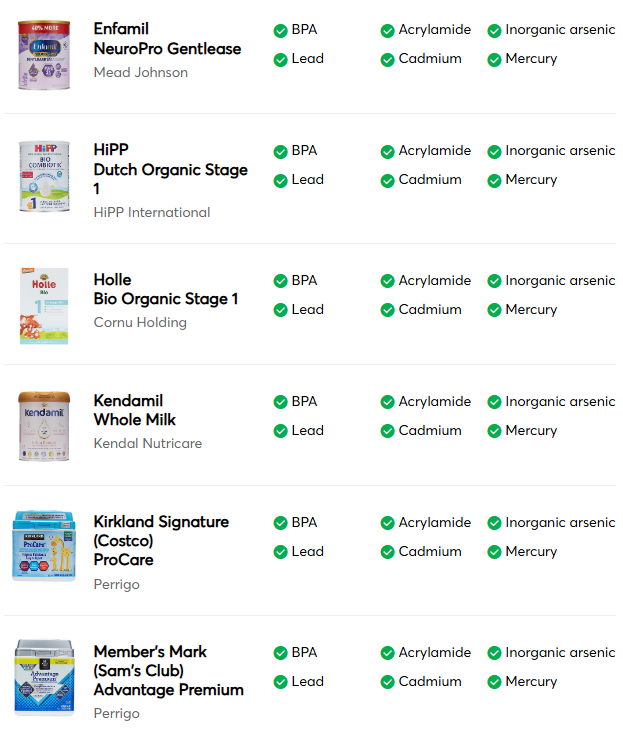
Safe Baby Formula Choices Based on Consumer Reports Testing

From Consumer Reports, April 18, 2025: We Tested 41 Baby Formulas for Lead and Arsenic

This Consumer Reports article is likely to generate a lot of attention. Thanks to Dr. Seth Marcus for sharing this reference.

An excerpt:

While some formulas had concerning levels [of arsenic and lead], there are safer choices. After seeing our results, the FDA is pledging further action…

Consumer Reports tests in the past have found elevated levels of inorganic arsenic in fruit juicebaby food, and bottled water…Our tests found the highest inorganic arsenic level in Abbott Nutrition’s EleCare Hypoallergenic, at 19.7 parts per billion (ppb), and the second highest in Similac Alimentum at 15.1 ppb, also made by Abbott.

As we had expected, CR’s tests found lead in almost all the formulas. Lead levels ranged from 1.2 ppb to 4.2 ppb, which is below the FDA’s Closer to Zero goal, but CR’s experts believe those levels are too high...

Together the formula made by these three companies—Abbott, Mead Johnson, and Perrigo—makes up 79 percent of the U.S. market…They also said trace levels of heavy metals in the food supply are not an issue that is unique to infant formula…

Perrigo, which makes Dr. Brown’s formula and many popular store brands we tested, including Kirkland, Parent’s Choice, Member’s Mark, and Up&Up, also told us that it routinely screens its formulas for heavy metals. “These compounds and PFAS are also found in breast milk,” a spokesperson wrote. “Their levels in infant formula are insignificant and well below regulations in the United States and around the world.”

Contaminants from the environment pose a problem for our entire food supply, CR experts say. But the problem is much more urgent for formula, given how vulnerable babies who depend on it are.

The FDA has long been limited by a lack of both resources and authority to carry out all the oversight it’s tasked with. ..

Keep these test results in perspective. Environmental pollutants are pervasive in our food supply, and all the contaminants in our tests—arsenic, lead, BPA, acrylamide, and PFAS—have also been previously detected in breast milk, food, and water…

Never ever try to make your own baby formula or offer alternative foods. It’s unsafe from a nutrition standpoint…

Use clean water to mix into your powdered formula. The EPA sets limits on contaminants in tap water for most of the country, but not every part of it. If you drink water from a well, for instance, that water is not regulated by the EPA. So it’s a good idea to get well water tested for heavy metals and PFAS before using it…
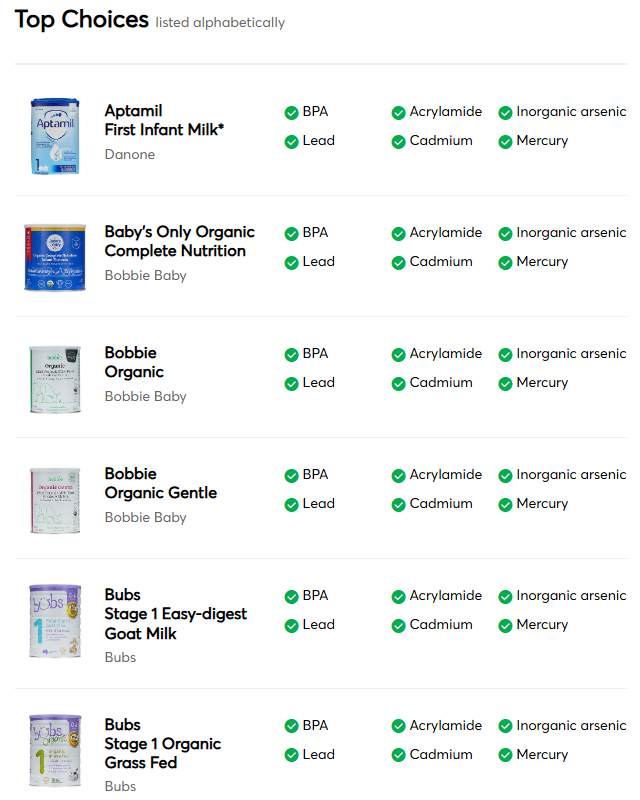
“Good Choices”

  • A2 Platinum -A2 Milk Company
  • ByHeart Whole Nutrition -ByHeart
  • Happy Baby Organics -Danone
  • Kendamil Organic -Kendal Nutricare
  • Neocate Hypoallergenic -Danone
  • Parent’s Choice Infant -Perrigo
  • Similac 360 Total Care -Abbott Nutrition
  • Similac 360 Total Care Sensitive -Abbott Nutrition
  • Similac Sensitive -Abbott Nutrition
  • Similac Soy Isomil -Abbott Nutrition

“Worse Choices”

  • Dr. Brown’s SoothePro -Perrigo
  • Elecare Hypoallergenic -Abbott Nutrition
  • Enfamil Nutramagen -Mead Johnson
  • Enfamil ProSobee Simply Plant-Based -Mead Johnson
  • Kabrita Goat Milk-Based -Ausnutria
  • PurAmino Hypoallergenic -Mead Johnson
  • Similac Alimentum -Abbott Nutrition
  • Similac NeoSure -Abbott Nutrition
  • Similac Total Comfort -Abbott Nutrition
  • Up&Up (Target) Soy -Perigo

My take: Formula companies need to continue to work on minimizing all of the contaminants. Yet, if all families selected only CR’s “top choices,” there would not be enough formula for infants who are not breastfed. In addition, this problem is even more of an issue in children needing specialized hypoallergenic formulas.

Related blog posts:

FDA Warns Consumers Not to Use Certain Powdered Infant Formula Produced in Abbott Nutrition’s Facility in Sturgis, Michigan

Here’s the link: FDA Warns Consumers Not to Use Certain Powdered Infant Formula Produced in Abbott Nutrition’s Facility in Sturgis, Michigan

2/17/22: Today, the U.S. Food and Drug Administration announced it is investigating consumer complaints of Cronobacter sakazakii and Salmonella Newport infections. All of the cases are reported to have consumed powdered infant formula produced from Abbott Nutrition’s Sturgis, Michigan facility ..The FDA is investigating complaints of four infant illnesses from three states.

The FDA is advising consumers not to use Similac, Alimentum, or EleCare powdered infant formulas if:

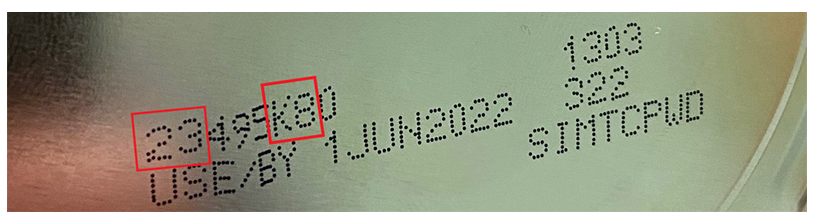
  • the first two digits of the code are 22 through 37; and 
  • the code on the container contains K8, SH or Z2; and 
  • the expiration date is 4-1-2022 (APR 2022) or later. 
  • Products that do not contain the information listed above are not impacted. The FDA advisory does not include liquid formula products or any metabolic deficiency nutrition formulas. Consumers should continue to use all products not covered by the advisory. 

AAP News: FDA issues warning for potentially contaminated infant formula

From USAToday: Baby formula recall 2022: FDA warns consumers not to use select Similac, Alimentum and EleCare: “More information is available at Similacrecall.com where you can type in the code on the bottom of the package. You can also call 1-800-986-8540 and follow the instructions provided.”

What to Feed Your Baby

“What to Feed Your Baby” — is the title of a recent, easy-to-read, practical book written by one of my colleagues, Stan Cohen.  I had the opportunity to read it and recommend it as an excellent resource for parents.  This book is not just for selecting formula and introducing foods, but it also reviews gastroesophageal reflux, colic, stooling problems, poor weight gain, overweight issues, prematurity, and allergies.  In addition, the subtitle, “Cost-Conscious Nutrition for Your Infant,” is an important element throughout the book.

The first few chapters highlight the advantages of breastfeeding but acknowledge that formula-feeding is an acceptable alternative.  Specific advantages that are outlined in Table 2.2 include decreased infections, decreased risk for several illnesses like sudden infant death syndrome (along with many others like diabetes and obesity), protection from allergies, and improved intelligence.  Advantages for the mother, like weight loss and better emotional health, are discussed as well.

Almost any question that a new mother would ask about the logistics of breastfeeding are answered in the 3rd chapter: “How long should each feeding be?” “Should I wake the baby?” “Do I need to stop if I have a cold?” “How long can the breastmilk be stored?”  The latter question has its own table 3.1 and the answer depends on the storage temperature.  At room temperature, covered breastmilk should be durable for 6-8 hours.  In addition, Dr. Cohen explains the need for vitamin D supplementation.

Chapters 4 and 5 help parents understand the highly marketed formulas and to understand a rationale for choosing one formula over another, including cost as a factor.  Dr. Cohen provides data on mean docosahexaenoic acid (DHA) content in breastmilk throughout the world.  In the U.S., the level is relatively low at 0.29 (as a percentage of fatty acids).  The breastmilk DHA level is nearly three times higher in Japan and Artic Canada.  These discrepancies account in part why formula companies may choose different target concentrations for some of their components when trying to mimic breastmilk.

While Dr. Cohen explains that some of the differences between formulas are akin to differences between Coke and Pepsi, he expresses a preference for the current Mead Johnson formula Enfamil Premium due to its higher DHA content –“though the research is not thoroughly established.”  However, he states that the differences probably do not justify a much higher cost.  For a generic brand, the Costco brand, “Kirkland Signature…are reasonable and less expensive, FDA-approved options.”

In addition, these chapters question whether infant organic formulas are truly organic (page 55), explain the issue of burping, and discuss the pragmatic advise regarding cleaning nipples/bottles; “kitchen clean” with soap and a washing with hot water should suffice and sterilization is not needed.

The most inciteful comments, in my opinion, are in chapter 5:

  • Lactose-free formulas: “Mead Johnson pulled its product from the market because lactose sensitivity is rare, rare, rare in infants…Abbott, in a shrewd marketing move, renamed its formula, originally called Lactofree, to Similac Sensitive, and that labeling has convinced an enormous number of mothers that this formula makes a difference.”  Similac Sensitive accounts for >10% of formula market.  A similar product is Gerber (previously Nestle) Good Start Soothe.
  • Elemental formulas: “cost as much as a monthly Porsche payment.”  Monthly costs of each type of formula are detailed in Table 5.3.  Routine cow’s milk based formula $149.88, soy-based $153.56, cow’s milk with rice starch $159.39, hydrolyzed (broken down protein) formula (e.g.. Alimentum, Nutramagen) $223.56, and elemental amino acid based $511.83.
  • Among extensively hydrolyzed formulas, Dr. Cohen indicates a preference for Alimentum (from Abbott) over its competitors due to better acceptance by infants.
  • The rationale for not switching from contracted WIC products is explained.  When changing from a contracted product to a non-contract product, the costs are much greater and among the same type of formula there is not a scientific rationale.
  • Reasons why goat’s milk are not a good choice and “dangerous” for infants are detailed.  “The protein content is over three times higher than cow’s milk…additionally, goat’s milk is deficient in folate and vitamin B6.”

As noted above, the book covers a variety of pediatric gastroenterology problems in the newborn.  As part of the chapter on undernutrition, additives to increase calories are detailed (pg 136).  For example, a tablespoon of polycose adds 23 cal, a tablespoon of rice cereal 15 cal, and  a tablespoon of vegetable oil 124 cal.

The last few chapters provide ample advice on transitioning to solid foods, reviews nutrients and mineral oils.  In addition, he provides growth charts (for full term, premature infants, and infants with Down syndrome) as well as tables on infant formula contents.

Take-home message: this is a terrific resource for parents to help understand the what, why and when of feeding their infant.  At the same time, the book provides advice on the most common pediatric gastroenterology problems of infancy like reflux, colic, stooling difficulties, allergies, and poor weight gain.

Book’s website and how to purchase:

http://www.what2feedyourbaby.com

To purchase the book:

Here is the link:

Reviews:

Other favorable reviews (http://what2feedyourbaby.com/reviews/) have come from influential pediatricians like Jay Berkelhammer and pediatric gastroenterologists like Jeff Hyams and Allan Walker.

In this book, Dr. Stanley Cohen, a pediatric gastroenterologist and nutritionist with longstanding interest in infant nutrition, provides a practical and pragmatic approach to a major concern for new mothers, namely What to Feed Your Baby.

— Allan Walker, M.D., director, Division of Nutrition, Conrad Taff professor of pediatrics and nutrition, Harvard Medical School

Related blog entries: