
Genetic Testing to Figure Out Drug Reactions

P Nicoletti et al. Gastroenterol 2023; 164: 454-466. Open Access! Identification of Reduced ERAP2 Expression and a Novel HLA Allele as Components of a Risk Score for Susceptibility to Liver Injury Due to Amoxicillin-Clavulanate

Key findings:

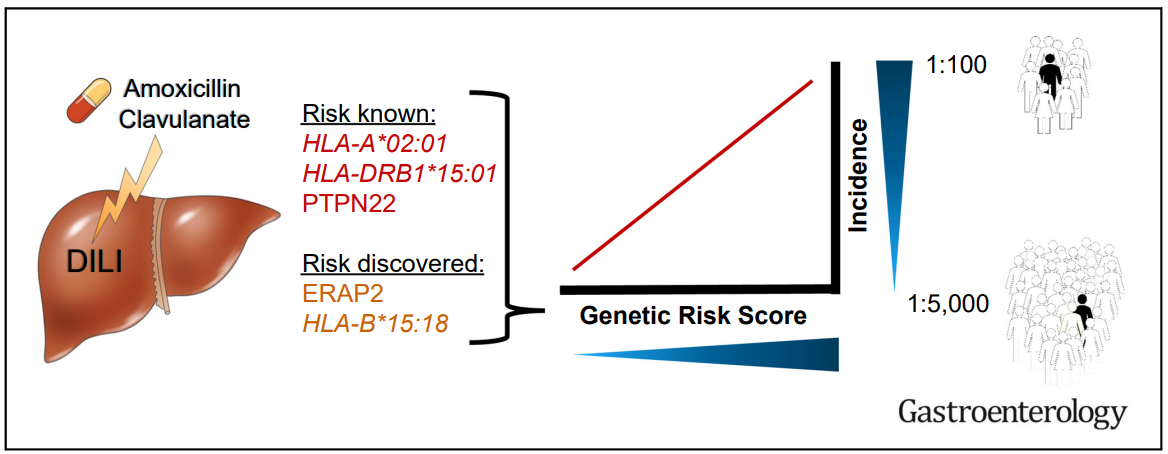
  • Transcriptome-wide association study revealed a significant association of AC-DILI risk with reduced liver expression of ERAP2 (P = 3.7 × 10–7), coding for an aminopeptidase involved in antigen presentation
  • “We also identified HLA-B∗15:18 as a novel AC-DILI risk factor in both discovery (OR, 4.19) and validation (OR, 7.78) cohorts”
  • A genetic risk score incorporating rs1363907, rs2476601, HLA-B∗15:18, HLA-A∗02:01, and HLA-DRB1∗15:01, was highly predictive of AC-DILI risk when cases were analyzed against both general population and non–AC-DILI control cohorts.
  • This genetic risk score does not apply to amoxicillin. “Clavulanate has long been considered the main component causing Amoxicillin-Clavulanate-DILI (LiverTox https://www.ncbi.nlm.nih.gov/books/NBK548517/).”
  • While the genetic risk score has high specificity, it is not highly sensitive. “Our multimarker model based on the 5 risk alleles predicted approximately 13% of the total risk for AC-DILI, which is approximately one-third of the total DILI risk that has previously been attributed to common genetic variants (approximately 40%)”

My take: In cases of suspected AC-DILI, identifying an abnormal genetic risk could help confirm the diagnosis. However, due to low sensitivity it is not likely to gain widespread clinical use.

Graphical Abstract:
Related blog posts:

Augmentin Hepatotoxicity

Augmentin (amoxicillin-clavulanic acid) hepatotoxicity is common, anywhere from 1 in 1000 prescriptions to 1 in 78,000 prescriptions.  Despite its frequent use in pediatrics, there is limited data on augmentin hepatotoxicity in this population.  A recent study adds some information (JPGN 2012; 55: 663-67).

As part of a prospective observational study involving 8 Spanish hospitals from 2008 to 2011, 11 patients, ages 1 to 11 years, with augmentin hepatotoxicity were identified.  Drug-induced hepatotoxicity was suspected in the presence of augmentin therapy if ALT was >2 time ULN, conjugated bilirubin was >2 times ULN, or if other liver biochemistries (AST/GGT or bilirubin) were >2 times ULN.  Causality criteria relied on the Council for International Organizations of Medical Sciences (CIOMS) scale.

According to CIOMS scale, 3 cases were highly probable for augmentin hepatotoxicity, 3 cases were probable, and 5 cases were possible.  In this study, the patient’s details and labs are given in Table 1.  Most cases were mild.  The most common symptom was vomiting. Only one had a bilirubin >1 mg/dL.  Two had very high ALT values (one 52 times normal). Viral serology (measured at least 2 determinations) and autoimmune titers were negative in all patients.

Resolution of the hepatotoxicity occurred over a 4 to 16 week period.  No cases required a biopsy.  The authors note that many more cases of milder disease likely go undetected.

Related blog entry:

Reference:

  • -Curr Drug Saf 2010; 5: 212-22.  Antibiotic-induced liver toxicity –clinical features/causality.
  • -JPGN 2008; 47: 395-405.  Drug-related hepatotoxicity/liver failure
  • -J Pediatr 2000; 136: 121.  Augmentin & cholestasis. 1.7 cases per 10,000 prescriptions.