Expansive View of Endoscopy from Porto IBD Group

The pediatric IBD Porto Group of ESPGHAN has updated endoscopy guidelines: S Oliva et al. JPGN 2018; 67: 414-430.   In total, the authors make 17 recommendations –here are a few of them:

A) In non-emergency situations, the diagnostic evaluation for suspected IBD in children should include a combination of EGD and colonoscopy.  Multiple biopsies from each segment are recommended even in the absence of macroscopic disease.

B) Endoscopic evaluation is recommended for the following:

  • before major treatment changes
  • in symptomatic patients when it is not clear whether the symptoms are inflammation-related
  • in Crohn’s disease(CD) to ensure mucosal healing during clinical remission
  • in Ulcerative colitis (UC) to ensure mucosal healing during clinical remission only if fecal calprotectin is elevated

C) 6-12 months after bowel resection to identify postoperative recurrence

D) Endoscopic surveillance in pediatric UC after 10 years from the onset of disease (as early as 8 years in older children (>16 years) with risk factors like extensive disease and strong family history

E) In patients with concurrent primary sclerosing cholangitis (PSC), surveillance colonoscopy may be considered every 1-2 years, starting from time of PSC diagnosis. However, in children <12 years of age, surveillance could be postponed based on individual risk factors.

In addition to discussions of conventional endoscopy, the authors favor evaluation of small bowel inflammation: “the choice to perform CE [capsule endoscopy], MRE or both, depends on local availability and expertise.”  The authors caution to consider strictures and the potential need for patency capsule prior to CE.

Conclusion of authors: “Endoscopy in pediatric IBD provides a more definitive diagnosis and disease extent evaluation, assesses therapeutic efficacy and leads to targeted therapy, which lessens complications and progression.”

My take: While I agree that endoscopy increases our understanding of disease extent and response to treatment, I do have some concerns about the recommendations (under section B above) regarding assessment of mucosal healing.  Part of the concern is that there is not a single accepted definition of mucosal healing.  Also, as a practical matter, there needs to be a discussion of the costs and more proof that frequent endoscopy will improve outcomes; it is possible that increased use of endoscopy will lead to some detrimental outcomes in some patients based on the interpretation of the results (eg. dropping a therapy that may be helping and replacing with a less effective treatment)..

Disclaimer: These blog posts are for educational purposes only. Specific dosing of medications/diets (along with potential adverse effects) should be confirmed by prescribing physician/nutritionist.  This content is not a substitute for medical advice, diagnosis or treatment provided by a qualified healthcare provider. Always seek the advice of your physician or other qualified health provider with any questions you may have regarding a condition.

Reassuring Study on Colonoscopy Safety in Adults

Full Abstract: Low Rates of Gastrointestinal and Non-Gastrointestinal Complicaitons for Screening or Surveillance Colonoscopies in a Population-Based Study

(L Wang, et al. Gastroenterol 2018; 154: 540-555https://doi.org/10.1053/j.gastro.2017.10.006)

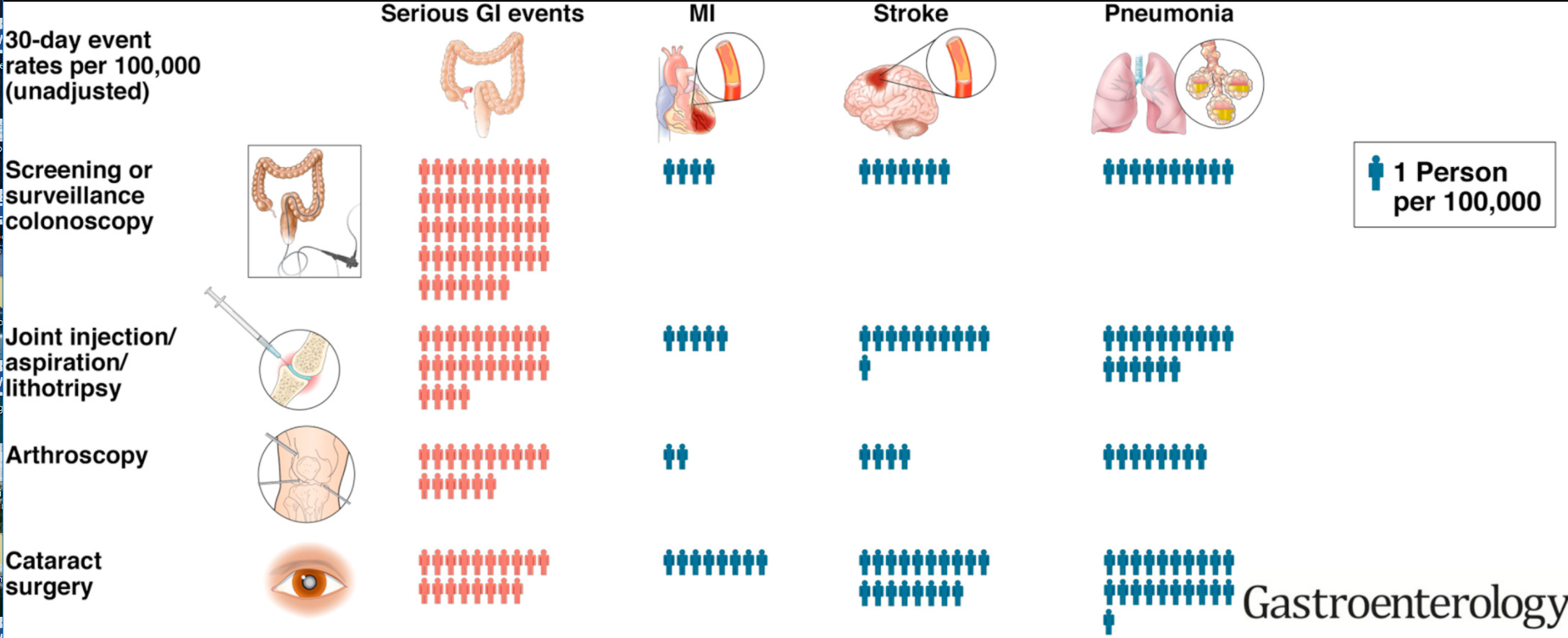
Using California’s Ambulatory Services Databases, the authors identified 1.58 million surveillance/screening colonoscopies (2005-2011) and compared complications to patients who underwent other ambulatory procedures like joint aspiration, arthroscopy and cataract surgery.

Availlable online: graphical abstract

Key findings:

  • GI complications including perforation and GI bleeding were low but more common with colonoscopy than comparator procedures
  • Rates of serious non-GI complications including myocardial infarction, stroke, and serious pulmonary events were no higher than other low-risk comparator procedures.
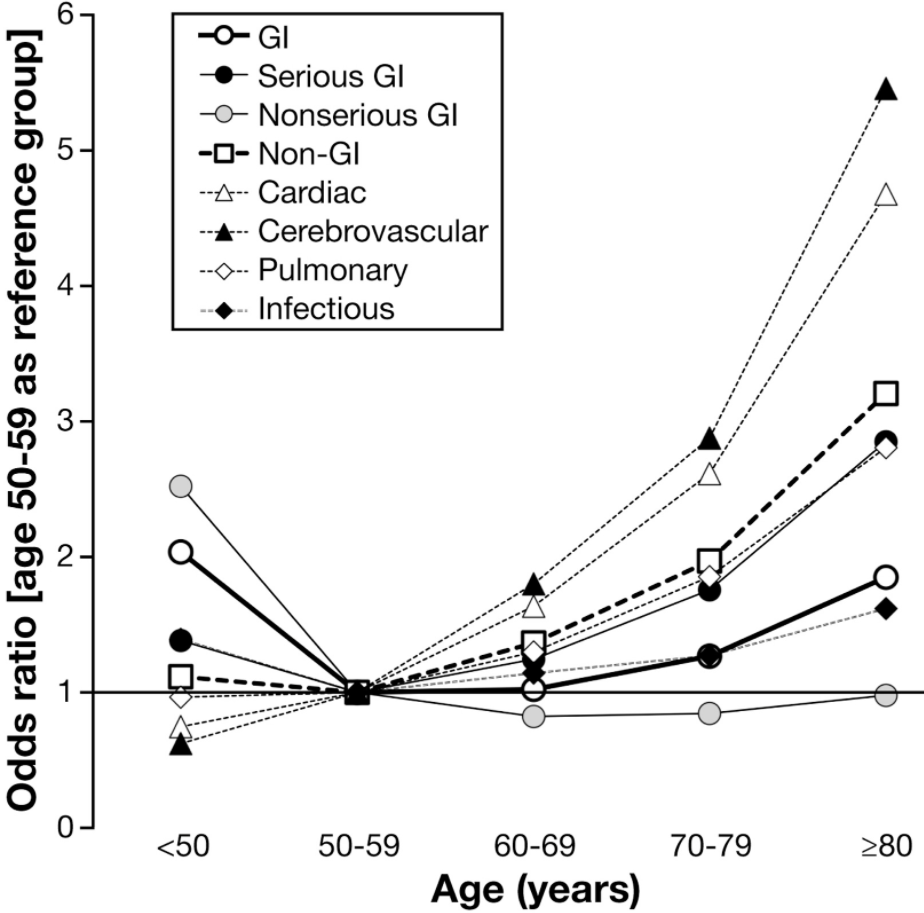
  • Complication rates were higher with advancing age, particularly in those >70 years. see Figure 2 below


Image available online: Figure 2


Improving the Value of Pediatric Colonoscopy

Two recent studies examine the diagnostic utility of pediatric gastrointestinal endoscopy:

  • PS Kawada et al. JPGN 2017; 64: 898-902
  • M Thomson, S Sharma. JPGN 2017; 64: 903-06

Before looking at these studies more closely, I would say that I was struck by contrasting remarks in their discussions. The first study: “a negative colonoscopy has not been shown to improve outcomes in those with functional pain” and references: Bonilla S et a. Clin Pediatr (Phila) 2011; 50: 396-401.  The second study states that “a negative endoscopic finding, with effective reassurance, can prevent unnecessary medicalization of many children in whom other nonorganic causes may present with GI symptoms.” The latter study does not provide any data to support their claim.

In terms of the specifics, the first study is a retrospective examination of 999 colonoscopies.  The indications for colonoscopy were suspected IBD; in this circumstance, 143 of 449 (32%) were normal.  For isolated rectal bleeding, 141 of 197 (72%) were normal.  For recurrent abdominal pain, all 46 were normal.  The cecal or beyond completion rate was only 52%, potentially lowering diagnostic yield.  The perforation rate during the 10 year timeframe (2001-2010) was 0.2%. The authors conclude that the yield of colonoscopy for recurrent abdominal pain (without other features) is very low and that many children with isolated rectal bleeding “should have a trial of conservative management before undergoing endoscopy.”

The second study retrospectively examined 153 endoscopic cases from a database of 2471 children (2012-2014).  The median age was 9.58 years. The authors found a diagnostic yield of 18.9% for upper endoscopy alone, 32.6% for ileocolonoscopy alone, and 39.2% for combined upper endoscopy/ileocolonoscopy. The terminal ileum intubation rate was 98%.

My take: Both of these studies look at pediatric endoscopy and reach opposite conclusions. The first study suggests that many colonoscopies could be avoided and the latter suggests that whether normal or not, endoscopy contributes to improved management. What is your conclusion?

Related blog posts:

Jean Hugues 1890, Edipe a Colone, Marbre taille d’apres le platre expose au Salon des Artistes fracaise. Musee d’Orsay


Turning Conventional Colonoscopy Positioning Upside Down

A recent article (The American Journal of Gastroenterology 110, 1576-1581 (November 2015) | doi:10.1038/ajg.2015.298) indicates that right-sided positioning rather than left-side down results in quicker and more comfortable colonoscopy.  While it is disconcerting to realize that I had been trained exactly opposite, if this technique works for me, it will be particularly helpful when patients undergo combination procedures since this means that the bed would not need to be rotated.  Thanks to Mike Hart for this reference.

Right Or Left in COLonoscopy (ROLCOL)? A Randomized Controlled Trial of Right- versus Left-Sided Starting Position in Colonoscopy

N VergisA K McGrathC H Stoddart and Jonathan M Hoare

OBJECTIVES:

Colonoscopy is technically challenging and can cause discomfort for patients. We aimed to test whether right-sided starting position for colonoscopy would result in shorter procedure time and greater patient comfort when compared with conventional left-sided starting position.

METHODS:

We conducted a randomized controlled trial in which patients were randomized to begin in either the right- (RL) or conventional left-lateral (LL) position. One hundred and sixty-three adult patients undergoing scheduled colonoscopy were stratified by age, gender, body mass index, and experience of the endoscopist. Patients were then randomized 1:1 in permuted blocks. The primary outcome measure was time to cecal intubation and secondary outcome measures included patient comfort that was evaluated by visual analog comfort scale.

RESULTS:

Median time to reach the cecum was quicker when colonoscopy began with patients positioned RL rather than LL (P=0.0078). Moreover, patients found RL more comfortable than LL (P=0.02). Multiple linear regression confirmed starting position in colonoscopy as an independent determinant of time to reach the cecum (P=0.007). Women and those who had previously undergone abdominal surgery gained the greatest benefit from right-sided positioning (RL vs. LL: 498 vs. 824s; P=0.03 and 498 vs. 797s; P=0.006, respectively).

CONCLUSIONS:

Our study reveals that right-sided positioning at the start of colonoscopy results in more comfortable and quicker procedures. Of the factors identified by multiple linear regression to independently have an impact on time to reach the cecum, only starting position is modifiable. Right-sided starting position may therefore be of benefit in colonoscopy, in particular for women and patients who have previously undergone abdominal surgery.

“Show Don’t Tell” –Colonoscopy Prep Instructions

A recent study, summarized in this link– Gastroenterology and Endoscopy News, indicates that providing an 11 minute video with colonoscopy prep instructions was more effective than written instructions.  Not only were the cleanouts better, but this resulted in better outcomes including higher adenoma detection rate and higher rates of completed colonosocpy.

Here’s an excerpt:

Dr. Bearelly and his colleagues randomized 298 individuals scheduled for screening colonoscopy to receive either the practice’s usual written instructions, or to receive the paper handout plus an instructional video (right). The 11-minute video—burned on a disk —covers the same instructions as the written materials, but in an interactive format that depicts a typical patient asking questions of one of the practice’s doctors.

The quality of bowel preparation between the two groups differed significantly (P=0.0098). Cecal intubation was 96% in the intervention group compared with 89% in the control group, and the adenoma detection rate was 53% and 42% in the two groups, respectively.

Patients in the intervention group had a Boston Bowel Preparation Score (BBPS) of 6.99±1.87, whereas those in the control group had a score of 6.43±2.54, although the difference was not statistically significant. A BBPS of 6, with a minimum of 2 in each segment, was considered adequate.

Take-home message:  Video instructions for colonoscopy are worthwhile.  In pediatrics, variability in cleanout regimens is a limiting factor.

Related blog posts:

NASPGHAN “Best Practices Cleanout Regimens”

The authors of a recent report (JPGN 2014; 59: 409-16) acknowledge that “bowel regimens vary significantly” and “few clinical studies in pediatrics have evaluated the use of various bowel preparation regimens.” Furthermore, “pediatric studies did not have a common efficacy measure.”

Nevertheless, they provide a “NASPGHAN best practices cleanout regimens.”  According to Table 7:

  • Option 1: PEG-3350 (eg. Miralax) -1-day cleanout:  If less than 50 kg, then 4 g/kg/day + bisacodyl 5 mg.  If >50 kg, then 238 g in 1.5 L sports drink + bisacodyl 10 mg.   PEG-3350 administered over 4-6 hours.
  • Option 2: PEG-3350 -2-day cleanout: If <50 kg, then 2 g/kg/day + bisacodyl 5 mg; if >50 kg, then 2 g/kg/day + bisacodyl 10 mg.
  • Option 3: NG cleanout: PEG-ELS (eg. Nulytely) 25 mL/kg/h (max 450 mL/h).  NG cleanouts mainly in those with history of failed preps or other adherence problems (eg. vomiting).
  • Option 4: non-PEG cleanout: Magnesium citrate 4-6 mL/kg/day + bisacodyl 5-10 mg.

My personal opinion is that Table 7 could drop the words “best practices” since the report states “alternative dosing regimens may be entirely reasonable” and the data are quite limited.

With regard to split dosing preparations which are now recommended in adults, their role in pediatrics is a “potential area for future research.” For adults, the U.S. Multi-Society Task Force Consensus Statement on Adequate Bowel Cleansing for Colonoscopy (Johnson DA et al. Optimizing Adequacy of Bowel Cleansing for Colonoscopy: Recommendations from the US Multi-Society Task Force on Colorectal Cancer. Gastroenterology 2014; 147(4):903-924) recommends:

  • Use of a split-dose bowel cleansing regimen is strongly recommended for elective colonoscopy, meaning roughly half of the bowel cleansing dose is given the day of the colonoscopy.
  • The second dose of split preparation ideally should begin four to six hours before the time of colonoscopy with completion of the last dose at least two hours before the procedure time.
  • During a split-dose bowel cleansing regimen, diet recommendations can include either low-residue or full liquids until the evening on the day before colonoscopy. 

Take-home message: This NASPGHAN report summarizes the literature and provides recommendations for effective bowel preparations.

Related blog posts:

Are Biopsies Needed with a Normal-appearing Colonoscopy?

“Colonoscopy in children routinely includes the practice of obtaining multiple biopsy samples even in the absence of gross mucosal abnormalities.”  This is the beginning of a recent report (JPGN 2014; 58: 773-78) which shows good agreement between endoscopic and histologic findings in a retrospective study of 390 colonoscopies.

Key findings:

  • “A known diagnosis of inflammatory bowel disease was a strong predictor of abnormal histology (OR 6.4 P<0.0001)”
  • 20 of 172 patients with a reportedly normal-appearing colonic mucosa had abnormal histology.  8 had a known diagnosis of IBD, 4 had symptoms/bloodwork highly suspicious for IBD, and another 3 were immunosuppressed.
  • The agreement rate (normal vs. abnormal) between pathologist and endoscopist was 84% with most of the disagreement when the endoscopist reported an abnormal finding whereas the pathologist reported normal histology.  This occurred in 11% of colonoscopies.

The authors “believe our data support the use of a combination of endoscopic appearance and evidence-based risk stratification to…reduce the number of biopsies obtained.”  “The symptom of abdominal pain as a primary indication for performing the procedure was an extremely strong negative predictor of histopathology. ”

Take-home message: If the colon appears normal and there is no prior evidence of IBD/along with reassuring laboratory studies, taking fewer biopsies is appropriate with colonoscopy in children.

Disclaimer: These blog posts are for educational purposes only. Specific dosing of medications/diets (along with potential adverse effects) should be confirmed by prescribing physician/nutritionist.  Endoscopy decisions should be determined by your physician. This content is not a substitute for medical advice, diagnosis or treatment provided by a qualified healthcare provider. Always seek the advice of your physician or other qualified health provider with any questions you may have regarding a condition.
How Colonoscopy & Preps are Indicative of Patient Activation and Health Care Decision-Making

I found two recent studies on bowel preps interesting primarily because of how they help us understand problems with utilization and problems with patient motivation.

The first study (Clin Gastroenterol Hepatol 2014; 12: 443-50) utilized a 5% random national sample of Medicare claims data.  The authors determined that among 57,597 Medicare beneficiaries 66 years and older that underwent screening colonoscopy (not therapeutic) 24.8% of these procedures were performed in individuals with a life expectancy <10 years.  Given the nature of the study (eg. relying on administrative data), there were several limitations.  However, the implication of the study is that there are a lot of unnecessary colonoscopies.  That is, screening colonoscopies are intended to interrupt a sequence of adenoma to adenocarcinoma that can take years; even when cancer is present, it can take several years before the onset of clinical symptoms.  Currently, the US Preventive Services Task Force (USPSTF) recommends against routine screening in those aged 75-84, precisely because the benefits of screening may be outweighed by the risks of screening.”  The authors note that “people with multiple comorbidities (and therefore lower life expectancy) are more likely to visit multiple providers, which increases the chances of receiving testing.”

The second study (Clin Gastroenterol Hepatol 2014; 12: 451-57) showed that patients with lower “patient activation” are much more likely to have a poor colonoscopy preparation.  Patient activation is defined as “an individual’s knowledge, skill, and confidence for managing his/her own health and health care.”  The author’s note that the “Patient Activation Measure (PAM) is a validated scale developed…to measure this construct.” This cross-sectional study took place in Chicago between 2008-2010 at either an academic practice or a ‘federally qualified health center.’ Key findings:

  • One-third of patients (n=134/462 adults) had suboptimal quality of bowel preparations. Of these, 15% (n=62) were fair quality and 17% (n=72) were poor quality.
  • After multivariable analysis and adjustments, patient activation (OR 2.12) and diabetes (OR 2.45) were independent predictors of suboptimal bowel preparation quality.
  • Health literacy (a measure of cognitive skill) was not correlated with patient activation (a measure of patient engagement).

Also noted in same journal issue: Clin Gastroenterol Hepatol 2014; 12: 470-77.  “In a supervised setting, nurse endoscopists perform colonoscopies (after a minimum of 100) according to quality and safety standards that are comparable with those of physician endoscopist and can substantially reduce costs.”

Take-home messages:

  1. Poor bowel preparations are common.  In studies of adult patients, split-dose preparations can help.  The associated editorial (pg 458-462) recommends delaying case and considering further oral prep or enemas for patients arriving with stool that is not clear or yellow.
  2. Colonoscopies are performed too frequently in some patients and not frequently enough in others.  Thus, something as simple as a colonoscopy is not so simple.

Related blog posts:

Variation in Practice -The Influence of Money

A recent study highlights the problem of bundling and shows how financial incentives distort care in some gastroenterology practices (Clin Gastroenterol Hepatol 2014; 12: 58-63).

Background: When needed, patients can undergo both colonoscopy and esophagogastroduodenoscopy (EGD) at the same time; when combined, the procedures are considered bundled.  It is more convenient for patients and less costly to do the two procedures during the same sedation.  However, Medicare reimbursement to physicians for bundled procedures is less than the sum of the two procedures when charged separately. This creates an incentive for physicians to unbundle these procedures.

Study design: The authors examined Medicare claims from 2007-2009 in a national, random sample (patients ≥66 years) –part of the Surveillance Epidemiology and End Results Program.

Results:

  • 12,982 had colonoscopy and EGD within 180 days.  ~35% of these were not bundled.  This included 2359 (18%) unbundled procedures which were performed within 30 days of each other.
  • Geographic differences were noted: bundling occurred less often in the Northeast (55%) and most often in the West (68%)

What does this study indicate about bundling (& human nature)?  This study indicates that physicians respond to underlying financial incentives to separate these procedures.  In our pediatric practice, we do not unbundle procedures.  The additional facility costs, use of anesthesia, costs to families from missing work, and convenience are compelling reasons to combine procedures if feasible.  However, this data indicates that unless physicians are paid the same value for each EGD and colonoscopy, there will continue to be many patients who have their procedures scheduled on separate dates.

Bottomline: Medicare and other insurance companies will save money by not paying less for combined procedures.

Another example of financial incentive influencing care with regard to ambulance and EMS care:  How Perverse Incentives Drive Up Health Care Costs / ideastream