Dubin-Johnson Syndrome

From NEJM:

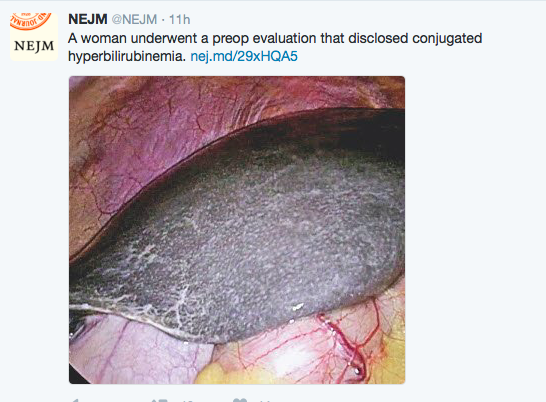
A 48-year-old woman scheduled to receive a laparoscopic cholecystectomy underwent a preoperative evaluation that disclosed conjugated hyperbilirubinemia…

A biopsy specimen revealed coarse, deep-brown, pigmented granules on periodic acid–Schiff staining (Panel B), primarily at the canalicular pole of the hepatocytes and especially in the pericentral zones, with otherwise well-preserved lobular architecture. Expression of the multidrug-resistance–associated protein 2 (MRP2) was absent on anti–MRP2 immunohistochemical analysis (Panel C; see also comparison with control specimen [inset]). A diagnosis of the Dubin–Johnson syndrome was confirmed. This syndrome is an autosomal recessive disorder that is caused by a mutation in MRP2 that results in deficient canalicular expression of MRP2 and impaired secretion of conjugated bilirubin into the bile. Such mutations cause an isolated increase in serum levels of conjugated bilirubin and the appearance of a black liver, without associated sequelae.
Dubin-Johnson

Diagnosing biliary atresia earlier

Biliary atresia (BA) is often suspected among infants with prolonged jaundice. In fact, efforts have been underway for a long time to encourage fractionation of the bilirubin values to look for conjugated hyperbilirubinemia, especially in infants that remain jaundiced at three weeks of life.  While this is still good advice, given the lack of success in implementation, there is good evidence that obtaining a fractionated bilirubin at any time point can help identify cholestasis associated with BA.

A recent article by Karpen et al (Pediatrics 2011; 128:. e1428 -e1433) indicates that direct bilirubin values are elevated beginning within the first one to two days in patients with BA.  In their cohort of 61 BA subjects, 56% had newborn fractionated bilirubin values.  Every BA patient had elevated direct bilirubin, on average 1.4 ± 0.43 mg/dL (normal <0.5) (compared with control patients:  0.19 ± 0.075 mg/dL, P < .0001).  Also, another important finding was that early on the ratio of direct bilirubin to total bilirubin was normal in 79%; normally this ratios is ≤0.2.  As such, all patients with increased direct bilirubin need to be followed closely.

Related blog entries:

Outcomes of Biliary Atresia

MicroRNAs and biliary atresia

Bleeding due to vitamin K deficiency