
DM Cohn et al. N Engl J Med 2026;395:1471-1482. Lonvoguran Ziclumeran — In Vivo CRISPR Gene Editing in Hereditary Angioedema
Background: “Lonvoguran ziclumeran (lonvo-z) — an investigational, in vivo gene-editing treatment based on clustered regularly interspaced short palindromic repeats (CRISPR) — is being developed as a single-dose treatment for hereditary angioedema”
Methods: 80 patients (16 yrs and older) underwent randomization; 52 were assigned to receive lonvo-z and 28 to receive placebo.
Key findings:
- Between weeks 5-28, there were 62% of the lonvo-z group that had no attacks compared to 11% of the placebo group
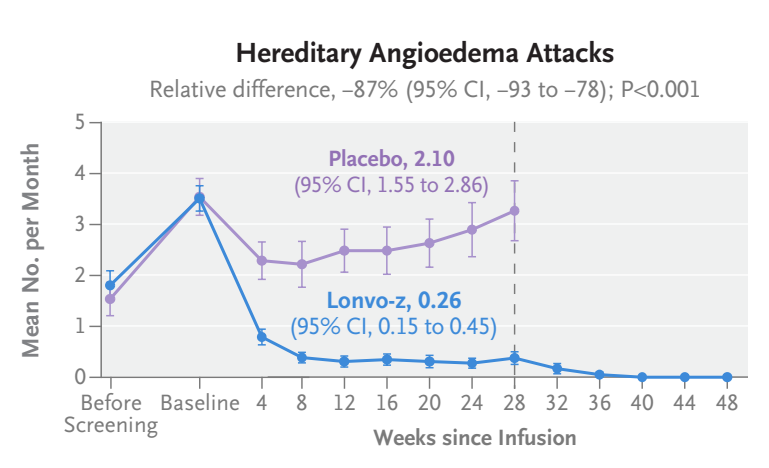
- Safety: “The most common adverse effect (occurring in >10% of the patients in the lonvo-z group) included infusion-related reaction, headache, fatigue, back pain, and upper respiratory tract infection. No serious or grade 3 or higher adverse events were reported in the lonvo-z group”
Discussion points:
- “The edit to the gene KLKB1 is intended to be permanent after treatment with lonvo-z.”
- Safety: “Consideration must therefore be given to the long-term safety of plasma prekallikrein knockdown. Reports in the literature of a rare congenital plasma kallikrein deficiency (Fletcher factor deficiency) suggest that such persons are healthy and have prolonged activated partial-thromboplastin time without an associated bleeding risk19…The most prevalent cardiovascular condition reported in persons with congenital plasma kallikrein deficiency is hypertension,20,22 which has not been reported as an adverse event in patients treated with lonvo-z to date.”
- “Another important consideration is the potential risk of off-target editing…Across all clinical trials conducted with lonvo-z to date, no evidence of adverse effects attributable to off-target editing has been observed.”
My take: This is a remarkable achievement; a single CRISPR infusion may cure individuals with Hereditary Angioedema. Long-term data is needed to more fully understand the safety profile. While this infusion is likely to be quite costly, the currently available treatments are also very expensive and without a defined end-point.
Related blog posts:
- Overlooking Important Detail$ in Hereditary Angioedema Treatment
- A “Swell Diagnosis” (part 2)
- “A Swell Diagnosis”
- Liver Briefs: Hereditary Angioedema/Liver Transplantation, Bulevirtide/PEG for HDV, and AASLD Cystic Fibrosis Guidance
- Intermittent Abdominal Pain and Intestinal Swelling –a Mystery? This case highlights how some medications (eg. lisinopril) can trigger angioedema


