No Exaggeration: Too Many Children Are Dying in the U.S. (2019) “The sad fact is that a child or adolescent in the United States is 57% more likely to die by the age of 19 years than those in other wealthy nations.” This is due mainly to more deaths from MVAs and from gun violence.
D Hemenway. NEJM 2024; 390:1352-1353 Twenty-Five Years after Columbine — Firearms and Public Health in the United States
This commentary notes that in the aftermath of Columbine, Smith and Weston had agreed “to upgrade its products and practices to help reduce the harms caused by its guns. Since a common cause of unintentional shootings is incorrectly believing that the gun is unloaded, its pistols would have chamber load indicators, and magazine disconnects would be available. The company would provide “ballistic fingerprints” on new firearms to help law-enforcement agencies trace guns. It would sell its guns only to dealers who had a plan for preventing gun theft and — to reduce gun trafficking — would agree to limit multiple-handgun sales to any individual buyer. The dealers would also have to agree not to sell large-capacity magazines.1 But the firearms industry immediately began boycotting the company, and its chief executive officer was forced to retire.”
This article offers the following advice to reduce firearm mortality, the number one killer of children:
“The Surgeon General could provide biannual reports on guns and suicide; the federal government could both conduct and fund research into smart guns and safer means of home protection than owning a handgun”
“Police could have social workers embedded in precincts”
“The faith community could make it clear that it is a cardinal sin to sell a gun to a stranger without a background check”
“Probably the most important thing our country can do is to elect more officials who will help make changes where the effect will be greatest — in the gun industry and the gun culture”
“To achieve a huge reduction in gun deaths will probably require mandating what is common for car drivers in the United States and for gun owners in other high-income countries: gun licensing, gun training, and handgun registration, along with universal background checks. These requirements are supported by most Americans”
“PLCAA (Protection of Lawful Commerce in Arms Act) protections should be eliminated, and the gun industry treated like other industries”
“And just as car manufacturers had to be forced to put seat belts, airbags, collapsible steering columns, and safety glass into their vehicles, the gun industry should be forced to take the types of steps that Smith and Wesson was willing to take 25 years ago”
No Exaggeration: Too Many Children Are Dying in the U.S. “The sad fact is that a child or adolescent in the United States is 57% more likely to die by the age of 19 years than those in other wealthy nations.” This is due mainly to more deaths from MVAs and from gun violence.
E Tobin-Tyler. NEJM 2023; 388: 1345-1347. Courts’ Disregard for Women’s Health and Safety — Intimate Partner Violence, Firearms, and “History and Tradition”
A few excerpts:
In June 2022, the Supreme Court issued its opinion in New York State Rifle & Pistol Association v. Bruen, which left the door open for constitutional challenges to virtually any state or federal firearm restriction. One of these restrictions is a federal law passed in 1994 as part of the Violence Against Women Act (VAWA) that makes it unlawful for people subject to certain domestic violence–related restraining orders to possess a firearm or ammunition for the duration of the order.
Writing for the majority in Bruen, Justice Clarence Thomas struck down New York’s restrictions on who may carry a firearm in public. In doing so, he declared that a government arguing in support of a restriction on firearm possession has the burden of showing that its regulation “is consistent with the Nation’s historical tradition of firearm regulation.”..
On the heels of the Supreme Court’s decision in Bruen, a federal district judge on November 10, 2022, held in United States v. Perez-Gallan that the VAWA’s restriction on firearm possession by people subject to restraining orders is unconstitutional…
Searching for relevant laws from the 18th and 19th centuries to justify current laws protecting people who have experienced IPV (intimate partner violence) obscures the fact that married women weren’t even considered legal subjects until the late 19th century. Instead, they were understood to be the property of their husbands.1 Black women who were enslaved, married or not, had no legal rights. “Wife beating” did not become illegal in some states until the late 19th century…
In Rahimi, the court applied Bruen’s “history and tradition” analysis to a case involving a person who not only was subject to a restraining order because he had allegedly assaulted his ex-girlfriend, but also had been involved in incidents in which he had fired a gun at people and at a constable’s car…The court determined that under Bruen’s analysis, there is no reason to consider the potential consequences for people experiencing IPV of permitting their abusers to possess guns.
My take: Deciding gun ownership laws solely on the basis of ‘history and tradition’ is incredibly stupid. Research shows that restriction of access to firearms by domestic abusers results in lower rates of gun deaths. This supreme court will allow anyone to possess a firearm, except those in their vicinity.
Related article: The Hill (5/11/23): Federal judge rules adults ages 18-20 cannot be blocked from purchasing handguns. “A federal judge in Virginia has ruled that federal laws prohibiting 18-to-20-year-olds from getting handguns at federally licensed firearms dealers are unconstitutional…The judge concluded that the Second Amendment’s “right of the people to keep and bear Arms” applies to people in that age group. “Because the statutes and regulations in question are not consistent with our Nation’s history and tradition, they, therefore, cannot stand,” Payne wrote.
Also, I want to give a shout out to Ajay Kaul (who completed his training in Cincy one year after I did) and his recent Bowel Sounds Podcast. Ajay is a terrific person. This was a good review on Achalasia and a reminder of the improvements in motility testing. A good clinical pearl was to ask anesthesiology to intubate patients with suspected achalasia to protect their airway.
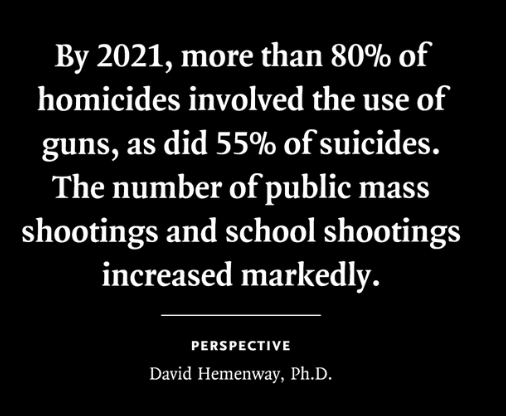
Firearm-related deaths are now the leading cause of death in U.S. children. The push to make guns more available is resulting in more tragic outcomes. In the U.S., putting too much mayonnaise on a sandwich can be a death sentence:
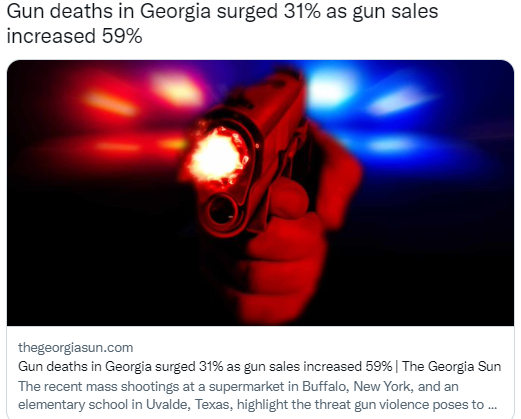
In Georgia, the law, signed by current governor Brian Kemp, allows Georgians to carry concealed handguns without first getting a license from the state. This law along with a previous “Guns Everywhere Law” has been associated with increased gun sales and increased gun violence and deaths.
After Uvalde, Amanda Gorman published the following poem
Everything hurts, Our hearts shadowed and strange, Minds made muddied and mute. We carry tragedy, terrifying and true. And yet none of it is new; We knew it as home, As horror, As heritage. Even our children Cannot be children, Cannot be.
Everything hurts. It’s a hard time to be alive, And even harder to stay that way. We’re burdened to live out these days, While at the same time, blessed to outlive them.
This alarm is how we know We must be altered — That we must differ or die, That we must triumph or try. Thus while hate cannot be terminated, It can be transformed Into a love that lets us live.
May we not just grieve, but give: May we not just ache, but act; May our signed right to bear arms Never blind our sight from shared harm; May we choose our children over chaos. May another innocent never be lost.
Maybe everything hurts, Our hearts shadowed & strange. But only when everything hurts May everything change.
No Exaggeration: Too Many Children Are Dying in the U.S. “The sad fact is that a child or adolescent in the United States is 57% more likely to die by the age of 19 years than those in other wealthy nations.” This is due mainly to more deaths from MVAs and from gun violence.
No Exaggeration: Too Many Children Are Dying in the U.S. “The sad fact is that a child or adolescent in the United States is 57% more likely to die by the age of 19 years than those in other wealthy nations.” This is due mainly to more deaths from MVAs and from gun violence.
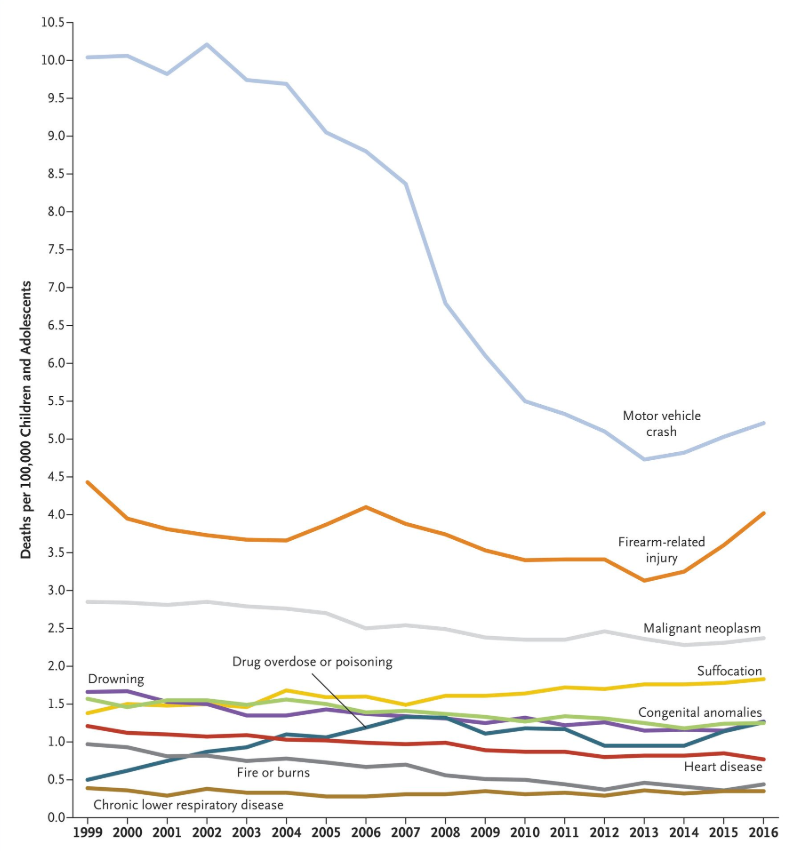
This short commentary explains how the childhood deaths due to motor vehicle accidents have improved. “The crossing of these trend lines demonstrates how a concerted approach to injury prevention can reduce injuries and deaths — and, conversely, how a public health problem can be exacerbated in the absence of such attention.”
This retrospective cohort study followed 17.6 million adult residents of California for up to 12 years.
Key findings:
Overall rates of homicide were more than twice as high among cohabitants of handgun owners than among cohabitants of nonowners (adjusted hazard ratio, 2.33).
These elevated rates were driven largely by higher rates of homicide by firearm (adjusted hazard ratio, 2.83).
Among homicides occurring at home, cohabitants of gun owners had sevenfold higher rates of being fatally shot by a spouse or intimate partner (adjusted hazard ratio, 7.16); 84% of these victims were female.
My take: Gun ownership increases the likelihood of firearm-related deaths.
No Exaggeration: Too Many Children Are Dying in the U.S. “The sad fact is that a child or adolescent in the United States is 57% more likely to die by the age of 19 years than those in other wealthy nations.” This is due mainly to more deaths from MVAs and from gun violence.
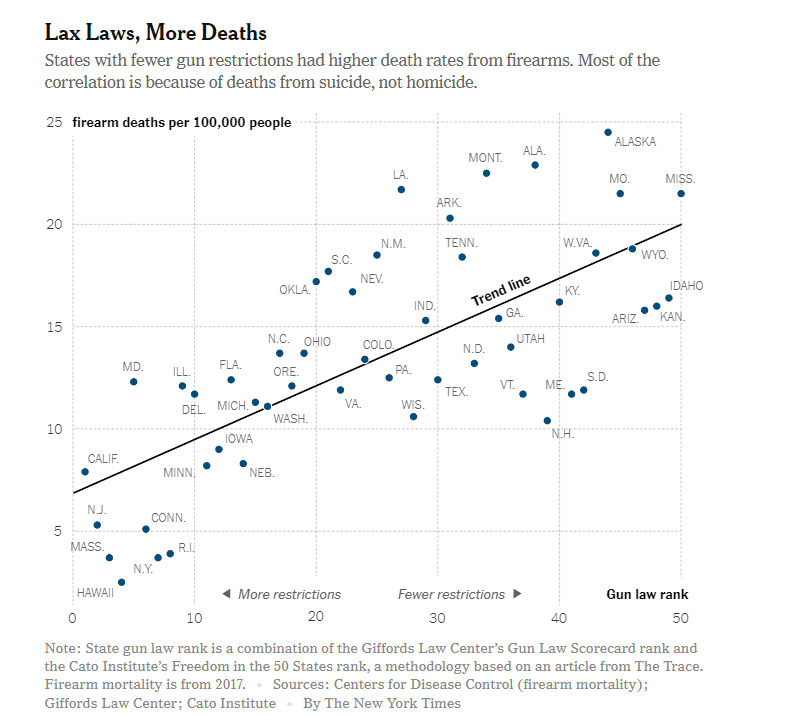
Those opposed to gun safety provisions (a.k.a. gun control legislation) argue that laws will not prevent criminals from obtaining firearms illegally. A recent commentary in NY Times provides some data that shows that states with more gun safety provisions have lower levels of gun-related deaths (especially suicides).
A recent report (RM Cunningham et al. NEJM 2018; 379: 2468-75; editorial 2466-7) highlights the poor outcomes for children in the U.S. based mainly on the CDC WONDER (Wide-ranging Online Data for Epidemiologic Research) database.
Key findings:
“The sad fact is that a child or adolescent in the United States is 57% more likely to die by the age of 19 years than those in other wealthy nations.”
Motor vehicle accidents (MVA) are the number one cause of deaths in children/adolescents, accounting for 20% of such deaths. The U.S. rate of death from MVAs is “triple that in other developed countries.” Overall, MVA deaths had dropped in half from 1999-2013 but have increased in last few years; this increase is thought to be related to distracted driving/walking due to cellphones.
Firearm-related deaths accounted for 15% of deaths in children/adolescents in U.S. In U.S., children/adolescents are “36 times as likely to be killed by gunshots.” Unlike adults in U.S., the majority of these gunshots are homicides (59%) rather than suicides (35%); unintentional firearm deaths accounted for 4% (2% undetermined firearm-related death). Among U.S. adults, 62% of deaths from firearms were from suicide.
Malignant neoplasms were the third leading mortality cause in children/adolescents, 9%. This rate is similar to other countries.
The figures in the study are very helpful:
Figure 2: Deaths from MVAs for the U.S. pediatric population are more similar to low-to-middle income countries (Figure 2A) whereas firearm-related deaths are much greater than all of the countries shown in Figure 2B (including Sweden, England, Hungary, Australia, Austria, Thailand, Tajikistan, Romania, Mongolia).
Figure 3. Deaths in U.S. rural areas are roughly double from MVAs than from the average of urban/suburban areas. Deaths from firearms are similar in all three areas. There are several factors which could explain the high rate of fatal MVAs in rural areas: longer time to get medical attention, faster speeds in less populous areas, less seat belts, lower enforcement of traffic laws, and impaired driving.
My take: The increased risk of death from MVAs and firearms identified in this study should not be considered “accidents” but failures. Is it too much to expect that a child born in the U.S. could have the same chance to reach adulthood as a child in Canada or a child in Europe?
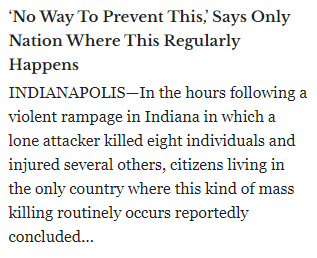
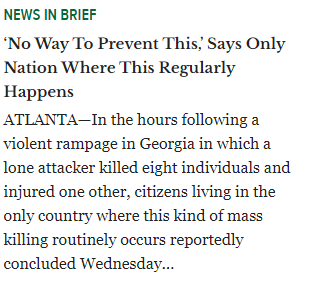
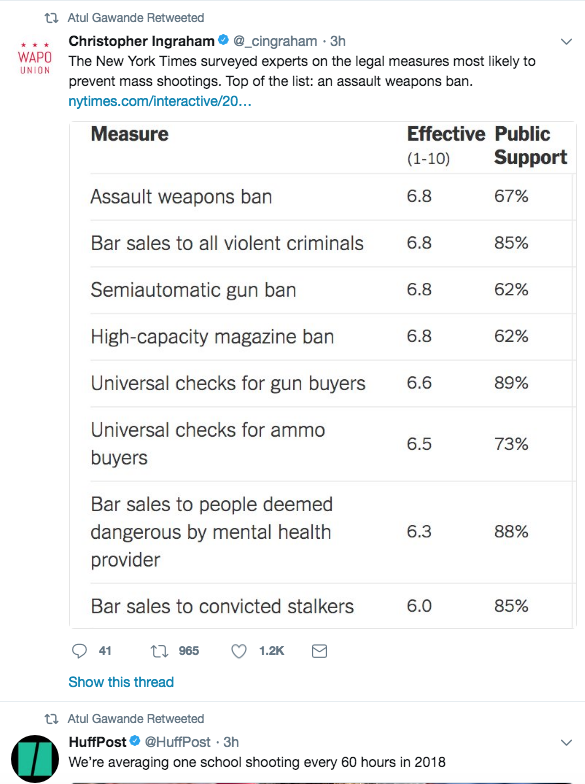
Between 2001-2013, gun related deaths exceeded the total number of deaths from AIDS, terrorism, war, and illegal drug overdoses combined (according to Vox -see Firearm Mortality in U.S). Here are some tweets in reaction to yesterday’s tragic events.









 gutsandgrowth