Upadacitinib’s Effectiveness for Perianal Fistulizing Crohn’s Disease

J-F Colombel et al. Clinical Gastroenterology and Hepatology, Volume 23, Issue 6, 1019 – 1029. Open Access! Efficacy and Safety of Upadacitinib for Perianal Fistulizing Crohn’s Disease: A Post Hoc Analysis of 3 Phase 3 Trials

Methods: This post hoc analysis evaluated upadacitinib outcomes in patients with fistulizing disease in the following studies: phase 3 induction (U-EXCEL, U-EXCEED) and maintenance (U-ENDURE) trials. It was noted that there were 1021 patients in U-EXCEL and U-EXCEED; 143 (14.0%) had any fistulas at baseline (66 draining). Most (n = 128) had perianal fistulas (56 draining).
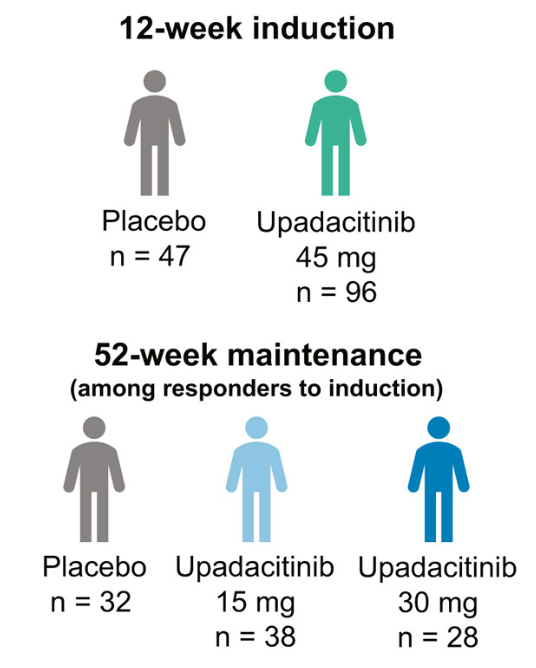
Key findings:

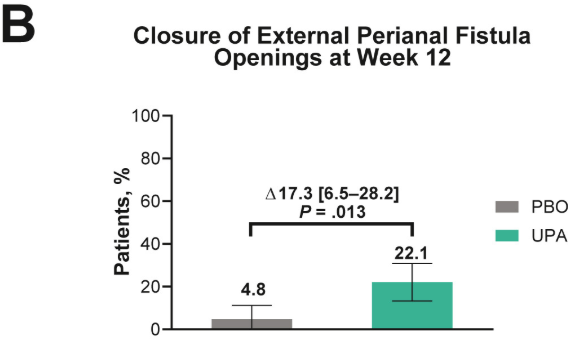
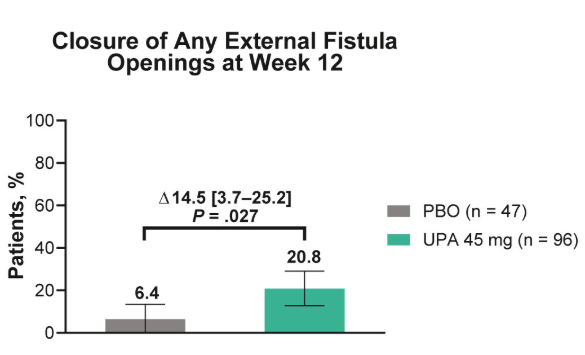
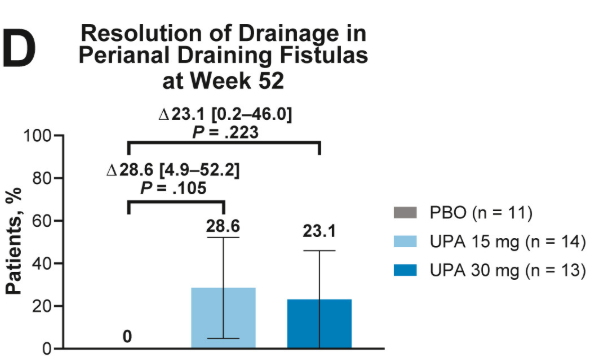
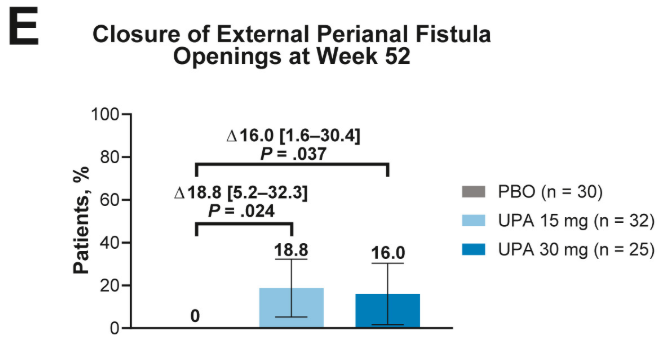
  • Fistulizing disease (primarily perianal) treated with upadacitinib achieved higher rates of resolution of drainage, closure of external openings, clinical remission, and endoscopic response vs placebo
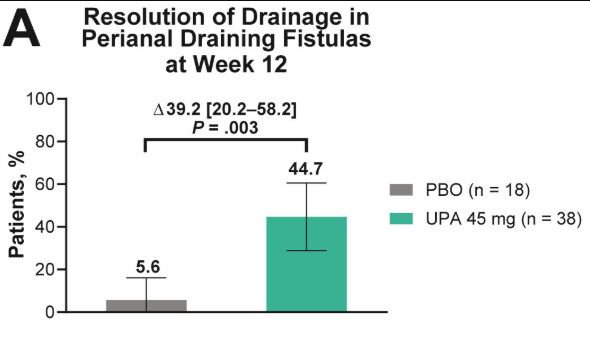
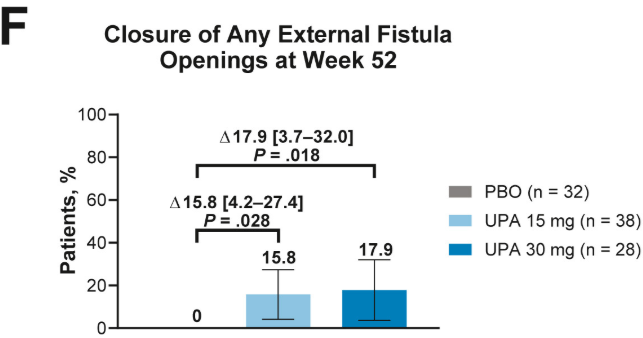
These slides from Figure 1 show the resolution of drainage in perianal draining fistulas, closure of external perianal fistula openings, and closure of external openings for any fistula at week 12 of the induction trials and week 52 of the maintenance trial.

Discussion points:

  • Patients with draining fistulas often experience higher disease burden
  • Most patients in U-EXCEL and U-EXCEED had failed at least 2 prior biologic treatments (which often included anti-TNF therapy), reflecting a more refractory and difficult-to-treat population in CD
  • Despite the presence of perianal disease, patients with fistulizing CD treated with upadacitinib showed concurrent improvements in CD symptoms (CDAI, SF, and APS), luminal disease (endoscopic response and SES-CD), and markers of inflammation

My take: This study shows that upadacitinib is more effective than placebo; however, the majority of patients continued with ongoing perianal disease.

Related blog posts:

Efficacy of Anti-TNF Agents for Internal Fistulas and Study of Antibiotics and Development of IBD

G Bougen et al. Clin Gastroenterol Hepatol 2020; 18: 628-36.  This retrospective study (n=156, median age 32 years) found that anti-TNF therapy delays or prevents surgery for almost half of patients with Crohn’s disease who had luminal fistulas.  Key findings:

  • With a median followup of 3.5 years, “68 patients (43.6%) underwent a major abdominal surgery.”
  • Fistula healing occurred on average 1 year after the introduction of anti-TNF treatment
  • The presence of a stricture or abscess increased the likelihood of surgery.
  • Three patients died from intestinal adenocarcinomas, one patient died from melanoma (6 months after initiation of anti-TNF therapy), one patient died from sepsis (3 months after initiation of anti-TNF therapy, and 32 patients (20.5%) developed an intestinal abscess.

My take: Therapy with anti-TNF agent, in the setting of a luminal fistula, is a reasonable option, especially in the absence of a concurrent stricture.

FS Troelsen, S Jick. Inflamm Bowel Dis 2020; 26: 440-7, editorial 448-9. Using a UK database, the authors identified 461 cases of ulcerative colitis (UC) and 863 cases of Crohn’s disease (CD) and then matched each case to 4 controls. Key findings:

  • There was no association between ever use of antibiotics and UC, OR 1.02 or CD, OR 1.01 compared to never use of antibiotics
  • CD was associated with antibiotic exposure before age 5 (OR 2.2) in analysis restricted to individuals followed from birth
  • A slight increase was seen for CD in ever users of quinolones (OR 1.76, CI 1.00-3.11) and metronidazole (OR 1.43, CI 0.87-2.34)

In the editorial, Charles Bernstein notes that “it may be that specific types of antibiotics…at specific times in a person’s life have differential risks for IBD development. Also, it may be that what triggers IBD in children is different than what triggers IBD later in life.”

Duke University -late Fall 2019

IBD Update March 2019

Briefly noted:

W El-Matary et al. Inflamm Bowel Dis 2019; 25: 150-5. This retrospective study of 667 children with Crohn’s disease who were prospectively enrolled in an inception study found that 85 (12.7%) had fistulizing perianal disease. The mean infliximab (pre-fourth dose) was 12.7 mcg/mL in responders compared with 5.4 mcg/mL in the active disease group.  My take: Higher trough levels are desirable in those with fistulizing disease.

LJT Smits et al. Inflamm Bowel Dis 2019; 25: 172-9. In a  prospective cohort with 83 patients with IBD (57 with Crohn’s disease) with at least 2 years of followup, 66% of IBD patients continued CT-P13 after switching from Remicade; two patients developed anti-drug antibodies.  The absolute numbers suggest no adverse impact of a single switch to the biosimilar product.

Related blog posts:

A Tinsley et al. Inflamm Bowel Dis 2019; 25: 369-76. This study documents the increased risk of influenza and increased influenza complications among IBD patients based on a database cohort of 140,480 patients (with and without IBD). The risk of hospitalization was 5.4% in patients with IBD compared with 1.85% in non-IBD patients.

Related blog post: Almost Everybody Needs Flu Shot -IBD Patients at Higher Risk

YY Xu et al. Inflamm Bowel Dis 2019; 25: 261-9. This meta-analysis included 18 nonrandomized controlled trial studies with 1407 patients who received preoperative infliximab and 4589 patients.  The authors showed that preoperative infliximab was not associated with any statistically significant differences for the 2 groups for any complications, reoperation, readmission or mortality.

CN Bernstein et alInflamm Bowel Dis 2019; 25: 360-8. This study, using population-based administrative health data (Manitoba) found increased burden of psychiatric disorders in IBD: compared with controls the incidence rate ratio for depression was 1.58, for anxiety 1.39, for bipolar disorder 1.82, and for schizophrenia 1.64.

Related blog post: #NASPGHAN17 Psychosocial Problems in Adolescents with IBD

View from Ryan Mountain, Joshua Tree National Park