Do Acid Blockers Given to Infants Increase the Risk of Allergic Disease?

A recent retrospective study (Mitre E, et al. JAMA Pediatr. 2018;doi:10.1001/jamapediatrics.2018.0315) suggests that acid blockers, both histamine receptor antagonists and proton pump inhibitors increase the risk of developing allergic disease.  Since this is a retrospective study, this association with allergic diseases has NOT been proven to have a causal relationship; thus, an alternative explanation would be that infants who are likely to develop allergic diseases could be prescribed these agents more frequently due to symptoms attributed to reflux.

Here is an excerpt from a summary of this study (from Healio):  Acid-suppressor, antibiotic use in infancy tied to later allergic disease

Of the 792,130 children included in the study (49.9% female), 7.6% were prescribed a histamine-2 receptor antagonist (H2RA) and 1.7% were prescribed a proton pump inhibitor (PPI) within the first 6 months of life. Antibiotics also were prescribed for 16.6% of infants included in the study during this time. Mitre and colleagues noted that data continued to be collected on these infants for a median of 4.6 years…

When children were prescribed an H2RA, the researchers noted adjusted HRs of 2.18 (95% CI, 2.04-2.33) for food allergy, 1.70 (95% CI, 1.60-1.80) for medication allergy, 1.51 (95% CI, 1.38-1.66) for anaphylaxis, 1.50 (95% CI, 1.46-1.54) for allergic rhinitis and 1.25 (95% CI, 1.21-1.29) for asthma.

Infants who were prescribed PPIs had comparable aHRs, which the researchers observed at 2.59 (95% CI, 2.25-3.00) for food allergy, 1.84 (95% CI, 1.56-2.17) for medication allergy, 1.45 (95% CI, 1.22-1.73) for anaphylaxis and 1.44 (95% CI, 1.36-1.52) for asthma.

Mitre and colleagues also calculated the aHRs related to later allergic disease in children who were prescribed antibiotics within the first 6 months of life. They observed these rates at 2.09 (95% CI, 2.05-2.13) for asthma, 1.75 (95% CI, 1.72-1.78) for allergic rhinitis, 1.51 (95% CI, 1.38-1.66) for anaphylaxis and 1.42 (95% CI, 1.34-1.50) for allergic conjunctivitis.

My take: This study is another reminder that these agents may be more detrimental than beneficial in the vast majority of infants.

Related blog post:

Better to Do a Coin Toss than an ENT Examination to Determine Reflux

A recent study (R Rosen et al. J Pediatr 2017; 183: 127-31) adds additional data to the literature which has shown that ENT doctors are NOT able to tell if there is reflux by examining the airway.

Prior post on this topic: Accuracy of ENT diagnosis of Reflux Changes

This prospective, cross-sectional cohort study of 77 children correlated ENT examinations with “reflux finding score” (RFS) by three blinded otolaryngologists with objective measures of reflux: pH-metry and impedance.  All children had chronic cough and underwent bronchoscopy and esophagogastroduodenoscopy.

Key findings:

  • “There was no correlation between pH-MII variables and mean RFS”
  • The concordance correlation for RFS between ENT doctors was low (intraclass correlation coefficient =0.32)
  • Using pH-metry as a gold standard, the positive predictive value for the RFS was 29% whereas with MII as the gold standard, the positive predictive value for the RFS was 40%.

My take: ENT doctors are unable to tell if a patient has reflux.  The finding of a red or swollen airway has poor predictive value in determining the presence of reflux –a coin toss is more reliable.  Based on this study and others, starting a PPI because of an abnormal airway exam does not make sense.

Related blog posts:

Monet, Musee de l’Orangerie

Update on Chronic Cough

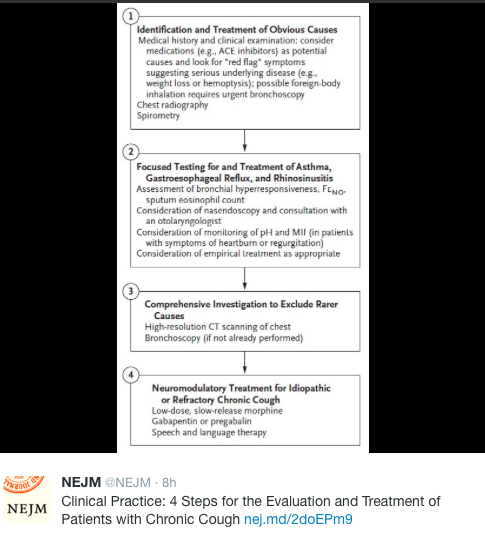
It is not uncommon for a pediatric gastroenterologist to see a patient with a chronic cough due to concerns about potential gastroesophageal reflux disease (GERD).  As such, a recent clinical practice article (JA Smith, A Woodcock. NEJM 2016; 375: 1544-51) by lung specialists was of interest, even though this article was not targeted to the pediatric population.

Key points:

  • The authors define a chronic cough as lasting more than 8 weeks and note that it common with respiratory conditions (eg. chronic obstructive pulmonary disease, asthma, and bronchiectasis) and some non-respiratory conditions (eg. gastroesophageal reflux and rhinosinusitis).  Medications, particularly ACE inhibitors, can trigger a chronic cough as well.
  • Steps in evaluation: 1. H&P, CXR, spirometry. 2. Consider metacholine challenge, ENT evaluation, consider empiric treatment (eg. inhaled glucocorticoids, PPI), and consider GERD evaluation. 3. High-resolution CT and bronchoscopy.
  • For many patients, there is likely to be an abnormality in neuronal pathways controlling cough and the term “cough hypersensitivity syndrome” has been coined.  Figure 2 (below) illustrates the neuronal pathways.
  • For refractory patients, potential therapies would include low-dose morphine, gabapentin or pregabalin, and speech language therapy.

screen-shot-2016-10-26-at-8-24-57-pm

GERD:

  • Guidelines “suggest a trial of treatment with acid-suppression therapy” (eg. twice-daily PPIs for up to 3 months).
  • “Most randomized, controlled trials of reflux treatment for cough have not shown a significant improvement in association with this type of treatment.”
  • Subgroups of patients with heartburn, regurgitation, or excessive acid reflux on esophageal pH monitoring “appeared marginally more likely to have a response to PPI treatment.”  pH or impedance tests “are poorly predictive of a response of cough to acid suppression.”

My take: In the absence of clinical reflux, reflux therapy is unlikely to help with chronic cough.  However, in patients with an adequate workup, an empiric course of a PPI is likely more preferable than empiric morphine or gabapentin.

Related blog posts:


screen-shot-2016-10-22-at-4-01-47-pm

Guidelines for Esophageal Atresia-Tracheoesophageal Fistula

From a NASPGHAN-ESPGHAN working group of surgeons and pediatric gastroenterologists. a recent guideline (U Krishan et al JPGN 2016; 63: 550-70) regarding esophageal atresia (EA) and tracheoesophageal fistula (TEF) has made 36 specific statements and graded the evidence for these recommendations.

On GERD:

  • Low level evidence: The authors recommended starting PPIs in the neonatal period and continuing them “up to the first year of life or longer, depending on persistence of GERD.”
  • High level evidence: pH monitoring is useful in evaluating the severity of acid reflux in patients with EA.  Low level evidence: pH-impedance monitoring is useful to evaluate and correlate non-acid reflux in selected patients.
  • High level evidence: “Endoscopy with biopsies is mandatory for routine monitoring of GERD in patients with EA.” The authors recommend evaluation (pH, impedance, and/or endoscopy) at time of stopping anti-acid treatment and during long-term follow-up. Specifically,  with low level of evidence, the authors advocate for one endoscopy after stopping PPI therapy, one before age 10 years, and one at transition to adulthood.”
  • High level evidence: Fundoplication has accepted role, despite dysmotility, in patients with recurrent anastomotic strictures and poorly controlled GERD despite maximal PPI therapy. Full evaluation prior to fundoplication is recommended.

Other Statements:

  • Low level evidence: the authors recommend regular multidisciplinary evaluation, the authors note that symptoms of aspiration during swallowing may be identical to GERD symptoms, and evaluation of dysphagia with EGD/UGI.
  • High level evidence: ENT evaluation may disclose other anatomic abnormalities
  • Low level evidence: The authors recommend that anastomotic strictures be excluded in symptomatic children and that there is no “evidence that routine screening and dilatation” is necessary in asymptomatic patients.
  • Low level evidence: Management of EA patients with eosinophilic esophagitis (EoE) should follow the treatment of EoE in non-EA patients.
  • High level evidence: Incidence of Barrett’s esophagus is increased in adults with EA.
  • No level evidence: Potential treatments for recurrent strictures: steroids, mitomycin C, stents, and endoscopic knife.

While some these recommendations noted above are based on low level evidence, it is worthwhile for experts to provide their opinions.  At the same time, there are some completely useless statements included in the guidelines, like those that suggest tailoring the treatment to the underlying problem.  For example: “Statement 19: We recommend tailoring management of post-fundoplication dysphagia to the underlying mechanism(s).”  Another useless statement: “Statement 21: No data are available on the most efficacious methods of avoiding feeding disorders in children with EA. However, the committee recommends a multidisciplinary approach to prevent and treat feeding difficulties.” (very low level evidence).  In my view, shortening the number of recommendations, mainly by eliminating the useless ones, would have been helpful.

My take: Despite my view that about 20% of the recommendations are useless (Statements 17, 19, 21, 25, 26A & 26B, 31, and 34), the overall guideline is helpful and it is still worthwhile for experts to provide their recommendations.

Related blog posts:

Rockland Harbor Lighthouse

Rockland Harbor Lighthouse

How often are acid blockers used in neonates?

A recent study (JL Slaughter et al. J Pediatric 2016l 174: 63-70) shows a high rate of acid blockers in neonatal intensive care units.  This study retrospectively analyzed the Pediatric Health Information System database (PHIS) from 2006-2013.

  • Of 122,0002 infants: 23.8% received either a histamine-2-receptor antagonist (H2RA) or proton pump inhibitor (PPI).
  • 19.0% had received an H2RA
  • 10.5% had received a PPI

My take (borrowed from authors): “despite limited evidence and  increasing safety concerns, H2RAs/PPIs are frequently prescribed to extremely preterm neonates…Our findings support the need for innovative studies.”  Wouldn’t it be nice if there was proof of efficacy in this population?

Vickery Creek, Roswell

Vickery Creek, Roswell

Five Year Data on Magnetic Device for GERD

Here’s an abstract regarding the efficacy of a magnetic device for gastroesophageal reflux in adults:

Background & Aims

Based on results from year 2 of a 5-year trial, in 2012 the US Food and Drug Administration approved the use of a magnetic device to augment lower esophageal sphincter function in patients with gastroesophageal reflux disease (GERD). We report the final results of 5 years of follow-up evaluation of patients who received this device.

Methods

We performed a prospective study of the safety and efficacy of a magnetic device in 100 adults with GERD for 6 months or more, who were partially responsive to daily proton pump inhibitors (PPIs) and had evidence of pathologic esophageal acid exposure, at 14 centers in the United States and The Netherlands. The magnetic device was placed using standard laparoscopic tools and techniques. Eighty-five subjects were followed up for 5 years to evaluate quality of life, reflux control, use of PPIs, and side effects. The GERD–health-related quality of life (GERD-HRQL) questionnaire was administered at baseline to patients on and off PPIs, and after placement of the device; patients served as their own controls. A partial response to PPIs was defined as a GERD-HRQL score of 10 or less on PPIs and a score of 15 or higher off PPIs, or a 6-point or more improvement when scores on vs off PPI were compared.

Results

Over the follow-up period, no device erosions, migrations, or malfunctions occurred. At baseline, the median GERD-HRQL scores were 27 in patients not taking PPIs and 11 in patients on PPIs; 5 years after device placement this score decreased to 4. All patients used PPIs at baseline; this value decreased to 15.3% at 5 years. Moderate or severe regurgitation occurred in 57% of subjects at baseline, but only 1.2% at 5 years. All patients reported the ability to belch and vomit if needed. Bothersome dysphagia was present in 5% at baseline and in 6% at 5 years. Bothersome gas-bloat was present in 52% at baseline and decreased to 8.3% at 5 years.

Conclusions

Augmentation of the lower esophageal sphincter with a magnetic device provides significant and sustained control of reflux, with minimal side effects or complications. No new safety risks emerged over a 5-year follow-up period. These findings validate the long-term safety and efficacy of the magnetic sphincter augmentation device for patients with GERD. ClinicalTrials.gov no: NCT00776997.

It is important to note the following:

  1. Symptom control was not different between the magnetic sphincter and surgery
  2. The target population met the inclusion criteria: typical GERD symptoms, abnormal esophageal acid exposure by pH monitoring, partial response to daily PPI, and absence of large hiatus hernia or severe esophagitis

Related blog post:  Stopping reflux with magnets | gutsandgrowth

Screen Shot 2016-05-16 at 6.06.19 PM


Guidelines on Functional Heartburn

How to diagnose and manage adults with functional heartburn: C Hachem, NJ Shaheen Am J Gastroenterol 2016; 111-53-61 (thanks to Ben Gold for reference).

Functional heartburn is defined as chronic symptoms of heartburn without objective evidence of reflux.  The authors algorithm (Figure 2) recommends endoscopy for patients who have had heartburn that is unresponsive to a 2 month trial of PPI.  If endoscopy is normal, pH-impedance study is recommended.  If abnormal, impedance indicates nonerosive reflux disease.  If normal and there is symptom correlation, this suggests esophageal hypersensitivity.  If normal and there is no symptom correlation, this suggests functional heartburn (though authors note a role for motility testing in this circumstance in their algorithm).

Their conclusions:

  • Functional heartburn (FH) responds poorly to PPI therapy
  • The pathophysiology of FH is unknown but it is often associated with visceral hypersensitivity
  • Modulation of pain perception and alternative therapies (melatonin, TCA, SSRI, biofeedback, acupuncture, or hypnotherapy) may be helpful

Related blog posts:

Flamenco Beach -Not the Best Day for the Beach

Flamenco Beach -Not the Best Day for the Beach

Common Sense: Lifestyle Intervention in Gastroesophageal Reflux Disease

“Common sense is not so common” –Voltaire

A recent study (E Ness-Jensen et al. Clin Gastroenterol Hepatol 2016; 14: 175-82) reviewed the literature and identified 15 original studies which met inclusion criteria regarding lifestyle interventions in gastroesophageal reflux disease (GERD).

Key findings:

  • Weight loss lowered esophageal acid exposure in 2 RCTs: 5.6% –>3.7% and 8.0%–>5.5% and reduced reflux symptoms in prospective observational studies
  • Tobacco cessation reduced reflux symptoms in normal-weight individuals in a large prospective cohort study OR 5.67
  • Head-of-the-bed elevation decreased supine acid exposure from 21% to 15%.
  • Early evening meals decreased supine acid exposure by 5.2% point change.

My take: With the increasing incidence of obesity, these type of lifestyle modifications need to be implemented in our teenagers with GERD.  For those who want to decrease use of medications, these interventions, if emphasized with conviction, are a good first step.

GERD cover

The Connection Between Anxiety and Gastroesophageal Reflux Disease

Why is it that reflux is so much worse during periods of anxiety and depression?

A recent prospective study (Kessing BF et al. Clin Gastroenterol Hepatol 2015; 13: 1089-1095) of 225 consecutive patients with symptoms of gastroesophageal reflux disease (GERD) looks into this issue.  All patients underwent ambulatory 24-hour pH-impedance (pH-MII) monitoring and had assessment of anxiety/depression with the Hospital Anxiety and Depression Scale.

GERD was defined by having pathologic acid exposure time and/or positive temporal correlation between the occurrence of symptoms ad reflux episodes. Hypersensitivity to reflux was considered if there was physiologic acid exposure times while having temporal association between reflux episodes and symptoms.  Functional heartburn indicated the presence of symptoms with a normal pH-MII.

Key findings:

  • 147 patients had GERD and 78 had functional heartburn; 36 patients were considered hypersensitive to gastroesophageal reflux.
  • Among patients with GERD (including patients with hypersensitivity), increased anxiety/depression levels were associated with more severe retrosternal pain/burning. However, anxiety/depression were NOT associated with an increased number of reflux episodes or number of symptoms reported on pH-MII.
  • Patients with functional heartburn had higher levels of anxiety than patients with GERD.

Bottomline: Anxiety is associated with increased GERD symptoms.  In addition, anxiety is more prevalent in patients with functional heartburn.

Briefly noted: Review (Lipa S, et al. Clin Gastroenterol Hepatol 2015; 13: 1058-67) of 4 trials with 153 analyzed patients:  “Stretta [radiofrequency ablation] for patient with GERD does not produce significant changes, compared with sham therapy, in physiologic parameters, including time spent at pH less than 4, LESP, ability to stop PPIs, or HRQOL.”.

Related blog posts:

Cumberland Island

Cumberland Island