A recent study (KR Reddy et al. Hepatology 2015; 62: 79-86) shows that the combination of ledipasvir/sofosbuvir is a safe, effective therapy for patients with genotype 1 Hepatitis C (HCV) and compensated cirrhosis.
The authors performed a post-hoc analysis of seven clinical trials in 513 treatment-naive and previously treated patients; 69% were previously treated. Key findings:
- Overall, 493 (96%) achieved an SVR12; 98% of treatment-naive patients achieved an SVR12.
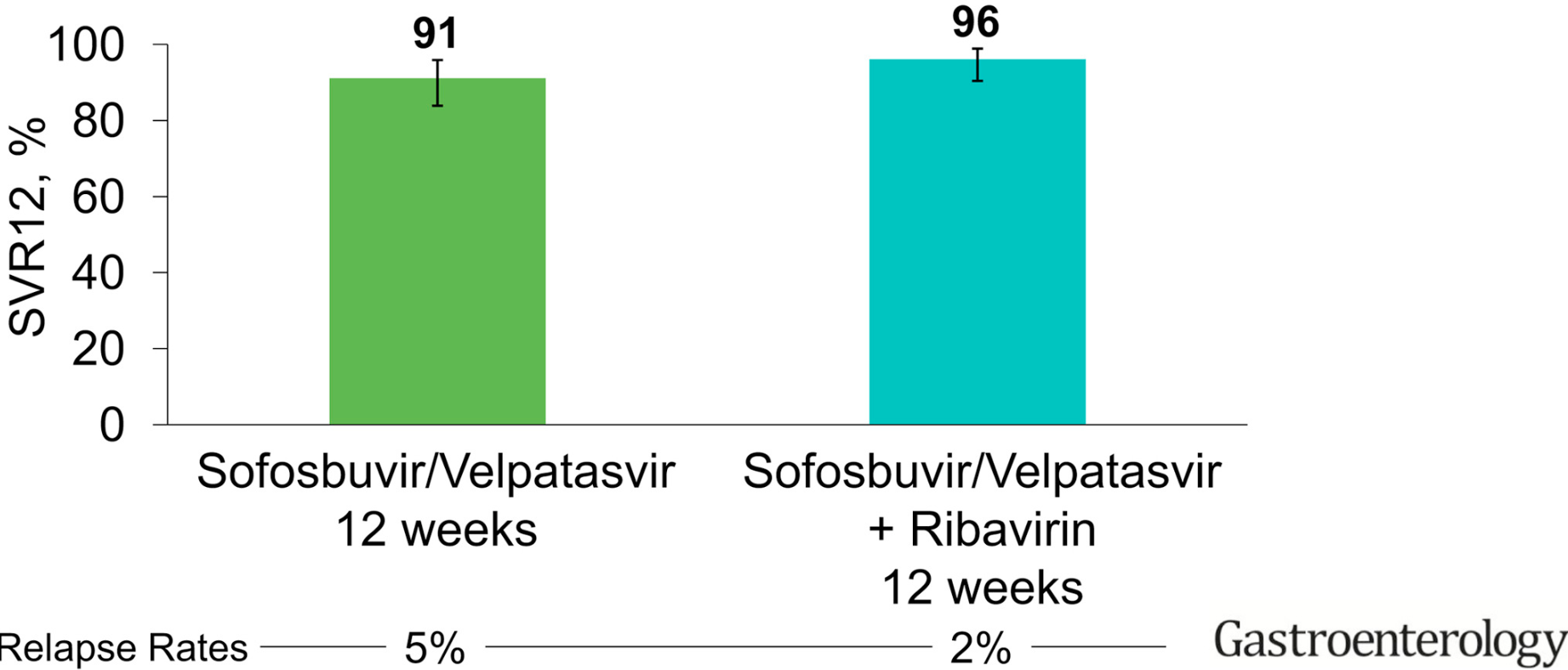
- However, many patients in this analysis had received ribavirin. In those treated without ribavirin (ledipasvir/sofosbuvir alone), the SVR12 was 90%.
- Most common adverse effects included headache (23%), fatigue (16-19%), and asthenia (14-16%).
Bottomline: While ledipasvir/sofosbuvir was effective in this population, the 90% SVR12 is not as good as 96%. This leads to the question of whether ribavirin is needed as well.
Related & briefly noted: SA Alqahtani et al. Hepatology 2015; 62: 25-30. Ledipasvir/sofosbuvir treatment (8-24 weeks) resulted in SVR of 97% (with or without ribavirin) among the 1952 patients treated in the ION-1, ION-2, and ION-3 studies.
Related blog posts:
From FDA (July 24th): FDA approves new treatment for chronic hepatitis C genotype 3 infections
“The U.S. Food and Drug Administration today approved Daklinza (daclatasvir) for use with sofosbuvir to treat hepatitis C virus (HCV) genotype 3 infections. Daklinza is the first drug that has demonstrated safety and efficacy to treat genotype 3 HCV infections without the need for co-administration of interferon or ribavirin, two FDA-approved drugs also used to treat HCV infection….
The safety and efficacy of Daklinza in combination with sofosbuvir were evaluated in a clinical trial of 152 treatment-naive and treatment-experienced participants with chronic HCV genotype 3 infection. Participants received Daklinza 60 mg plus sofosbuvir 400 mg once daily for 12 weeks and were monitored for 24 weeks post treatment. The studies were designed to measure whether a participant’s hepatitis C virus was no longer detected in the blood 12 weeks after finishing treatment (sustained virologic response), suggesting a participant’s infection had been cured.
Results showed that 98 percent of the treatment-naive participants with no cirrhosis of the liver and 58 percent of the treatment-naive participants with cirrhosis achieved sustained virologic response. Of the participants who were treatment-experienced, 92 percent with no cirrhosis of the liver and 69 percent with cirrhosis achieved sustained virologic response. Daklinza labeling carries a Limitations of Use statement to inform prescribers that sustained virologic response rates are reduced in HCV genotype 3 infected patients with cirrhosis.”
From FDA (July 24th): FDA approves Technivie for treatment of chronic hepatitis C genotype 4
“The U.S. Food and Drug Administration today approved Technivie (ombitasvir, paritaprevir and ritonavir) for use in combination with ribavirin for the treatment of hepatitis C virus (HCV) genotype 4 infections in patients without scarring and poor liver function (cirrhosis).
Technivie in combination with ribavirin is the first drug that has demonstrated safety and efficacy to treat genotype 4 HCV infections without the need for co-administration of interferon, an FDA-approved drug also used to treat HCV infection…
The safety and efficacy of Technivie with ribavirin were evaluated in a clinical trial of 135 participants with chronic HCV genotype 4 infections without cirrhosis. Ninety-one participants received Technivie with ribavirin once daily for 12 weeks. Forty-four participants received Technivie once daily without ribavirin for 12 weeks. The studies were designed to measure whether a participant’s hepatitis C virus was no longer detected in the blood 12 weeks after finishing treatment (sustained virologic response), suggesting a participant’s infection had been cured.
Results showed that 100 percent of the participants who received Technivie with ribavirin achieved a sustained virologic response. Of those who received Technivie without ribavirin, 91 percent achieved sustained virologic response.”

Garden of the Gods, Colorado Springs

 gutsandgrowth