
JM Rosen, SK Gupta SK, R Kellermayer. Pediatr Gastroenterol Nutr. 2026; 1-4. doi:10.1002/jpn3.70634. Four decades in the making: generative artificial intelligence and the secondary-literature glut in biomedical publishing.
Key points:
- “Narrative reviews, systematic reviews, and meta-analyses (articles that synthesize existing evidence rather than generate new observations) have been accumulating at a pace that outstrips the growth of primary research for more than three decades. Generative artificial intelligence (AI) … has removed the last practical constraint on it and made the process much faster.”
- Systematic reviews by 2019 had seen “a greater than 20-fold rise across two decades, compared with only a 2.6-fold rise in PubMed-indexed publications generally….Ioannidis argued that the production of systematic reviews and meta-analyses had “reached epidemic proportions,” estimating that a large share were redundant, misleading, or conflicted, with some clinical questions accumulating more than a dozen overlapping meta-analyses of the identical evidence base, and with production increasingly concentrated among a small number of prolific sources (geographic, topical, and/or contracted) rather than spread evenly across the field.1“
- “The tasks that constitute a systematic review, framing a question, searching, screening, extracting data, synthesizing findings, and drafting prose, are precisely the tasks at which large language models now perform with superficial competence…the technology is now fluent enough to produce a document with the surface features of a competent review, but not trustworthy enough to be left unsupervised”
- “Fabricated references in PubMed Central had increased more than 12-fold since 2023, to 4046 instances; these were concentrated in exactly the kind of citation-dense writing on which reviews and meta-analyses depend for their evidentiary claims.9“
- “Nearly all current policy operates at the level of disclosure: authors must state whether and how they used AI.”
Proposed Changes:
- “First, a mandatory novelty statement… that distinguishes their submission from the existing literature and from what a generative AI system, prompted on the same topic, could already produce unassisted.”
- “Second, a stated human contribution, an explicit account of the clinical judgment, methodological innovation, or original synthesis that the authors, not a language model, provided.”
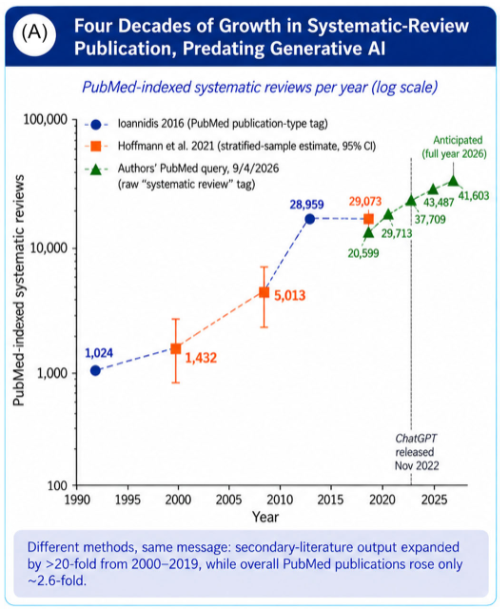
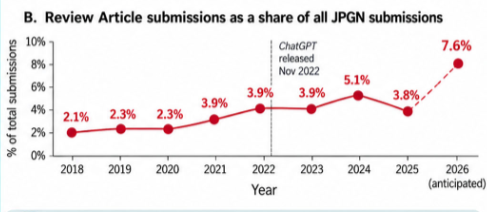
My take: AI has exponentially worsen the problem of flooding journals with unnecessary and untrustworthy systematic reviews.
Related blog posts:
- Rising Scientific Fraud: Threats to Research Integrity Plus One
- Do We Need Lie Detector Tests for Research Participants?
- Ethan Mollick on AI’s Exponential Rise and an Otter on a Plane
- “Being a Doctor Will Never Be the Same After A.I.”
- AI for Capsule Endoscopy
- The Future of Medicine: AI’s Role vs Human Judgment

