How Generative AI Is Worsening the Meta-Analysis Glut

JM Rosen, SK Gupta SK, R Kellermayer. Pediatr Gastroenterol Nutr. 2026; 1-4. doi:10.1002/jpn3.70634. Four decades in the making: generative artificial intelligence and the secondary-literature glut in biomedical publishing.

Key points:

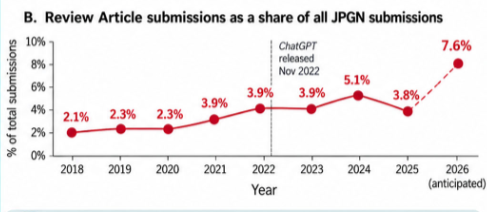
  • “Narrative reviews, systematic reviews, and meta-analyses (articles that synthesize existing evidence rather than generate new observations) have been accumulating at a pace that outstrips the growth of primary research for more than three decades. Generative artificial intelligence (AI) … has removed the last practical constraint on it and made the process much faster.”
  • Systematic reviews by 2019 had seen “a greater than 20-fold rise across two decades, compared with only a 2.6-fold rise in PubMed-indexed publications generally….Ioannidis argued that the production of systematic reviews and meta-analyses had “reached epidemic proportions,” estimating that a large share were redundant, misleading, or conflicted, with some clinical questions accumulating more than a dozen overlapping meta-analyses of the identical evidence base, and with production increasingly concentrated among a small number of prolific sources (geographic, topical, and/or contracted) rather than spread evenly across the field.1“
  • “The tasks that constitute a systematic review, framing a question, searching, screening, extracting data, synthesizing findings, and drafting prose, are precisely the tasks at which large language models now perform with superficial competence…the technology is now fluent enough to produce a document with the surface features of a competent review, but not trustworthy enough to be left unsupervised”
  • “Fabricated references in PubMed Central had increased more than 12-fold since 2023, to 4046 instances; these were concentrated in exactly the kind of citation-dense writing on which reviews and meta-analyses depend for their evidentiary claims.9“
  • “Nearly all current policy operates at the level of disclosure: authors must state whether and how they used AI.”

Proposed Changes:

  • “First, a mandatory novelty statement… that distinguishes their submission from the existing literature and from what a generative AI system, prompted on the same topic, could already produce unassisted.”
  • “Second, a stated human contribution, an explicit account of the clinical judgment, methodological innovation, or original synthesis that the authors, not a language model, provided.”
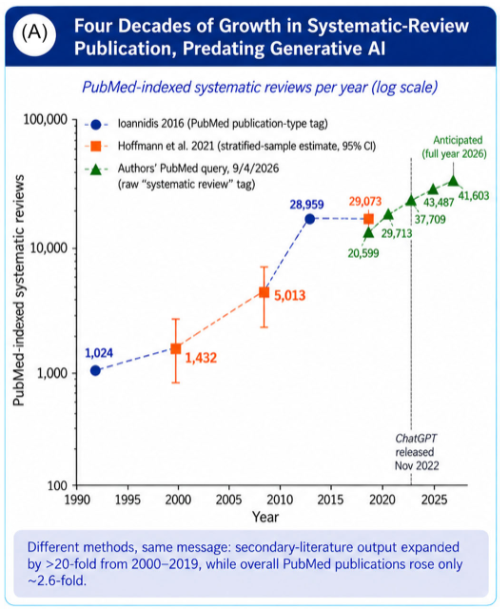
Four decades of growth in PubMed‐indexed systematic‐review publication, predating generative AI by roughly three decades.Blue circles show raw PubMed publication‐type tag counts for “systematic review” reported by Ioannidis. Orange squares show independent,model‐based stratified‐sample estimates reported by Hoffmann et al. Green triangles show the authors’ own PubMed query for the raw“systematic review” publication‐type count; the open triangle for 2026 (41,603) is an anticipated full‐year total.

My take: AI has exponentially worsened the problem of flooding journals with unnecessary and untrustworthy systematic reviews.

Related blog posts:

“Battle of Hospital A.I. vs. Insurer A.I.”

Reed Abelson , Teddy Rosenbluth. NY Times 4/24/26: Battle of Hospital A.I. vs. Insurer A.I. Is Pushing Medical Costs Higher. Thanks to Seth Marcus for sharing this article.

An excerpt:

In the latest sign that artificial intelligence is fueling higher health care costs, a group of insurers released a report Thursday claiming that hospitals’ use of A.I. was responsible for nearly $1 billion in additional expenses over two years…

Using codes for various medical conditions, hospitals submitted claims for tens of thousands of patients that described their illnesses as more complex in 2024 and 2025 than in 2023. Despite the added conditions, there was no evidence that the patients had received different treatment from the hospitals, according to the analysis by the Blue Cross Blue Shield Association, which represents state Blue Cross plans.

Using A.I. tools, hospitals are collecting more information about their patients, and submitting bigger claims, the association said…

Just as providers are using sophisticated A.I. tools to say their patients are sicker, insurance companies have been accused of using the tools to delay or deny care. The companies have come under intense criticism for their use of A.I. when requiring prior approval of treatments and medicines…

But as more hospitals and doctors use A.I., costs will continue to rise. Benefit consultants and insurers cite it as one of the factors that could lead to double-digit increases next year. A recent survey of employers suggested that costs could go up as much as 11 percent next year for employers unless they cut back on benefits.

My take: By leveraging AI, doctors and hospitals are able to claim that patients have increased complexity to justify higher reimbursement codes. This shift has caught insurance companies flat-footed and increased hospital profitability. When the insurance companies negotiated the rates for each reimbursement code, historical data allowed them to predict the costs based on projected use of each code; these projections are way off now. Using AI to document complexity, these hospital coding changes can no longer be denied as “upcoding” by insurance companies.

Over the long term, I expect insurance companies to work on lower reimbursement for higher-complexity coding. Over the short term, the increase in hospital profits will result in higher insurance costs for patients and businesses.

Related blog posts:

Svartifoss (which translates to “Black Falls”), one of the most distinctive and photographed waterfalls in Iceland. The hexagonal basalt columns which frame an 80-foot cascade were formed geologically by lava flowing down a cliff face and cooling incredibly slowly, a process called columnar jointing.