
GV Mazariegos et al. Liver Transplantation 2023; 29: 671-682. Open access! Center use of technical variant grafts varies widely and impacts pediatric liver transplant waitlist and recipient outcomes in the United States
Background: Waitlist (WL) mortality is highest in children under the age of 1 year (12.5 deaths/100 WL years).2 It is thought that TVG (technical variant grafts) [including living donor (LD) and deceased donor split/partial grafts] improve outcomes.
Methods: The authors, in this retrospective study, analyzed Organ Procurement and Transplantation Network (OPTN) data on first-time LT or liver-kidney pediatric candidates listed at centers that performed >10 LTs during the study period, 2004–2020.
Key findings:
- Sixty-four centers performed 7842 LTs; 657 children died on the WL
- Death from listing was significantly lower with increased center TVG usage (HR = 0.611) and LT volume (HR = 0.995)
- Recipients of LD transplants (HR = 0.637) had significantly increased survival from transplant compared with other graft types, and recipients of deceased donor TVGs (HR = 1.066) had statistically similar outcomes compared with whole graft recipients
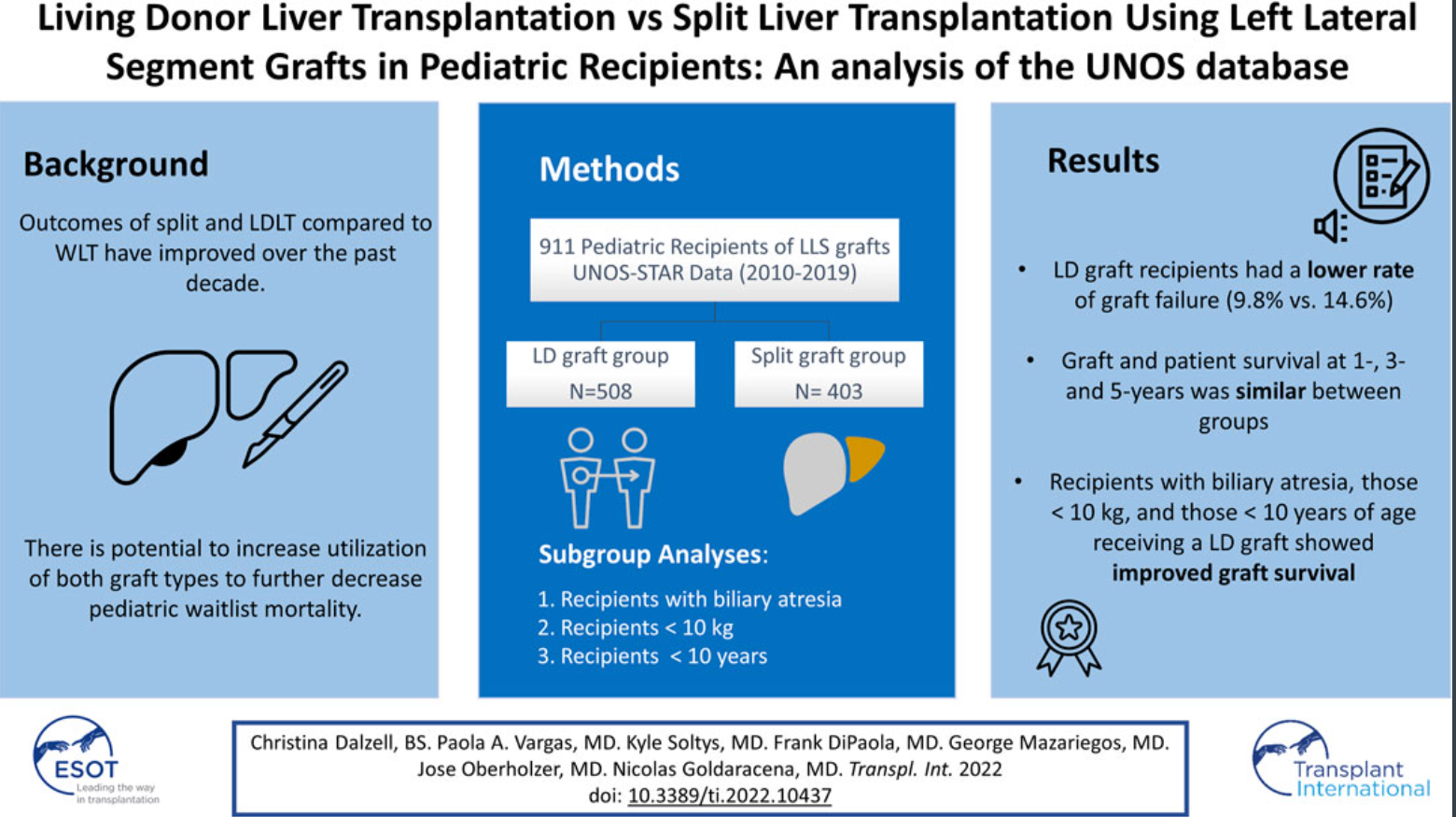
My take (borrowed from authors): “LD partial grafts and overall volume performed by the center in the preceding 3 years was significantly associated with increased post-LT survival. Deceased donor graft type (DD TVG vs. DD Whole) was not a predictor of post-LT survival after accounting for patient diagnosis, center volume, and other significant factors that were predictive of survival. DD TVG should not be considered an inferior graft option in experienced centers…LD grafts are associated with a survival advantage.”
BA Sayed, M Cattral, VL Ng. Liver Transplantation 2023; 29: 663-664. Open access! (editorial) Insufficient use of technical variant grafts: An unfulfilled promise in pediatric liver transplantation Key points:
- “While outcomes have improved, with current 1- and 5-year patient survival >97% and 94%, respectively, many children continue to die on the waitlist (WL) or are removed because they are too sick.1,2“
- “As expected, these children were younger, smaller, sicker (more status 1 listings), and remained on the WL longer than children who received a transplant during the same time period…These small infants are particularly at risk because of the difficulty of obtaining an appropriately sized-matched graft. Data indicate that this problem can be solved largely by increasing the use of technical variant grafts (TVGs), which includes living donor (LD) grafts and split/reduced grafts from deceased donors (DDs).4,5“
- “This manuscript obliquely touches on another pressing issue within the pediatric LT community, namely, the core skill set of a pediatric LT surgeon. Currently, there is no such distinct designation in the North American training environment, and therefore, no training requirements exist. To provide the full spectrum of surgical care, the technical skill set should include LD hepatectomies and graft implantations, DD graft reduction/splitting, the reduction or hyper-reduction of left lateral segment grafts, and staged abdominal closure.”
My take: Where a patient is listed is a very important variable in outcomes. Choosing a low volume center without availability to perform TVG increases the risk of lethal outcomes. This information should be disclosed to families at all centers.
Also: T Miloh et al. Liver Transplantation 2023; 29: 735-744. Open access! Costs of pediatric liver transplantation among commercially insured and Medicaid-insured patients with cholestasis in the US
Health care resource utilization and costs associated with pediatric LT were retrospectively assessed using insurance claims data from the US IBM MarketScan Commercial and Medicaid databases collected between October 2015 and December 2019. Study cohort: 53 commercially insured and 100 Medicaid-insured children
- Key findings: Commercially insured and Medicaid-insured patients averaged US $512,124 and $211,863 in medical costs and $26,998 and $15,704 in pharmacy costs, respectively
Related blog posts:
- Liver Shorts: Relationship of Hepatic Steatosis to Cardiovascular Disease and the Cost of Liver Transplantation
- How Low Can You Go with Split Livers? (2023)
- Liver Update: Past Time to Split (2022) & Graft Fibrosis -Will the Liver Last?
- More on Time to Split (2018)
- More on It’s Past Time to Split (2017)
- Pediatric Liver Transplantation: Past Time to Split (2017)



 gutsandgrowth