




The other day I was having a fun discussion on words that we may choose before providing information that others might not like. Some examples:
A recent report (GP de Chambrun et al. Clin Gastroenterol Hepatol 2015; 13: 1405-15) debunks claims that vaccines increase the risk of inflammatory bowel disease (IBD). A report by Thompson NP et al (Lancet 1995; 345: 1071-74) suggested that measles vaccination could increase risk of IBD. In the current study, the researchers examined 11 previous studies for review and meta-analysis. Vaccines included: BCG, DPT, smallpox, poliomyelitis, pertussis, H1N1,measles, mumps, rubella, and combined MMR. This study included 2399 patients with IBD and 33,747 controls. Bottomline: “Results of this meta-analysis show no evidence supporting an association between childhood immunization or H1N1 vaccination in adults and risk of developing IBD.” With regard to the measles vaccine in particular, the relative risk was 1.33 (CI 0.31 -5.80) in cohort studies and the relative risk was 0.85 (CI 0.60 -1.20) in case-control studies.
What types of words do you hear people use before saying something someone is not going to like?
Related posts:
In a study with 95,727 children, there was no link between receipt of the MMR (measles, mumps, rubella) vaccine and autism, even in children at high risk (eg. sibling with autism).
Here’s a summary from USA Today: No link between MMR and Autism
Original JAMA article (free & entire article)
Related blog: “Too many vaccines and autism” is debunked | gutsandgrowth
An unrelated commentary, “Social Distancing and the Unvaccinated,” (NEJM 2015; 372: 1481-83) notes that a recent ruling (Phillips v City of New York) upholds the state’s authority to bar unvaccinated children from school during outbreaks. This practice is referred to as social distancing to lessen likelihood of further transmission. This “reiterated the Supreme Court decision in the 1905 case Jacobson v. Massachusetts, which clearly found vaccine mandates constitutional.”
GI Care For Kids: Our group has been very supportive of the Crohn’s and Colitis Foundation of America (CCFA) and especially active in staffing the yearly Camp Oasis for more than 20 years. Throughout the year, there are a number of other events to support CCFA. This past weekend many of us participated in “Taking Steps.” Here are a few pictures:

Super Poopers: Ben Gold, Larry Saripkin, Dinesh Patel, Seth Marcus, and Jay Hochman
Dr. Spandorfer’s team raised a great deal of money (50K) and he/his family were featured in the Atlanta Journal Constitution (Local Family Takes Big Steps to Raise Awareness). His son, Jack, spoke at the event, and was honored as this year’s hero. They also had pretty clever T-shirts

With ‘Pip” Spandorfer (whose team raised $50,000)
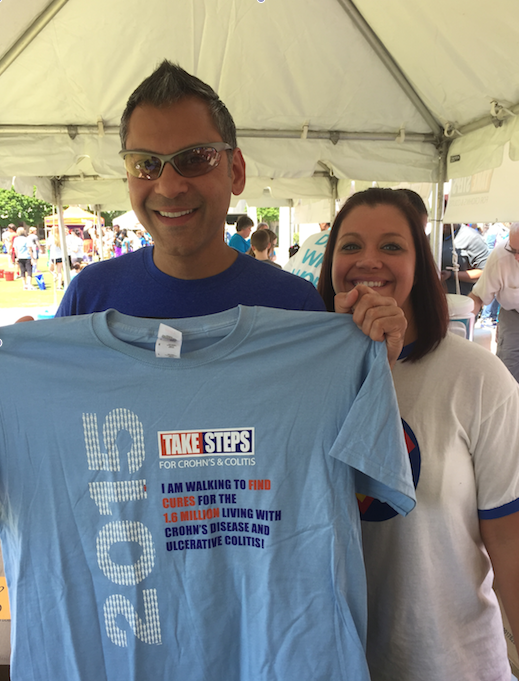
Dinesh Patel and Kimberly Sheats
The following link (from Jeff Lewis’ twitter feed) provides a terrific review and summary of the effectiveness of vaccines, the debunked myths, and how “anti-vax” movement hurt not just themselves but others too.
Vaccines Work, Here Are the Facts -Cartoon
Related blog posts:
This past month a recent perspective article (NEJM 2014; 371: 1661-3) provides an update on measles and the problems with vaccination rates.
Key points:
Related blog posts:
Three recent news items provide more up-to-date reasons for childhood vaccines.
1. Delaying vaccines may increase seizures –here’s the link and an excerpt (from NY Times):
“Some parents postpone their children’s vaccinations because they believe the delay decreases the risk. But a new study finds the opposite may be true.
The analysis, published online in Pediatrics, involved 5,496 children born from 2004 to 2008 who had seizures in the first two years of life.
For children who received any of their shots as recommended before age 1, there was no difference in the incidence of seizure in the 10 days after vaccination compared with the period before vaccination. But compared with giving it in the first year, giving the measles-mumps-rubella vaccine at 16 months doubled the incidence of seizure, and giving the measles-mumps-rubella-varicella vaccine at that age increased it almost six times.”
2. Rate of measles infections at 20 year high –here’s the link and an excerpt: (from USA Today)
“The USA has the most measles cases in 20 years…The confirmed case count for 2014, as of May 23, was 288 and growing, the CDC says. That number includes 138 cases from Ohio, where the biggest outbreak is ongoing – and where the actual count is 166 as of Thursday, according to the state Health Department.
The nationwide total is the highest for late May since 1994, when 764 cases were reported, the CDC says. It surpasses the 220 cases reported in all of 2011, which was the most in the post-2000 era.
“This is not the kind of record we want to break, but should be a wake-up call for travelers and for parents to make sure vaccination records are up to date,” said Anne Schuchat, director of the CDC’s National Center for Immunizations and Respiratory Diseases. Schuchat…Before the measles vaccine became available in 1963, the virus infected about 500,000 Americans a year, causing 500 deaths and 48,000 hospitalizations.
Cases this year have been reported in 18 states and New York City. Ninety percent have been among people who have not been vaccinated or have unknown vaccination status, according to the CDC. Most of the patients report religious, philosophical or personal reasons for avoiding vaccines.”
3. When parents withhold vaccines, vulnerable children get sick and sometimes die –here’s the link (reference noted from Eric Benchimol’s twitter feed) and an excerpt:
“Jason Lawson recalled a terrifying 10 days in B.C. Children’s Hospital when his son Beckett was six, after Beckett became severely ill from chicken pox.
At the time, Beckett was still receiving a maintenance dose of chemotherapy to kill potential cancer cells. That treatment also suppressed Beckett’s immune system.
When an unvaccinated child at the school passed on chicken pox, the consequences were dire — at one point the virus got into Beckett’s liver and started to do damage, which in some cases can be irreversible….
Lawson said he’s speaking out to remind families that protecting their friends and neighbours is another good reason to make the effort.“
Take home message: With every medical intervention, there are risks and benefits. Those who forego vaccines increase the risk for themselves, their families and friends.
Related blog posts:
Most of the time, having more wealth and education translates into better health care outcomes. One exception has been with some vaccine-preventable illnesses like the measles, according to a recent article in USA Today which reported on the CDC’s efforts to counter anti-vaccination misinformation.
Here’s an excerpt:
Vaccines given to infants and young children over the past two decades will prevent 322 million illnesses, 21 million hospitalizations and 732,000 deaths over the course of their lifetimes, according to a new report from the Centers for Disease Control and Prevention.
Vaccines also will have saved $295 billion in direct costs, such as medical expenses, and a total of more than $1.3 trillion in societal costs over that time, because children who were spared from sometimes-devastating illnesses will be able to contribute to society, the report shows. These calculations may underestimate the full impact of vaccines, the study notes, because authors considered only the early 14 routine childhood immunizations typically required for school entry. Authors didn’t include flu shots or adolescent vaccines given at ages 11 or 12…
Before the measles vaccine became available in 1963, the virus infected about 500,000 Americans a year, causing 500 deaths and 48,000 hospitalizations. In recent years, the number of diagnoses fell to around 60 to 65, mostly in isolated travelers arriving in the USA.
Doubts about vaccines safety – and fading memories of vaccine-preventable diseases — have contributed to a resurgence of nearly forgotten diseases such as measles, which was officially declared eradicated in the USA in 2000. Numerous studies have debunked the notion that vaccines cause autism or other chronic diseases, says William Schaffner , an infectious disease specialist and professor at the Vanderbilt University School of Medicine in Nashville….
Congress created the entitlement program in 1994, responding to a measles outbreak in 1989 to 1991 that sickened 55,000 people and killed more than 100. At the time, measles outbreaks were fueled by viruses circulating among low-income, inner-city residents.
The picture has completely changed today, Schaffner says. The federal program has eliminated racial and ethnic disparities among vaccines. Today, the bulk of the unvaccinated children come from wealthy, educated families where parents intentionally choose not to immunize them, due to concerns about vaccine safety. These relatively wealthy children can then spread measles after returning from vacations in Europe, which has had large outbreaks for several years, Schaffner says.
“Borders can’t stop measles, but vaccination can,” says CDC Director Tom Frieden.
A recent article in USA Today focused some light on the issue of vaccine avoidance and its consequences. Two specific examples in the article included the death of an infant to pertusis and healthy boy who lost his arms and legs as a consequence of the measles. In my opinion, the authors and editors of this publication make a mistake by offering up too much credence to the vaccine naysayers presumably to provide a “balanced report.” Their arguments should have been subjected to further scrutiny. Here’s the link, decide for yourself:
Excerpt:
Recent measles outbreaks in New York, California and Texas are examples of what could happen on a larger scale if vaccination rates dropped, says Anne Schuchat, the CDC’s director of immunizations and respiratory diseases. Officials declared measles, which causes itchy rashes and fevers, eradicated in the United States in 2000. Yet this year, the disease is on track to infect three times as many people as in 2009. That’s because in most cases people who have not been vaccinated are getting infected by others traveling into the United States. Then, Schuchat says, the infected spread it in their communities.
The 189 cases of measles in the U.S. last year is small compared with the 530,000 cases the country used to see on average each year in the 20th century. But, the disease — which started to wane when a vaccine was introduced in 1967 — is one of the most contagious in the world and could quickly go from sporadic nuisance to widespread killer.
Measles kills about once in every 1,000 cases. As cases mount, so does the risk. “We really don’t want a child to die from measles, but it’s almost inevitable,” says Schuchat. “Major resurgences of diseases can sneak up on us.”…
Even so, in some states the anti-vaccine movement, aided by religious and philosophical state exemptions, is growing, says Paul Offit, chief of infectious diseases at Children’s Hospital of Philadelphia. He points to states like Idaho, Illinois, Michigan, Oregon and Vermont — where more than 4.5% of kindergartners last year were unvaccinated for non-medical reasons — as examples of potential hot spots. Such states’ rates are four times the national average and illustrate a trend among select groups.
“People assume this will never happen to them until it happens to them,” Offit says. “It’s a shame that’s the way we have to learn the lesson. There’s a human price for that lesson.”
The most vulnerable are infants who may be too young to be vaccinated, children with compromised immune systems and others who may be unable to be vaccinated for medical reasons, scientists say.
Related blog posts:
A recent editorial highlights the fact that the “last mile is the longest” when it comes to eradicating diseases with vaccines (NEJM 2013; 368: 1374-75). The point the authors make is that as vaccines become successful, there is increasing refusal in communities to receive vaccines. Few individuals may have direct or indirect experience with vaccine-preventable diseases when initial efforts are successful.
Much like bacterial resistance to antibiotics, individuals may become resistant to the use of vaccines when the perception of their utility dissipates. As such, the authors note that eradication efforts going forward must not be a half-hearted effort. “If a disease such as measles is considered a priority by the global public health community, human and financial resources should be committed up front to a full-scale eradication initiative.”
Related blog entries:
 gutsandgrowth