Physician Burnout -“Hidden Health Care Crisis”

A really good review on the topic of physician burnout: BE Lacy, JL Chan. Clin Gastroenterol Hepatol 2018; 16: 311-17.

This topic has been discussed on this blog and multiple other sites.  This reference covers a lot of ground and provides a lot of useful information.  Also, some esoteric piece of information: “The term burnout first was used in the psychology literature in 1974 by Herbert Freudenberg during his work with drug addicts. He observed that many of his patients would stare blankly at their cigarettes until they burned out.”

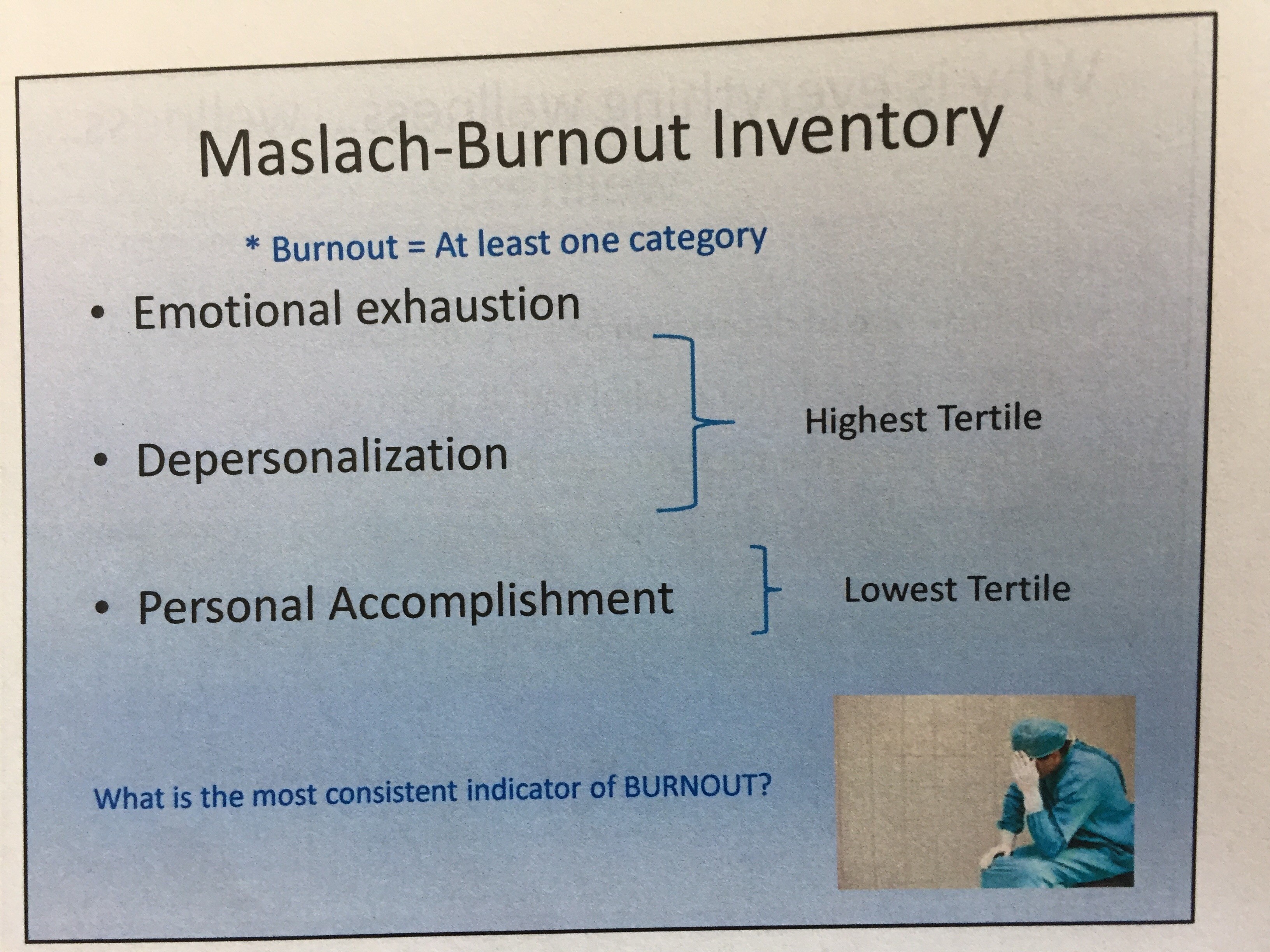
Three key components to burnout: emotional exhaustion, depersonalization, and decrease sense of personal accomplishment

Physicians at greatest risk: perfectionists, personal qualities of idealism, and “intense sense of responsibility”

Root causes -work stress (in all its forms)

Prevention of burnout: take care of yourself, exercise, good sleep habits, “learn to say no,” use your vacation time/disconnect

Keys to treating physician burnout:

  • “learn to balance personal and professional goals”
  • “shape your career and identify stressors”
  • “nuture wellness strategies”
  • Try to become engaged in your job
  • Work on resilence

Related blog posts:

Physician Team Cohesiveness

Recently, I attended our medical staff semi-annual meeting.  Two speakers (Dr. Usha Sathian and Dr. Lucky Jain) provided some impressive information about the growth of the hospital system’s outreach with ambulatory care services and about the development of Emory/associated institutions’ academic medicine advances.  The latter includes graduate medical education, extensive grants, and involvement in more than 1000 current clinical studies.  The number of trainees at all levels has grown incredibly.  These trainees are much more likely to stay in Georgia than trainees in many other parts of the country.

This growth corresponds to increases in the hospital’s bed capacity and technical abilities.  A third speaker, Dr. Joseph Rosenfeld, was honored for being both a community physician and attending physician for 40 years!  When he first arrived, there were eight pediatric ICU beds at Egleston Children’s hospital.  Now, there has been about an 8-fold increase.  The number of hospital beds has more than tripled.

Yet, sadly in my view, only a tiny number of physicians attended this meeting, a fraction that attended when the medical staff was much smaller.  Despite the huge increase in staff physicians, there is a dwindling number who attend meetings; this is true for grand rounds as well.  When I first arrived in town about 20 years ago, I looked forward to these meetings to engage and meet my colleagues.  In addition, due to ever larger number of subspecialists, it is much less frequent that when I rotate on hospital service that I will see the well-known neurologist, pulmonologist, endocrinologist, infectious disease expert and so many others.

I came away from the staff meeting with a tangible feeling that despite the incredible success of the system in developing improved capabilities that the feeling of working together as a team of subspecialists and generalists has diminished.  This makes me wonder whether other aspects of modern medicine and the worry over physician burnout are not related to increased isolation of physicians into their specialty silos and to cloistering into our computers and smartphones.

Though I feel grateful to be able to help children in my work, the biggest reason that I chose pediatrics was because of my admiration for the pediatricians I had met and my desire to both emulate their work and to work with them.  I think working closely together is one aspect that makes being a pediatric specialist worthwhile.

My take: Experts have recommended “peer support” to prevent burnout and increase job satisfaction.  My experience, which I suspect is shared widely, indicates that engaging with our peers is becoming less frequent.

Related blog posts:

Physician Burnout Spreading (Part 2)

A recent article (JC Anderson et al. Am J Gastroenterol 2017; 112:1356–1359; doi: 10.1038/ajg.2017.251; published online 8 August 2017) also addresses the topic of physician burnout with a focus on gastroenterology, link: Strategies to Combat Physician Burnout

Excerpts:

  • Physician burnout has reached epidemic proportions, with 54.4% of physicians reporting at least one burnout symptom in 2014, an increase from 45.5% 3 years earlier
  • A Medscape survey in 2016 showed a burnout rate among gastroenterologists of 49%, up from 41% the year before
  • Key drivers of burnout are excessive workload, an inefficient environment and
    inadequate support, problems with work life integration, loss of value and meaning in work, and the loss of autonomy, flexibilityand control in work 
    The cost of burnout is high, as these physicians are more likely to leave medicine, retire early, make more medical errors, and have lower patient satisfaction scores

Combating Physician Burnout:

  • Leadership : Having good leaders affects the well-being ansatisfaction of physicians in health care organizations
  • Reducing Administrative tasks -scribes, mid-level providers 
  • Control over workflow and work hours
  • “Peer support is crucial, nothing else can replace it.
  • “Physicians who spend at least 20% otheir total effort in an activity that they find most meaningful are at a lower risk for burnout”
  • Self-care: Stress management and mindfulness can reduce burnout

Related blog posts:

Physician Burnout Spreading (Part 1)

Last week, I went to our integrated health care network meeting.  Among the topics was physician burnout.  Lately, this is a “hot” topic with a lot of publicity regarding this increasingly-common problem.

At our meeting, some of the keep points -noted below & in the slides that follow:

  • Physician burnout rate is increasing based on most recent studies
  • Many physicians, 42%, would not choose medicine as their career today
  • Manifestations of burnout include “compassion” fatigue

Physicians may be more at risk for burnout due to the following:

  • Frequent personality characteristics: workaholics, accustomed to delayed gratification
  • Practice aspects: long hours, huge responsibilities

How to Prevent Burnout:

  • Lower stress –recharge with outside activities: hobbies, excursions, charitable work, physical activities, and emotional/spiritual
  • Resources: Stop Physician Burnout, Burnout Prevention Matrix  both by  Dike Drummond


Related blog post: Quality Care = Work Satisfaction for Physicians

Related blog posts:


“Addressing Physician Burnout”

In the last few years, there have been increasing reports of physician burnout.  A recent report (JAMA. Published online February 9, 2017. doi:10.1001/jama.2017.0076) (thanks to Ben Gold for this reference) provides a concise review of the reasons and potential mitigating strategies.

Full Text Link: “Addressing Physician Burnout”

An excerpt:

Physicians also have to navigate a rapidly expanding medical knowledge base, more onerous maintenance of certification requirements, increased clerical burden associated with the introduction of electronic health records (EHRs) and patient portals, new regulatory requirements (meaningful use, e-prescribing, medication reconciliation), and an unprecedented level of scrutiny (quality metrics, patient satisfaction scores, measures of cost).

These challenges have taken a toll on US physicians. Burnout is a syndrome of exhaustion, cynicism, and decreased effectiveness at work…The first large, national study of burnout among US physicians across all specialties did not occur until 2011. That study of 7288 participating physicians documented that approximately 45% reported at least 1 symptom of burnout and that burnout was more common among physicians than US workers in other fields…

The first large, national study of burnout among US physicians across all specialties did not occur until 2011. That study of 7288 participating physicians documented that approximately 45% reported at least 1 symptom of burnout and that burnout was more common among physicians than US workers in other fields…

Physician burnout has been linked to self-reported errors, turnover, and higher mortality ratios in hospitalized patients…

The current burden of documentation related to the clinical encounter required to meet billing requirements, quality reporting, and separate justification for each test ordered individually is unsustainable…

Individual physicians must also do their part…Individual physicians have a professional responsibility to take care of themselves. Adequate sleep, exercise, and attending to personal medical needs should be considered a minimal standard for self-care. Physicians must also proactively identify personal and professional priorities and take deliberate steps to integrate their personal and professional lives.

Related blog posts:

birthoutcomesaftertnt

Increasing Rates of Professional Burnout

A recent study (T Shanafelt et al. Mayo Clin Proc. 2015;90(12):1600-1613) indicates that there may be increasing rates of physicians with “Professional Burnout.”  The study is limited by suboptimal response rates but provides some useful information on this topic.

Full text article: Changes in Burnout and Satisfaction With Work-Life Balance in Physicians and the General US Working Population Between 2011 and 2014

Results: Of the 35,922 physicians who received an invitation to participate, 6880 (19.2%) completed surveys. When assessed using the Maslach Burnout Inventory, 54.4% (n=3680) of the physicians reported at least 1 symptom of burnout in 2014 compared with 45.5% (n=3310) in 2011 (P<.001). Satisfaction with work-life balance also declined in physicians between 2011 and 2014 (48.5% vs 40.9%; P<.001). Substantial differences in rates of burnout and satisfaction with work-life balance were observed by specialty.  In contrast to the trends in physicians, minimal changes in burnout or satisfaction with work-life balance were observed between 2011 and 2014 in probability-based samples of working US adults, resulting in an increasing disparity in burnout and satisfaction with work-life balance in physicians relative to the general US working population.  After pooled multivariate analysis adjusting for age, sex, relationship status, and hours worked per week, physicians remained at an increased risk of burnout (odds ratio, 1.97; 95% CI, 1.80-2.16; P<.001) and were less likely to be satisfied with work-life balance (odds ratio, 0.68; 95% CI, 0.62-0.75; P<.001).

The indices that the authors studied included measures of the following (Table 2):

  • Emotional exhaustion
  • Depersonalization
  • Personal Accomplishment
  • Depression: 38% (2011) –>39% (2014)
  • Suicidal ideation: 6.4% (2011) and 6.4% (2014)
  • Burned out rate: 45.5% (2011) –>54.4% (2014)
  • Career satisfaction (would become a doctor again): 70% (2011) –>67% (2014)

Satisfaction with work life balance (Figure 1):

  • Pediatrics generally better than other fields, but close to 50% in 2014 were not satisfied compared with about 40% in 2011 (P <.05).

Take-home message from authors:

Burnout and satisfaction with WLB among US physicians are getting worse. American medicine appears to be at a tipping point with more than half of US physicians experiencing professional burnout. Given the extensive evidence that burnout among physicians has effects on quality of care, patient satisfaction, turnover, and patient safety, these findings have important implications for society at large. 11-20.  There is an urgent need for systematic application of evidence-based interventions addressing the drivers of burnout among physicians. These interventions must address contributing factors in the practice environment rather than focusing exclusively on helping physicians care for themselves and training them to be more resilient.

Related blog posts:

Zion National Park

Zion National Park


The burden of being a physician

The following link comments on a study regarding the high rate of physician burnout:

The Widespread Problem of Doctor Burnout – NYTimes.com

Among my physician friends, the topic of emotional fatigue comes up infrequently.  While there are different difficulties for every type of job, I think if you are not a physician it is hard to understand the emotional toll of the job.  If you care about what you do, it is hard to disassociate from the obvious suffering that some patients endure.  In addition, in many cases the decisions that we help families reach often have unexpected outcomes.

Though some physicians may not struggle with these issues, the link above indicates that this problem is pervasive.

If you have a practical solution, let me know.  Happy New Year.

Related blog (more upbeat):

“It is never boring to be a physician” | gutsandgrowth