Weight Gain If Semaglutide Stopped

This article discusses several conditions like Prader-Willi and pregnancy that can result in increase hunger and then elaborates on genetic tendency towards obesity in an age of abundant ultra-processed high calorie foods. Excerpts:

A famous 1990 study of identical twins born in Sweden showed that pairs who were separated at birth and adopted had weights more similar to each other than to their adoptive families…The ability to sense such fullness — and hunger — varies, the result of genetic differences in brain circuits that control appetite.

The new drugs are the first to manipulate the hormonal regulatory systems governing energy balance. The drugs simulate the action of our native GLP-1 but with longer-lasting effects, amplifying the fullness signal inside the body…At the very least, though, the way the drugs work can teach us that people who are larger did not necessarily choose to be, just as people who are smaller did not — and are not morally superior. This “isn’t a free pass, either to individuals who do have the capacity to choose better, nor does it take the heat off of food industries,” said a University of Sydney nutritional biologist, Stephen Simpson, but it’s “evidence that obesity isn’t a personal lifestyle choice.”

My take: For those who benefit from GLP-1 medications, it is important to recognize that weight gain is likely when the medications are discontinued; this indicates once treatment is started, the goal would be to use indefinitely –until something better comes along.

Related blog posts:

Disclaimer: This blog, gutsandgrowth, assumes no responsibility for any use or operation of any method, product, instruction, concept or idea contained in the material herein or for any injury or damage to persons or property (whether products liability, negligence or otherwise) resulting from such use or operation. These blog posts are for educational purposes only. Specific dosing of medications (along with potential adverse effects) should be confirmed by prescribing physician.  Because of rapid advances in the medical sciences, the gutsandgrowth blog cautions that independent verification should be made of diagnosis and drug dosages. The reader is solely responsible for the conduct of any suggested test or procedure.  This content is not a substitute for medical advice, diagnosis or treatment provided by a qualified healthcare provider. Always seek the advice of your physician or other qualified health provider with any questions you may have regarding a condition
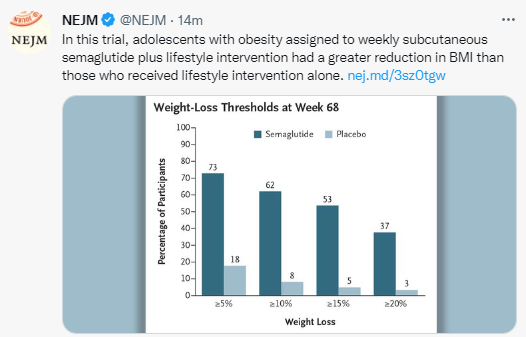

Semaglutide in Adolescent Obesity

D Weghuber et al NEJM 2022; DOI: 10.1056/NEJMoa2208601. Once-Weekly Semaglutide in Adolescents with Obesity

Methods: In this double-blind, parallel-group, randomized, placebo-controlled trial, we enrolled 201 adolescents (12 to <18 years of age) with obesity (a body-mass index [BMI] in the 95th percentile or higher) or with overweight (a BMI in the 85th percentile or higher) and at least one weight-related coexisting condition.  180 (90%) completed treatment. Participants were randomly assigned in a 2:1 ratio to receive once-weekly subcutaneous semaglutide (at a dose of 2.4 mg) or placebo for 68 weeks, plus lifestyle intervention.

Key findings:

  • The mean change in BMI from baseline to week 68 was −16.1% with semaglutide and 0.6% with placebo
  • At week 68, a total of 95 of 131 participants (73%) in the semaglutide group had weight loss of 5% or more, as compared with 11 of 62 participants (18%) in the placebo group
  • Improvement with respect to cardiometabolic risk factors (waist circumference and levels of glycated hemoglobin, lipids [except high-density lipoprotein cholesterol], and alanine aminotransferase) were greater with semaglutide than with placebo
  • “The safety of semaglutide in this adolescent population appeared to be consistent with findings among adults with overweight or obesity… Gastrointestinal disorders (primarily nausea, vomiting, and diarrhea) were the most frequent adverse events with semaglutide (occurring in 62% of participants, as compared with 42% in the placebo group) and were generally mild or moderate in severity and of short duration (median duration, 2 to 3 days for nausea, vomiting, and diarrhea in the semaglutide group)”
  • “Permanent discontinuations because of gastrointestinal disorders were very low. Furthermore, semaglutide did not appear to affect growth or pubertal development during the trial period”

My take: As in adults, treatment with semaglutide results in weight loss.

Related blog posts:

Tirzepatide: Promotes Impressive Weight loss

Source Study: AM Jastreboff et al NEJM 2022; DOI: 10.1056/NEJMoa2206038. Tirzepatide Once Weekly for the Treatment of Obesity

USA Today (6/6/22): Diabetes drug helps patients lose never-before-seen amounts of weight, study shows

An excerpt:

The drug, called tirzepatide, works on two naturally occurring hormones that help control blood sugar and are involved in sending fullness signals from the gut to the brain...Those taking the highest of three studied doses lost as much as 21% of their body weight – 50-60 pounds in some cases…

Another obesity treatment approved last year called semaglutide, from Novo Nordisk, provides an average of up to about 15% weight loss. Previous generations of diet drugs cut only about 5% of weight and many carried prohibitive side effects…

About 15% of participants who received the active drug dropped out of the 72-week trial, about a third because of gastrointestinal side effects. Twenty-six percent of trial volunteers who received a placebo dropped out.

On May 13, the Food and Drug Administration approved tirzepatide, under the trade name Mounjaro, for the treatment of Type 2 diabetes…The new tirzepatide trial, called SURMOUNT-1, included more than 2,500 volunteers [without diabetes]…Nine out of 10 lost weight, and on the highest dose, 15 mg, they lost an average of 52 pounds each...

It’s too soon to know what price Lilly will set for tirzepatide. Mounjaro, the same drug used to treat diabetes at the same doses, retails for almost $1,000 a month…Semaglutide went on the market last year for weight loss and has been in short supply ever since, Rind said. It costs about $1,600 a month for the 2.4 mg weight loss dose, which is higher than the 1 or 2 mg doses used to treat diabetes. Like other weight loss drugs, semaglutide isn’t covered by many insurance plans. 

My take: This therapy, already approved for Type 2 Diabetes, appears promising for obesity but costly. More time will be needed to understand the safety profile with extended use.

Related blog post: Are We On the Verge of Pharmacologic Management of Obesity (Again)?

Atalaya Hike, Santa Fe, NM

Potential or Problematic New Treatment for Nonalcoholic Steatohepatitis

A recent study describes the efficacy and safety of Semaglutide, a glucagon-like peptide-1 receptor agonist for nonalcholic steatohepatitis (NASH): PN Newsome et al. NEJM 2021; 384: 1113-1124. A Placebo-Controlled Trial of Subcutaneous Semaglutide in Nonalcoholic Steatohepatitis

Methods: This was a a 72-week, double-blind phase 2 trial involving patients with biopsy-confirmed NASH and liver fibrosis of stage F1, F2, or F3. Patients were randomly assigned, in a 3:3:3:1:1:1 ratio, to receive once-daily subcutaneous semaglutide at a dose of 0.1, 0.2, or 0.4 mg or corresponding placebo.

Key findings:

  • The percentage of patients in whom NASH resolution was achieved with no worsening of fibrosis was 40% in the 0.1-mg group, 36% in the 0.2-mg group, 59% in the 0.4-mg group, and 17% in the placebo group (P<0.001 for semaglutide 0.4 mg vs. placebo).
  • An improvement in fibrosis stage occurred in 43% of the patients in the 0.4-mg group and in 33% of the patients in the placebo group (P=0.48).
  • The mean percent weight loss was 13% in the 0.4-mg group and 1% in the placebo group. 
  • Safety: Malignant neoplasms were reported in 3 patients who received semaglutide (1%) and in no patients who received placebo. Overall, neoplasms (benign, malignant, or unspecified) were reported in 15% of the patients in the semaglutide groups and in 8% in the placebo group

Clearly this study indicates that there may be safety concerns with semaglutide. In addition to the malignant neoplasms, there were 8 individuals with colonic polyps in the treatment groups and 7 with renal cysts in the treatment group. However, the authors note that in a recent meta-analysis with 55,921 patients, GLP-1 agonists were not associated with an increased risk of malignant neoplasms (Diabetes Obes Metab 2020; 22: 699-704).

Related article: JPH Wilding et al. NEJM 2021; 384: 989-1002. Once-Weekly Semaglutide in Adults with Overweight or Obesity Key finding: The mean change in body weight from baseline to week 68 was −14.9% in the semaglutide group as compared with −2.4% with placebo. This study indicates potential for GLP-1 Agonist class for pharmacologic treatment of obesity.

My take: The improvement in NASH with semaglutide is encouraging and perhaps improvement in fibrosis will occur with more time. Yet, more time is also needed to determine if this agent is truly safe in this population. In patients receiving other GLP analogues, vigilance for adverse events is needed as well.