Is Risankizumab More Effective for Crohn’s Disease Than Ustekinumab?

M Dubinsky et al. Adv Ther. 2023; 40(9): 3896–3911. Open Access! Matching-Adjusted Indirect Comparison Between Risankizumab and Ustekinumab for Induction and Maintenance Treatment of Moderately to Severely Active Crohn’s Disease

Background/Methods: Risankizumab (RZB) and ustekinumab (UST), interleukin (IL)-23 and IL-12/23 inhibitors, respectively, are approved treatments for moderately to severely active Crohn’s disease (CD); direct comparison between the two is ongoing. The authors indirectly compared efficacy of RZB versus UST using data from phase 3 trials (three trials for each medication):

Key findings:

Induction: Higher proportions of patients achieved clinical and endoscopic outcomes with RZB vs. UST, resulting in significantly (p ≤ 0.05) greater percent differences between groups for CDAI remission (15%) and endoscopic response (26%) and remission (9%)
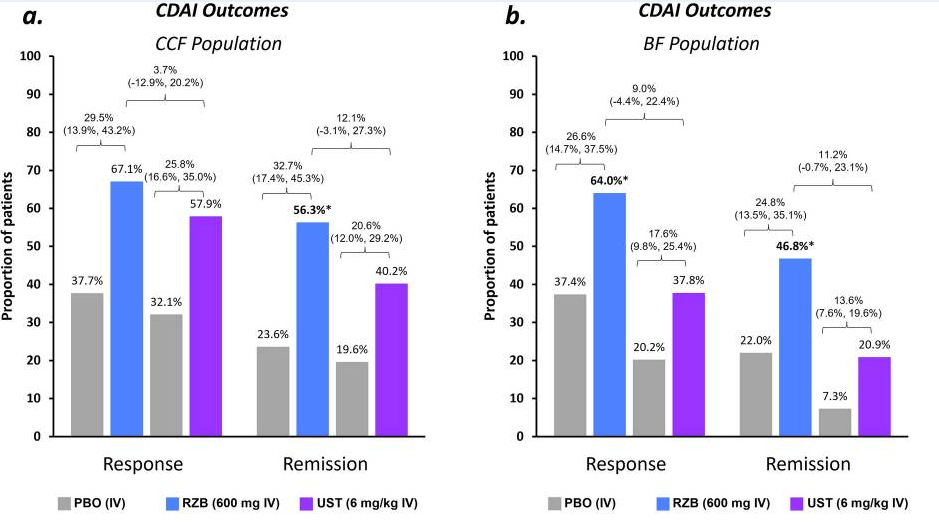
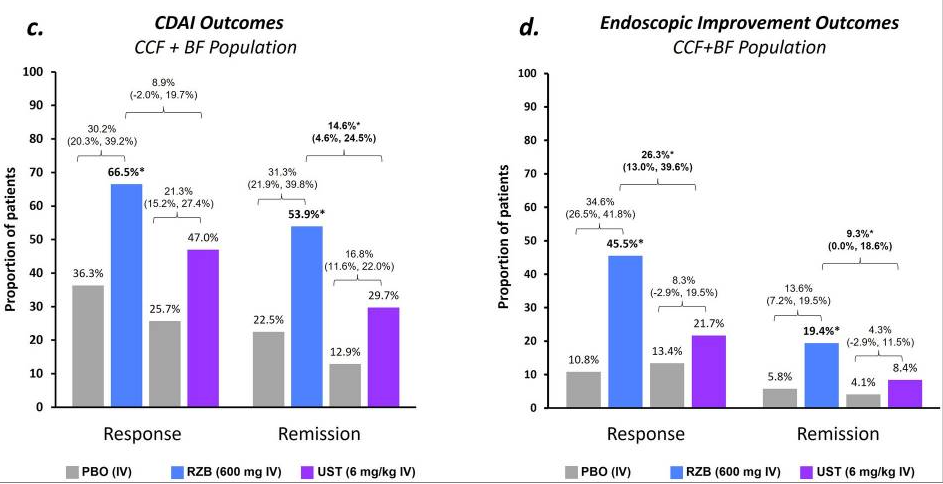
Rates of response and remission following induction therapy with RZB (600 mg) or UST (6 mg/kg). *p ≤ 0.05 for RZB versus UST. Relative effect measures are shown as the percent difference between treatment groups; absolute effect measures are the proportions of patients achieving each outcome in each treatment group. BF biologic failure, CCF conventional care failure, CDAI Crohn’s Disease Activity Index, IV intravenous, PBO placebo, RZB risankizumab, UST ustekinumab

Maintenance: rates of CDAI remission were similar (range − 0.3% to − 5.0%) for RZB vs. UST; however, endoscopic response and remission rates appeared more favorable (see Figure 2 below)
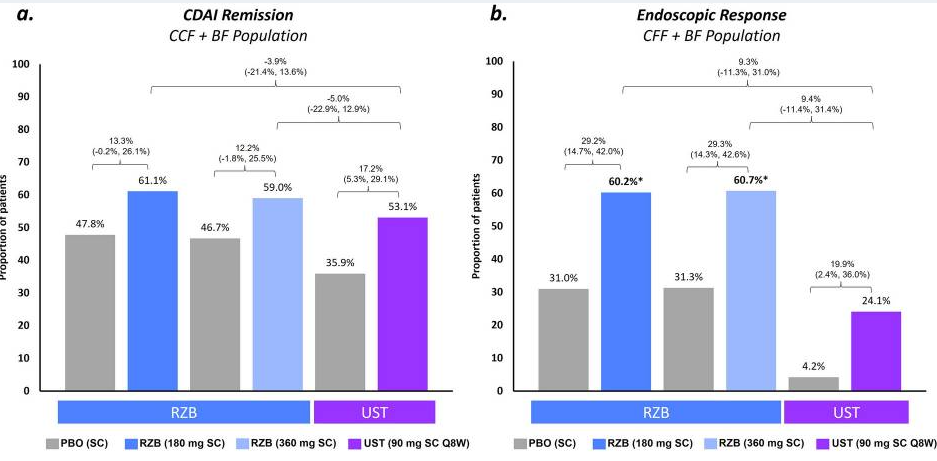
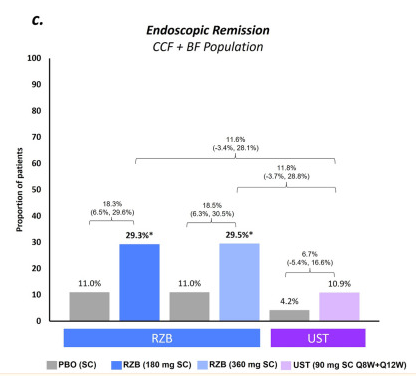
Rates of response and remission following maintenance therapy with RZB (180 mg or 360 mg) or UST (90 mg Q8W). *p ≤ 0.05 for RZB versus UST. Relative effect measures are shown as the percent difference between treatment groups; absolute effect measures are the proportions of patients achieving each outcome in each treatment group. BF biologic failure, CCF conventional care failure, CDAI Crohn’s Disease Activity Index, PBO placebo, Q8W every 8 weeks, Q12W every 12 weeks, RZB risankizumab, SC subcutaneous, UST ustekinumab

My take: Since this was not a direct randomization trial, these results are not definitive. However, in this indirect analysis, risankizumab appears to be superior to utekinumab in effectiveness of for Crohn’s disease.

Related blog posts:

Disclaimer: This blog, gutsandgrowth, assumes no responsibility for any use or operation of any method, product, instruction, concept or idea contained in the material herein or for any injury or damage to persons or property (whether products liability, negligence or otherwise) resulting from such use or operation. These blog posts are for educational purposes only. Specific dosing of medications (along with potential adverse effects) should be confirmed by prescribing physician.  Because of rapid advances in the medical sciences, the gutsandgrowth blog cautions that independent verification should be made of diagnosis and drug dosages. The reader is solely responsible for the conduct of any suggested test or procedure.  This content is not a substitute for medical advice, diagnosis or treatment provided by a qualified healthcare provider. Always seek the advice of your physician or other qualified health provider with any questions you may have regarding a condition.

Ustekinumab for Ulcerative Colitis (UNIFI Trial)

A landmark study (BE Sands et al. NEJM 2019; 381: 1201-14) shows that ustekinumab (Stelara) can be an effective therapy for moderate-to-severe ulcerative colitis (UC); it is already an approved, established therapy for Crohn’s disease. This randomized placebo-controlled study included an 8-week induction trial (n=961) followed by a 44-week maintenance trial (n=523) for patients with response.

Clinical remission was defined as a total socre of ≤2 on the Mayo scale (range 0-12) and no subscore >11 on any of the four Mayo scale components.

Key findings:

  • During induction, there was a similar clinical remission rate between those who received 130 mg fixed intravenous dose compared to those who received 6 mg/kg: 15.6% and 15.5% compared to 5.3% for placebo group.
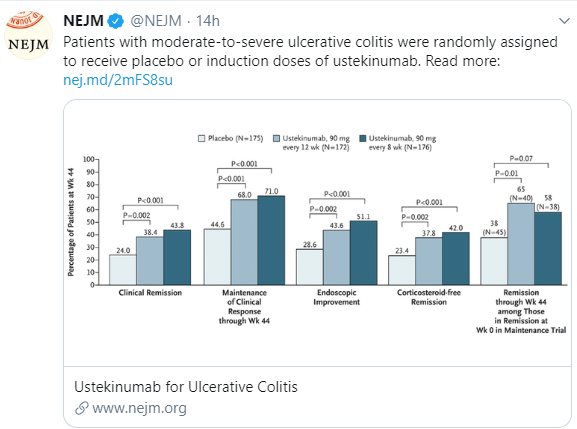
  • During maintenance, among patients receiving 90 mg every 8 weeks the clinical remission rate at 44 weeks was 43.8%, in those with 90 mg every 12 weeks the rate was 38.4%; placebo group was 24.0%.
  • The response to ustekinumab occurred in those with or without previous treatment failure with biologic agents, though response was lower in both induction and maintenance in those with prior treatment failure.  In both phases, at least 59% of participants had failed either or both anti-TNF agents or vedolizumab.
  • In this study, there were similar serious adverse events with ustekinumab compared to placebo.  In the treatment groups, there were two deaths (one from ARDS, one from esophageal varices) and 7 cases of cancer (3 nonmelanoma skin cancer, two colon cancer, one prostate, one renal).  There was one death from testicular cancer in the placebo group. Also four patients in the ustekinumab group had opportunistic infections including CMV in two, legionella in one and HSV in one.

In terms of dosing, the authors note that there was greater improvement in calprotectin values during induction in the group who received 6 mg/kg compared to those who received 130 mg.  At week 44, using more objective and stringent end points (eg. endoscopic improvement), greater clinical benefit was observed with the every 8 week regimen.

Visual abstract from NEJM Twitter Feed:

The following image depicts patients response during the maintenance phase –the lightest color is placebo, followed by every 8 weeks, and then the darkest color is every 12 weeks.  The x-axis measures (left to right) are clinical remission, maintenance of clinical response at week 44, endoscopic improvement, corticosteroid-free remission, and remission at 44 weeks in those with remission after induction.

My take: Ustekinumab is more effective for placebo in patients with ulcerative colitis.  More experience is needed to understand its long-term safety.

Related blog posts:

Landmark Publication for Ustekinumab (Stelara)

A recent study (BG Feagan, WJ Sandborn et al NEJM 2016; 375: 1946-60) provides extensive data regarding the effectiveness of ustekinumab for Crohn’s disease.

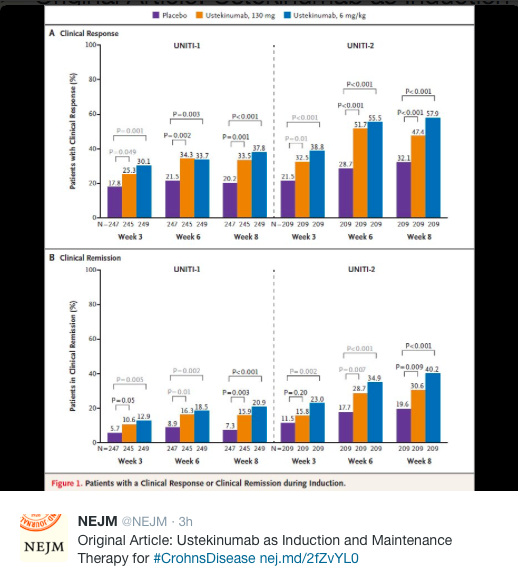
This publication combines three trials (industry-sponsored): UNITI-1, UNITI-2, and IM UNITI.  The first two trials with 741 and 628 patients respectively examined intravenous ustekinumab for induction.  Patients (18 years or older with Crohn’s disease) received either 130 mg, 6 mg/kg or placebo.  UNITI-1 were patients with primary or secondary nonresponse to TNF antagonists.  UNITI-2 were patients in whom conventional therapy failed or in which unacceptable side effects developed. The majority of UNITI-2 patients had not received a TNF antagonist.

IM UNITI with 397 patients followed patients who completed the first two trials for maintenance (90 mg SC every 8 weeks or every 12 weeks).  For this study, the primary end point was remission at week 44 (CDAI score <150).

The IM UNITI study involved 260 sites in 27 countries.

Key findings:

  • With the induction trials, ustekinumab outperformed placebo at 6 weeks.  For UNITI-1, 130 mg dosing resulted in 34.3% response, 6 mg/kg resulted in 33.7% response and placebo 21.5%.
  • For UNITI-2, 130 mg dosing resulted in 51.7% response, 6 mg/kg resulted in 55.5% response and placebo 28.7%.
  • For IM UNITI, every 8 weeks dosing resulted in 53.1% remission at week 44, compared with 48.8% dosed every 12 weeks, and 35.9% who received placebo.
  • For IM UNITI, among those who started in remission at week 0, 66.7% (q 8 weeks), 56.4% (q12 weeks) and 45.6% (placebo) remained in remission at 44 weeks.

When looking at more objective results, both UNITI-1 and UNITI-2 showed significant drops in calprotectin and CRP values; both of these objective markers favored 6 mg/kg over 130 mg fixed induction dose.

  • UNITI-1 at 6 weeks, calprotectin dropped 38.6 in 130 mg dosing group, 41.3 in 6 mg/kg group and 0 in placebo.
  • UNITI-2 at 6 weeks, calprotectin dropped 55.0 in 130 mg dosing group, 106.3 in 6 mg/kg group and 0 in placebo.
  • For the IM UNITI objective markers, it was noted that the median CRP values generally were unchanged in both treatment groups (q8 weeks, and q12 weeks) but increased in the placebo group by ~4 mg/L.  Also, calprotectin remained <250 mg in both ustekinumab treatment groups at a much higher percentage than those who received placebo.

Safety:

Extensive safety data are reported and more than 60% of all patients, including placebo-treated patients reported potential adverse effects.  Adverse effects and serious adverse effects were similar in treatment and control groups. During 1 year of therapy, there were no deaths or instances of the reversible posterior leukoencephalopathy syndrome.

Other points:

  • Response to ustekinumab was observed as early as week 3
  • UNITI-2 patients, most of whom had not failed a TNF antagonist, had higher response than UNITI-1 likely due to disease which was less refractory and of shorter duration

My take: These data support the use of ustekinumab for Crohn’s disease, particularly in patients who have not responded to other therapies.

stelarastudy


Using Ustekinumab for Crohn’s Disease

From GI & Hepatology News: New targeted Crohn’s therapy performs well in phase III trial.

This study of Ustekinumab (aka Stelara) was different than previous studies (see previous gutsandgrowth blog from 2012: Ustekinumab for Crohn’s disease) in that this study targeted patients who were NOT ant-TNF failures; however, about 80% of patients had failed corticosteroids.

An excerpt:

Ustekinumab, a monoclonal antibody targeted against interleukins 12 and 23 (IL-12 and IL-23)…

 The trial, called UNITI-2, enrolled patients with moderate to severe Crohn’s disease who had failed traditional therapies but were naive to or at least had not failed a tumor necrosis factor (TNF) inhibitor…

In UNITI-2, 628 patients were randomized to placebo, 130 mg of ustekinumab in a fixed subcutaneous dose of 130 mg, or a weight-based dose of 6 mg/kg of subcutaneous ustekinumab…The primary endpoint was a CDAI reduction of at least 100 points at 6 weeks. Clinical remission at 8 weeks, defined as CDAI less than 150, was a secondary endpoint.

The primary endpoint was reached by 28.7% randomized to placebo, 51.7% of those randomized to the fixed dose of ustekinumab, and 55.5% of those randomized to weight-based dosing. The advantage for the active treatment arms was statistically significant (both P less than .001). For the secondary endpoint of clinical remission at 8 weeks, the rates were 19.6% for placebo, 30.6% (P = .009 vs. placebo) for fixed-dose ustekinumab, and 40.2% (P less than .001 vs. placebo) for the weight-based dose…

Ustekinumab was well tolerated with similar rates and types of adverse events reported in the active treatment and placebo groups.

My take: This study indicates that ustekinumab is likely to be another treatment option for patients with Crohn’s disease.