ACCURE Trial: Appendectomy As an Adjunct Ulcerative Colitis Treatment Plus One

YIZ Acherman, et al. The Lancet Gastroenterology & Hepatology, 2025. DOI: 10.1016/S2468-1253(25)00026-3. Open access! Appendicectomy plus standard medical therapy versus standard medical therapy alone for maintenance of remission in ulcerative colitis (ACCURE): a pragmatic, open-label, international, randomised trial

Background: “An inverse association between appendicectomy and the development of ulcerative colitis was first reported in 1987, with subsequent case-control studies confirming this observation, and suggesting a possible role of the appendix in ulcerative colitis. In 2016, our research group did a systematic review and meta-analysis of available (case-control) studies. This analysis showed that previous appendicectomy was associated with a significantly reduced risk of developing ulcerative colitis, with an overall odds ratio of 0·39 (95% CI 0·29–0·52).”

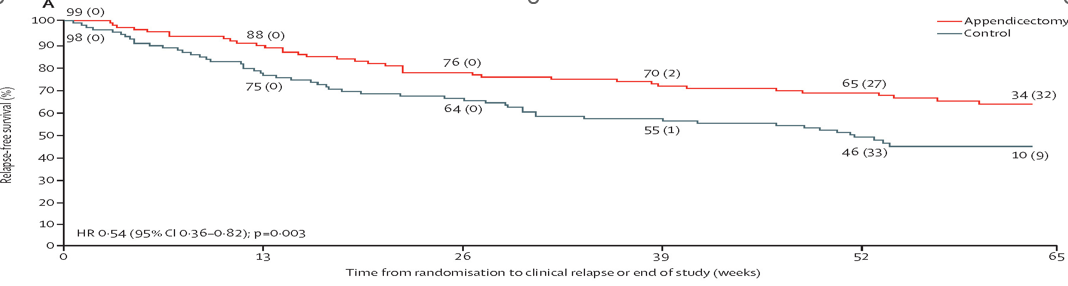
Methods:  Adult patients (n=197) with established ulcerative colitis who were in remission but had been treated for disease relapse within the preceding 12 months were randomly assigned (1:1) to undergo appendicectomy plus continued maintenance medical therapy (intervention group) or to continue maintenance medical therapy alone (control group). Approximately 25% of participants had pancolitis.

Key findings:

  • The 1-year relapse rate was significantly lower in the appendicectomy group than in the control group (36 [36%] of 99 patients vs 55 [56%] of 98 patients; relative risk 0·65 [p=0·005; adjusted p=0·002). 
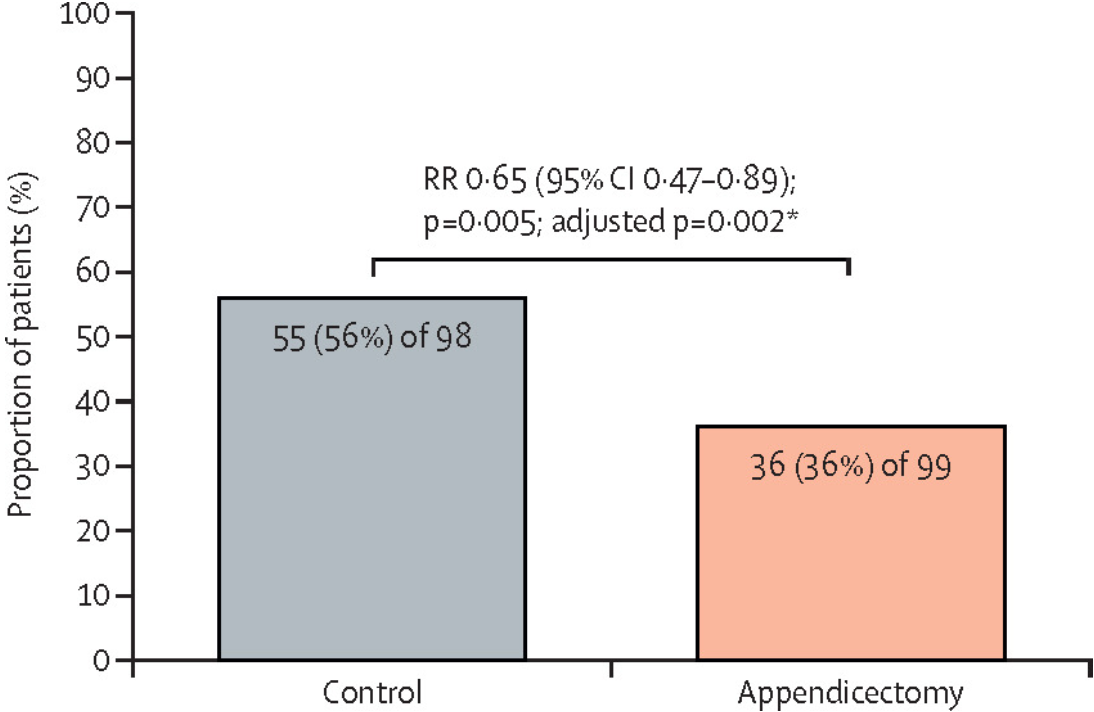
Relapse Rate

My take (borrowed from the authors): “The ACCURE trial is the first randomised controlled trial evaluating the clinical effectiveness of appendicectomy in maintaining remission in patients with ulcerative colitis without advanced medical therapy (ie, biologicals or small molecules). This trial shows that laparoscopic appendicectomy, in addition to standard medical therapy, significantly reduces the relapse rates within 1 year.”


Also, NPR notes 5/5/25: NIH cuts baby ‘Safe to Sleep’ team. Here’s what parents should know

Related blog posts:

Disclaimer: This blog, gutsandgrowth, assumes no responsibility for any use or operation of any method, product, instruction, concept or idea contained in the material herein or for any injury or damage to persons or property (whether products liability, negligence or otherwise) resulting from such use or operation. These blog posts are for educational purposes only. Specific dosing of medications (along with potential adverse effects) should be confirmed by prescribing physician.  Because of rapid advances in the medical sciences, the gutsandgrowth blog cautions that independent verification should be made of diagnosis and drug dosages. The reader is solely responsible for the conduct of any suggested test or procedure.  This content is not a substitute for medical advice, diagnosis or treatment provided by a qualified healthcare provider. Always seek the advice of your physician or other qualified health provider with any questions you may have regarding a condition.

Are We Making Progress on Infant Sleep-Related Deaths? (Not anymore)

An interesting commentary (KP Quinlan. JAMA Pediatrics; 2018; 172: 714-6) points out the need for better surveillance and prevention efforts for sudden unexpected infant deaths (SUIDs).

Key points:

  • Since the late 1990s, there has NOT been significant improvement in SUID.  In 1999, there were 3716 SUIDs compared with 3684 in 2015.
  • This rate of SUID is 9 times the rate of deaths to motor vehicle crashes for an 18 year-old driver.  The author notes the driving-related fatalities have declined by ~50% for persons younger than 20 years since 2000.
  • Promotion of safer sleeping habits is important. Bed sharing raises the SUID risk but is commonly practiced by parents from all backgrounds.
  • There is very little publicity of this problem and there is not a systematic surveillance system.  . How often do we here about a teenager involved in a crash and how often do we here about an infant with SUID? If there was more awareness of this danger, it is likely that there would be more actions taken

Related posts:

Useful website: Charlieskids.org This website has a book called “Sleep Baby Safe and Snug” which incorporates updated recommendations on safe sleep practices.

Children should sleep in the same room but on a separate surface from their parents for at least the first six months of their lives, and ideally the first year. They say that this can halve the risk of SIDS…You can read the AAP’s full guidance here. These are a few more of the pediatricians’ recommendations:

  • Infants under a year old should always sleep lying on their backs. Side sleeping “is not safe and is not advised,” the AAP says.
  • Infants should always sleep on a firm surface covered by only a flat sheet. That’s because soft mattresses “could create a pocket … and increase the chance of rebreathing or suffocation if the infant is placed in or rolls over to the prone position.”
  • Any other bedding or soft objects, like pillows or stuffed animals, could obstruct a child’s airway and increase the risk of SIDS and suffocation, according to the AAP.
  • The pediatricians say breastfeeding reduces the risk of SIDS.
  • The same goes for pacifiers at nap time and bedtime, although the doctors say the “mechanism is yet unclear.” They add that “the protective effect is observed even if the pacifier falls out of the infant’s mouth.”
  • Smoking – both during pregnancy and around the infant after birth – can increase the risk of SIDS. Alcohol and illicit drugs during pregnancy can also contribute to SIDS, and “parental alcohol and/or illicit drug use in combination with bed-sharing places the infant at particularly high risk of SIDS,” the pediatricians say.

Pushback on AAP SIDS -Sleeping Guidelines

Recently, this blog summarized AAP SIDS recommendations.  These recommendations have been reviewed in a NY Times commentary: Should Your Baby Really Sleep in the Same Room as You?

This opinion piece provides a good background on the issue os whether having a baby sleep in the same room is beneficial and explains some of the flaws in the studies behind the recommendations.  Here’s an excerpt:

So when the American Academy of Pediatrics recently issued new infant sleep guidelines — highlighting a recommendation that babies sleep in their parents’ rooms for at least six months but ideally a full year — some parents despaired…

Yet the recommendation drew skepticism from some doctors, who argued that a close look at the evidence showed that the benefits of room-sharing didn’t always justify its costs to parents, who would have to sacrifice privacy, sex and, above all, sleep…

Depriving parents of good sleep can also endanger babies. Sleep-deprived people can have decreased empathy. Sleep deprivation is associated with anincrease in car accidents (which are a top killer of older children). It stresses marriages and families and is significantly associated with an increased riskof postpartum depression.

And with regard to the studies:

The first thing to note is that they all collected data in the 1990s, when SIDS was much more common than it is today. The academy said room-sharing “decreases the risk of SIDS by as much as 50 percent,” but that was before the significant improvement in SIDS rates. It’s not clear that sharing a bedroom would make as much of a difference today as it did then.

The second is these were all studies in Europe, where room-sharing is much more common. Only about 20 percent to 41 percent of infants in the control group slept in their own rooms. That makes it hard to pinpoint the reason they survived, and to generalize the findings to the United States.

My take: While the risk of SIDS may improve when infants sleep in the same room, this article makes a compelling argument that it may cause more harm than benefit.


“Tummy Time” Not Needed

A recent NY Times article reviews a study which showed no benefit in motor development in babies who had “tummy time.”

Here’s the link: nyti.ms/11vrG11 

Here’s an excerpt:

Putting infants to sleep on their backs, recommended since the early 1990s, has helped reduce the prevalence of sudden infant death syndrome. ..Now a new study, published in May in the journal Early Human Development, suggests that tummy time may be irrelevant.

Canadian researchers compared 1,114 infants born from 1990 to 1992, just before the “back to sleep” campaign began, with 351 infants born 20 years later. They found no difference between the two groups in the age at which prone to supine or supine to prone rolling began, or in the order in which those behaviors appeared….

Whether tummy time helps or not, said the lead author, Johanna Darrah, a pediatric physical therapist at the University of Alberta, “the back to sleep campaign has not adversely affected motor development. Motor development happens.”