
SL Gortmaker, SN Bleich, DR Williams. NEJM 2024; 390: 681-683. Childhood Obesity Prevention — Focusing on Population-Level Interventions and Equity
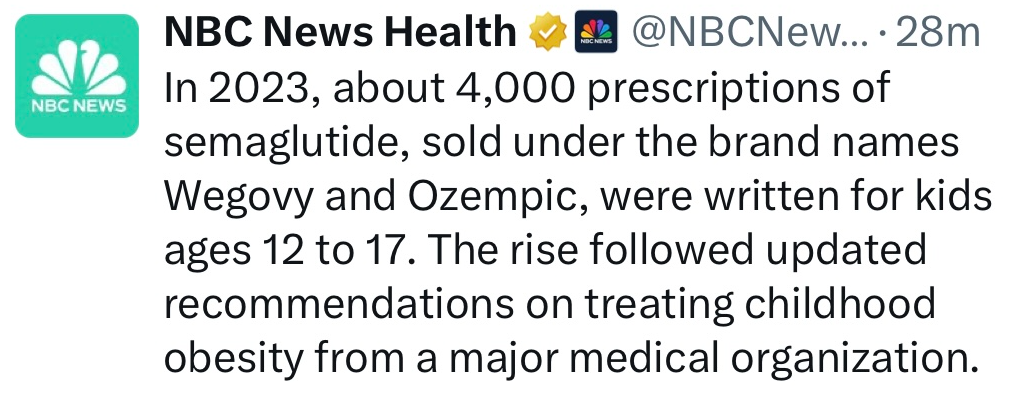
Despite the exciting advances in obesity pharmacology, most children and adults are unlikely to benefit from these expensive therapies anytime in the near future.
This commentary’s key points:
- “Scholars and policymakers shouldn’t lose sight of population-level strategies that can prevent excess weight gain and obesity among children in the first place.”
- The authors identify three successful policy examples: 1. Revision of WIC food packages to improve nutritional quality at a cost about $18 per child. 2. Improving school lunch standards (2010 Healthy, Hunger-Free Kids Act) at a cost of about $30 per child. 3. Excise tax on sugar-sweetened beverages. “In California, an analysis found that such a tax would be cost-saving, would prevent 42,700 cases of obesity in children and 223,000 cases in adults statewide over 10 years because of projected reductions in consumption of sugar-sweetened beverages.”
- “Leveraging these strategies won’t fix the problem of childhood obesity overnight, but it could (and has already begun to) slow the development of new cases, particularly among members of historically underserved populations — a major public health achievement.”
My take: There is not a simple solution for widespread obesity in children and adults. We need to chip away at this problem from every angle. It is crucial to use public policy changes as one of our tools.
Related blog posts:
- “The Paramount Health Challenge for Humans in the 21st Century”
- Call For Action: Adolescent Nutrition Series
- Pharmacotherapy for Obesity
- NY Times: Bariatric Surgery at 16
- Weight of the Nation

 gutsandgrowth