Impact of CFTR Modulators on the Need for Liver and Lung Transplantation in Patients with Cystic Fibrosis

M Mendizabal et al. Liver Transplantation 2025; 31: 412-416. Have CFTR modulators changed the need for liver and lung transplantation among patients with cystic fibrosis? An analysis of the UNOS database

This article notes that there have been 146,851 waitlistings and 95,254 liver transplants in the U.S. between 2012 and 2023. This includes 194 waitlistings and 138 transplants in patients with cystic fibrosis.

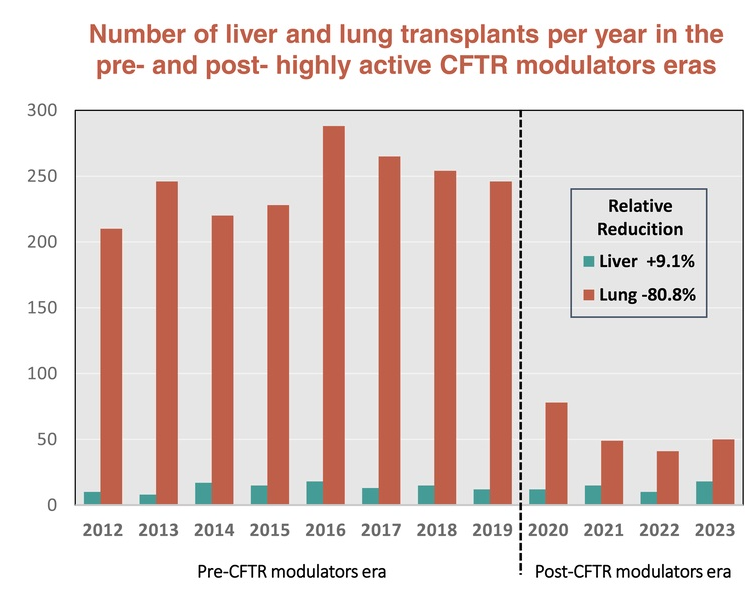
Key finding:

My take: This is great news for patients with cystic fibrosis. The drop in lung transplants is surely the tip of the iceberg. Think about your next breath! For patients with cystic fibrosis, these new medications make every single breath better. Longer followup is needed to determine if the long-term use of these agents may lower the rate of end-stage liver disease as well.

Related blog posts:

One Week Treatment to Protect Non-Liver Transplant Recipients of HCV+ Organs & Baseball Dog

Link: Bat Dog

————

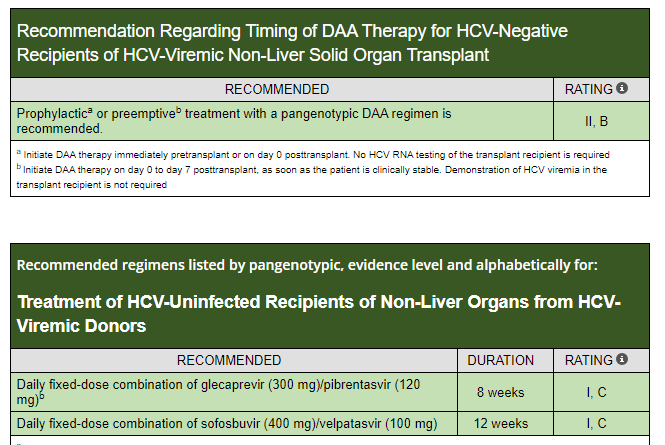
A recent report in Gastroenterology and Hepatology News (July 2024: Shortened Protocol Can Prevent Infection in Recipients of HCV+ Organs) highlighted the recommended use of 1 week empiric treatment to prevent the development of hepatitis C in transplant recipients of HCV+ organs.

The cost for a one week course of “the Toronto Protocol” which includes glecaprevir-pibrentasvir along with ezetimbe is ~$2800. This is much less than a full course which likely would cost ~$30,000. Ezetimbe, cholesterol-lowering agent, has the ability to prevent HCV from entering cells.

For liver transplant recipients of HCV+ donor, a 12 week course of treatment is recommended

From HCV Guidelines:

Related blog posts:

NY Times: “Who Deserves a Lifesaving Organ?”

NY Times: “Who Deserves a Lifesaving Organ?”

Yesterday’s post discussed policy efforts to help with equitable access for transplantation. This essay explores some of the same issues.

A few excerpts:

  • What makes someone a “good” transplant candidate? Maybe it is inevitable that doctors’ biases creep in when we must make fraught decisions about a scarce resource….
  • A transplant program is also beholden to its metrics. If the one-year survival of transplant recipients is lower than expected or if transplant failure is higher than expected, a program could be put on probation or lose its certification entirely…
  • Social-support requirements vary based on the intensity of the surgery and the length of the required rehabilitation. But in general, a patient is expected to have one to three people who can commit to helping in recovery — driving to appointments, managing medications or responding to overnight emergencies…
  • So much of transplant decision-making is about narrative, which is one reason misconceptions can take hold when patients do not speak English as their primary language. Hispanic patients are about half as likely as their white peers to receive kidney donations from family or friends— a gap that Dr. Juan Carlos Caicedo, an adult and pediatric transplant surgeon who directs the Hispanic Transplant Program at Northwestern Medicine, is working to close. “People will argue that these are not good patients because they don’t follow recommendations, but they are dead wrong,” he told me. “They are great patients, as long as they understand you.”..
  • Change is happening. At my hospital, our lung transplant team is working to identify recipients from underserved communities who can become “ambassadors” to educate others and build trust…
  • Perhaps most important, transplant teams are openly discussing and challenging their assumptions about who makes a “good” transplant candidate. And in doing so, more lives may be saved.
Thanks to Jennifer for this picture

Expanding Organ Transplantation with Hepatitis C-Positive Donors

A recent study (AE Woolley et al NEJM 2019; 380: 1606-17) highlighted the outcomes of heart and lung transplant (uninfected) recipients of organs from HCV-infected donors (“DONATE HCV” trial).

In this study, 44 patients (36 lung transplant recipients, 8 heart transplant recipients) were treated preemptively with 4 weeks of sofosbuvir-velpatasvir to block viral replication.

Key findings:

  • 42 of 44 (95%) had a detectable viral load immediately after transplantation.
  • The first 35 (who have all completed 6 months of folllowup) all cleared HCV viremia –undetectable HCV at 6 months post-transplantation
  • No treatment-related complications were noted

In the associated editorial by EA Blumberg (1669-70), it is noted that organs for transplantation are in short supply for the more than 113,000 persons on waiting lists in the U.S.  “In 2018, only 36,500 persons received transplants…and 12,225 persons were removed from the waiting list because of death or progressive illness than rendered them” too sick for transplantation.

HCV donors will expand the donor pool substantially (up to one-third more donors) and these donors are typically younger and with fewer coexisting conditions.

My take: With the high response rate of the newer direct-acting antivirals (100% in this study) along with the (cost) effectiveness of a shorter course, this study shows how promising HCV-positive donors are for improving outcomes in patients in need of organ transplantation.  Long term data are still needed to determine if there are unforeseen problems (eg. late severe relapse of HCV, increased cardiovascular disease).

Related blog post: Increased Organ Availability Related to Opioid Epidemic

Increased Organ Availability for Transplantation Related to Opioid Epidemic

A letter to the editor (MR Mehra et al. NEJM 2018; 378: 20: 1943-45) provides a perspective on the increasing availability of organs for transplantation from drug overdoses/opioid epidemic from 2000 to 2016.

Key findings:

  • “The drug-abuse epidemic has been associated with a sharp increase in the recovery of organs from brain-dead donors in the United States but not in Europe. “
  • “The U.S. data indicate that survival among recipients from donors who died from drug intoxication is similar to survival among recipients from donors who died from other causes.”

My take: Opioid use is more likely to place one at risk for needing a liver transplantation due to increase acquistion of hepatitis C infection and is more likely to make a donor available due to drug overdoses.

Related blog posts: